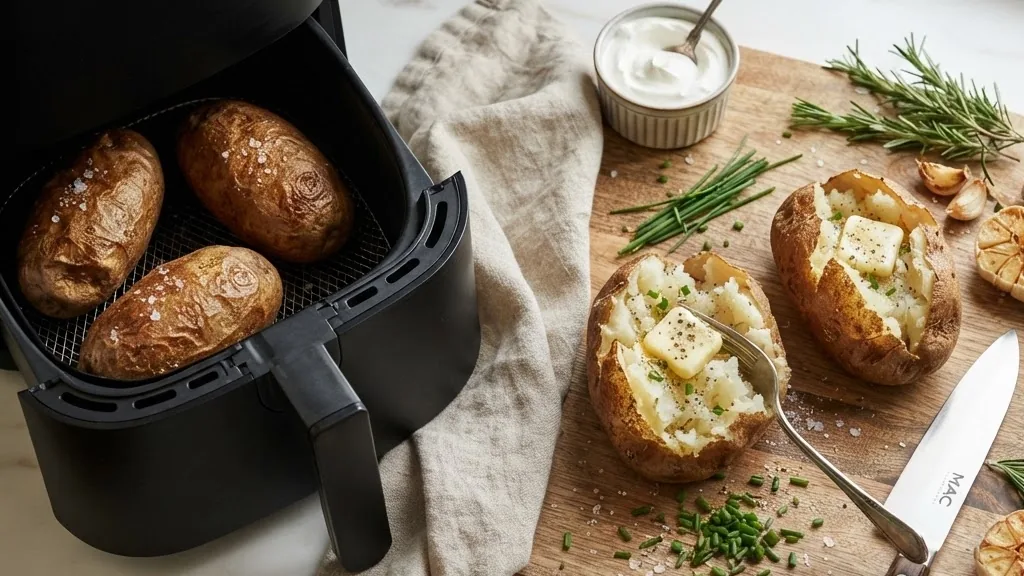
If you want to know how long to cook baked potatoes in air fryer models, the honest answer is that it depends almost entirely on weight, and a kitchen scale plus a thermometer will beat any single number a chart could give you. That said, the working range is tight enough to memorize.
Times below are cross-checked against the USDA and the Idaho Potato Commission for the numbers that matter.
Quick answer: A medium 7 to 8 ounce russet takes 35 to 40 minutes at 400 F, flipped once at the halfway mark. Small 5 to 6 ounce potatoes finish in 30 to 35 minutes; large 9 to 10 ounce potatoes need 45 to 55 minutes. Do not wrap them in foil if you want crisp skin, and do not trust the clock alone. A potato is fully baked when the center reads 205 F to 210 F on an instant-read thermometer, or when a paring knife slides in with zero resistance. Rub with a little oil and coarse salt, poke a few vents, and give each potato room to breathe.
The short version, sorted by potato size
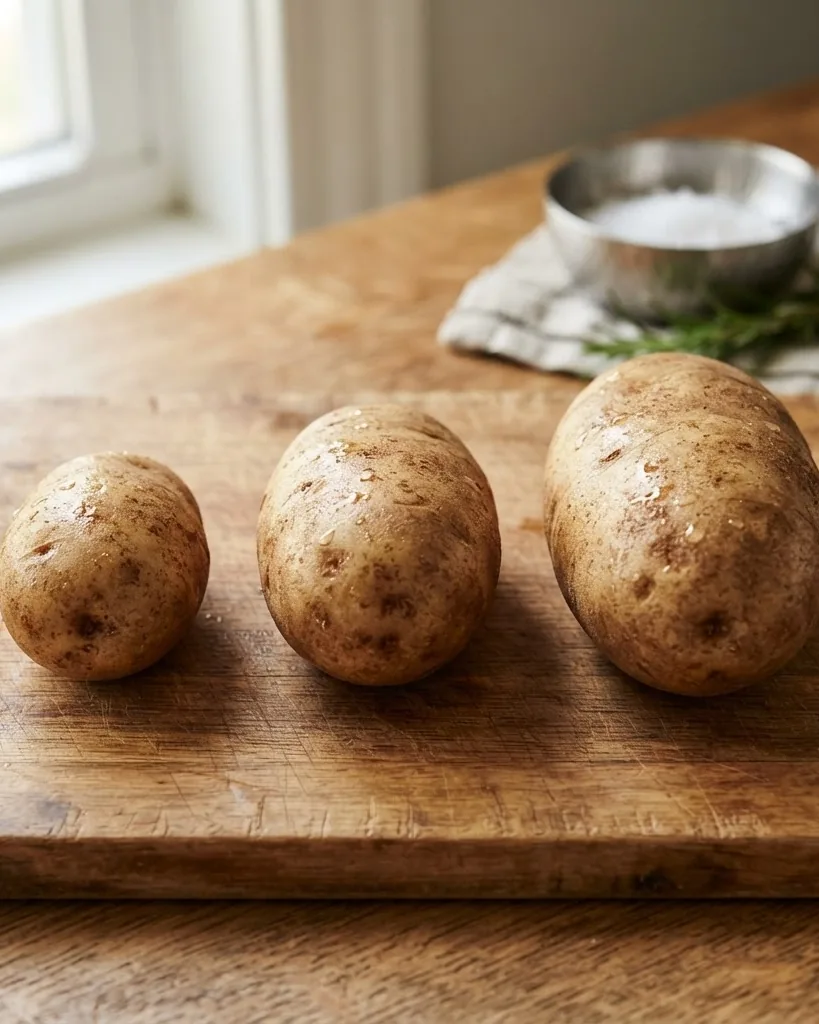
Weight is the variable that actually moves the timer. A potato is a dense, wet mass, and heat has to travel to the center by conduction, so a potato that weighs 40 percent more does not cook in 40 percent more time; it cooks in something closer to that plus a buffer. Individual russets in the same produce-aisle net bag can range from 5.5 to 13 ounces, which is exactly why people get inconsistent results at a fixed time.
Here is the timing chart. Every row is a 400 F basket run with one flip, using bare russets rubbed in oil. If your machine only offers a preset like 390 F, add about 5 minutes to each range.
| Potato size | Weight | Temp | Time (flip once) | Notes |
|---|---|---|---|---|
| Small | 5 to 6 oz | 400 F | 30 to 35 min | Good for kids or side portions |
| Medium | 7 to 8 oz | 400 F | 35 to 40 min | The standard dinner potato |
| Large | 9 to 10 oz | 400 F | 45 to 55 min | Loaded-potato size |
| Extra large | 12 oz and up | 400 F | 50 to 60 min | Check center temp before serving |
| Any size | varies | 390 F | add ~5 min | Skin stays slightly softer |
The common mistake is treating “medium” as one number. Run a 7 ounce and a 10 ounce potato in the same basket for the same 38 minutes, and the small one comes out fluffy while the big one is still tight and waxy in the middle. Either sort by size or pull them individually as each one hits temp.
Why air fryer times run shorter than the oven
An air fryer is a small convection oven with an aggressive fan, and the food surface sees hotter, faster-moving air than it would on a rack in a full-size oven. That is why a russet that needs 45 to 60 minutes in a 425 F oven finishes noticeably sooner in a basket at 400 F. The tighter chamber also means the skin dries and crisps while the inside steams itself soft.
Basket size matters more than brand. My 6 quart Cosori holds three or four medium potatoes with gaps between them; a 4 quart basket really only fits two before they start touching. When potatoes touch, the contact points stay pale and dense, so two batches beat one crowded basket. If you are still learning your machine, the walkthrough on how to preheat an air fryer covers why a few minutes of warm-up evens out the browning on batch one.
How to prep for crisp skin and a fluffy center
The prep is short, but each step earns its place. Skip the oil and the skin turns papery instead of crackly; skip the vents and you risk a potato splitting open mid-cook and spraying starch across the basket.
- Scrub the potatoes under cold water and dry them completely. Wet skin steams instead of crisping.
- Poke each potato 4 to 6 times with a fork. These vents let steam escape so the potato does not burst.
- Rub on about 1 teaspoon of oil per potato. Avocado, canola, and olive all work; avocado has the higher smoke point.
- Sprinkle coarse or kosher salt over the oiled skin. The salt draws moisture out and helps the skin shatter.
- Load them in a single layer with space between each one. Do not wrap in foil.
The oil-and-salt step is worth doing with intention. Pour the oil into your palm, roll the potato in it, then set it on a plate of coarse salt and turn it so the grains stick all the way around. Too little oil and the salt slides off; too much and the skin fries in a slick that never fully crisps. One level teaspoon per medium potato is enough. If your oil has a low smoke point, like unrefined olive oil, you may see faint smoking near the end of a long cook, which is another reason to keep avocado oil by the basket.
That foil rule matters most. Foil traps steam against the skin and gives you a soft, pale exterior, which defeats the entire reason to use a basket. Beyond the sog, wrapping a potato tightly in foil for a long hold is discouraged for food-safety reasons once it cools, because the sealed, low-oxygen pocket is a poor place to leave a starchy food sitting warm. If you want the wrapped, soft-skin style, an oven is honestly the better tool. For the crisp version done right, the step-by-step air fryer baked potato recipe shows the oil-and-salt finish.
The doneness number that actually matters
Time gets you close. Temperature tells you the truth. A potato is not a steak, where a few degrees changes the whole texture; it has a clear target, and hitting it is the difference between gummy and light. According to the Idaho Potato Commission, a fully baked Idaho Russet Burbank reads right around 210 F in the center.
My working rule is to pull potatoes when the center reads 205 F to 210 F. Below about 205 F the starch has not fully gelatinized, so the middle stays dense and a little waxy no matter how brown the skin looks. Pull at 205 F and let carryover heat carry it the rest of the way while the potatoes rest for a couple of minutes.
The reason internal temperature matters more than color is chemistry, not fussiness. Potato starch granules need to absorb water and swell, a process called gelatinization, and that happens across a temperature band that finishes in the low 200s Fahrenheit. Stop short and the granules stay tight, which is the dense, slightly sweet, waxy bite people complain about. Hit the window and the same potato reads as light and dry. A thermometer costs less than a bag of potatoes and removes the guesswork on the one variable that actually decides the texture.
If you do not own a thermometer, use the knife test: slide a thin paring knife straight into the thickest part. Done potatoes offer no resistance, like the knife is going through soft butter. Any drag in the center means it needs more time. Keep measuring for a good while before trusting the knife test alone. You can read the Idaho Potato Commission’s temperature guidance for the fuller explanation of why that window works.
Should you run 400 F or 390 F
Most machines default to a preset near 390 F or 400 F, and the gap is small but real. Compare the same two potatoes side by side, one basket at 400 F and one at 390 F, both for 38 minutes. The 400 F skin cracked and crunched; the 390 F skin stayed a shade leathery and needed another few minutes. So 400 F is the default for skin; drop to 390 F only when cooking something delicate alongside the potatoes.
Going above 400 F is a trap. At 410 F and up the skin can scorch and turn bitter before the center reaches 205 F, especially on a large potato where the heat has a long way to travel. Higher heat does not shorten a big potato’s cook time in any useful way; it just risks a burnt shell over a raw middle. Keep the temperature at 400 F and let time do the work on the interior.
Common mistakes that quietly add time
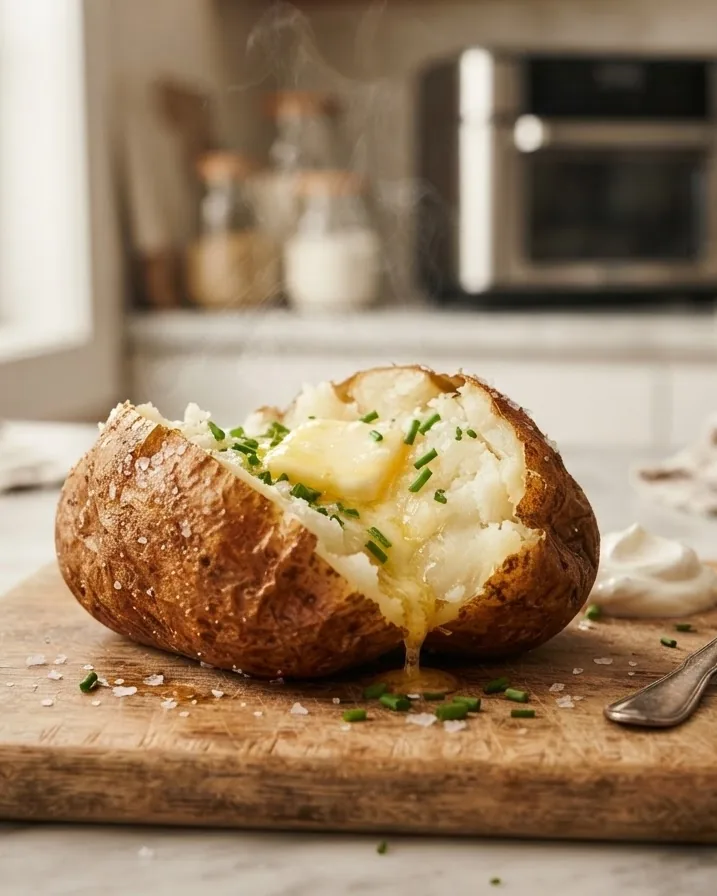
When potatoes take an hour and still come out hard, the cause is almost always one of these. None of them are obvious in the moment, which is what makes them worth listing.
- Crowding the basket. Potatoes touching each other block airflow at the contact points, so those spots stay dense. Leave gaps.
- Skipping the flip. The side resting on the basket floor browns faster. Flip at the halfway mark for even skin.
- Cold potatoes straight from the fridge. A refrigerated potato starts colder and can add 5 minutes. Room-temperature potatoes cook truer to the chart.
- Guessing the weight. A 12 ounce potato needs nearly double the time of a 6 ounce one. Weigh them or sort by eye.
- Wrapping in foil. It softens the skin and slows the surface crisping without meaningfully speeding the center.
The flip is the step people argue about most, but the test is simple. Run two potatoes, flip one and leave the other, and the unflipped potato comes out with a dark underside and a paler top every single time. Thirty seconds of effort at the midpoint fixes it.
What you are actually eating
A baked potato has a reputation as a diet food, and the plain version earns it before anyone adds butter and sour cream. According to the USDA, baked russet with the flesh and skin runs about 95 calories per 100 grams. A medium potato around 173 grams lands near 160 to 165 calories, with roughly 37 grams of carbohydrate, about 4 grams of fiber, and close to 4.5 grams of protein.
The number that surprises people is potassium. Potatoes USA data puts a medium 5.3 ounce potato with the skin at about 620 milligrams of potassium and 27 milligrams of vitamin C, which is why a plain baked potato competes with a banana ounce for ounce. Most of the fiber and a good share of the minerals sit in the skin, so eating it crisp instead of peeling it away is doing you a favor. You can look up the exact profile on USDA FoodData Central if you want to build out a full macro count.
Once you have the base method down, the same 400 F potato becomes a starting point for other dishes. Leftovers turn into twice-baked potatoes the next night: scoop the fluffy interior, mix it with cheese, and run the shells back through the basket to re-crisp.
Russet versus Yukon Gold and red potatoes
The chart above assumes russets, and there is a reason they are the default. Russets are high-starch, low-moisture potatoes, so the interior turns light and floury when it hits temperature. That dry, fluffy texture is what most people mean by a baked potato, and it holds a pat of butter without going gluey.
Yukon Gold sits in the middle. It has less starch and more moisture, so a baked Yukon Gold comes out creamier and denser rather than fluffy. Timing at 400 F is close to a russet of the same weight, but pull them at the low end of the window because the tighter flesh dries out faster if you push past 210 F. They are the better pick when you plan to mash the interior for a twice-baked filling.
Red and other waxy potatoes are the wrong tool for a classic baked potato. They hold their shape and stay firm even when fully cooked, which is ideal for potato salad but disappointing when you want a fluffy split-open center. If all you have are waxy potatoes, cook the smaller ones and expect a firmer bite. Whatever variety you use, weight and center temperature still drive the timing more than the name on the bag.
Sweet potatoes are a common follow-up question, and they play by slightly different rules. A medium sweet potato bakes at 400 F in roughly 35 to 45 minutes depending on shape, since they are often long and tapered rather than round. Their higher sugar content means the skin browns and can caramelize faster, so check them a few minutes earlier. The doneness target is the same soft, no-resistance center, but sweet potatoes read done closer to fork-soft than to a hard 210 F number, and the flesh should be creamy rather than fluffy. Rub them with oil the same way; the sugars that leak out will leave sticky spots on the basket, so a quick soak afterward saves scrubbing.
One habit that pays off across all varieties: buy potatoes close in size for a single batch. A basket of matched 7 to 8 ounce potatoes reaches 205 F within a minute or two across the board, so there is no pulling one and leaving three. Mismatched sizes are the single biggest reason a batch finishes unevenly, and it is the easiest thing to fix at the store.
On make-ahead and reheating: baking a few extra on purpose pays off. A cooked potato keeps in the fridge for three to four days, and reheating one in the air fryer at 350 F to 375 F for 4 to 6 minutes brings the skin back to crisp far better than a microwave, which leaves it steamed and limp. Baking a raw whole potato from frozen is not recommended; the outside overcooks long before the dense frozen core thaws and reaches 205 F. Bake fresh, then freeze the cooked potatoes if you want a stockpile, and reheat from there.
Frequently asked questions
How long to cook baked potatoes in air fryer at 400 F for a medium potato?
A medium 7 to 8 ounce russet takes 35 to 40 minutes at 400 F, flipped once halfway. Confirm doneness by checking that the center reads 205 F to 210 F or that a knife slides in without resistance.
Do I need to preheat the air fryer for baked potatoes?
Preheating is optional but helpful. Three to five minutes of warm-up gives more even browning on the first batch, especially the skin. Without it, add a couple of minutes to your first run.
Can I cook baked potatoes without oil?
Yes, but the skin turns dry and papery rather than crisp. A teaspoon of oil per potato plus coarse salt is what gives you the crackly shell most people want from a baked potato.
Why is my potato brown outside but hard in the middle?
The skin crisps faster than the center cooks, so a brown exterior is not proof of doneness. The potato is too large for the time used, or the heat was too high. Drop to 400 F and cook until the center hits 205 F.
Should I wrap the potato in foil in the air fryer?
No, not if you want crisp skin. Foil traps steam against the surface and leaves the skin soft and pale. Cook the potato bare in a single layer for the best texture.
How do I keep baked potatoes warm for a crowd?
Hold finished potatoes in a 170 F oven or a warming drawer, loosely tented. Do not leave them sealed in foil for long, since the trapped steam will soften the skin you worked to crisp.nnSources: USDA FoodData Central; Idaho Potato Commission (Dr. Potato); Potatoes USA. Cook to a center temperature of 205 F to 210 F and use weight, not just the clock, to time your batch.