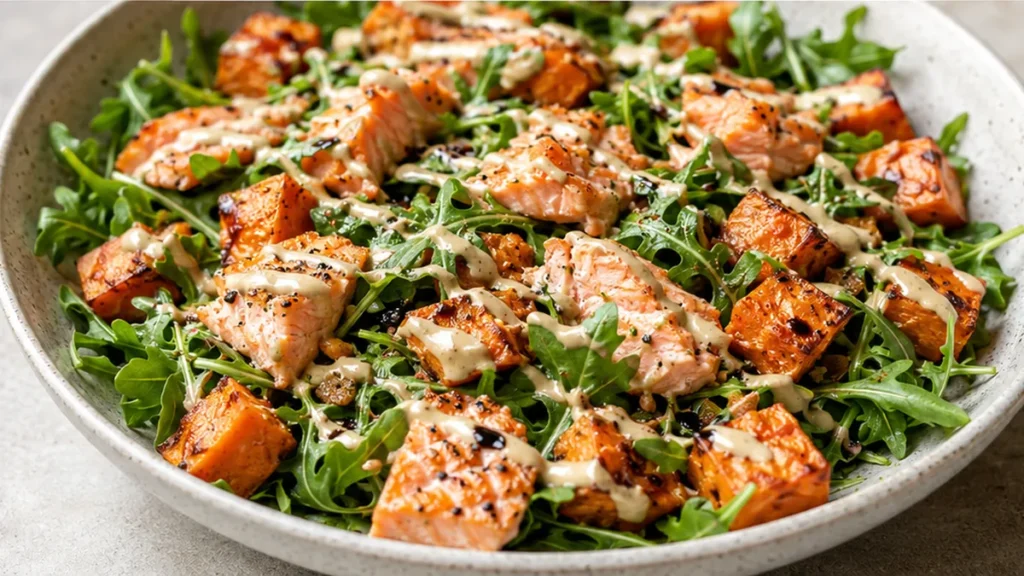
This salmon arugula salad is a perfect choice for those seeking a nutritious and flavorful meal that comes together quickly. Combining the rich taste of salmon with the peppery bite of arugula and a zesty tahini dressing creates a truly satisfying experience. This salmon arugula salad suits a busy weeknight when you need something fast but still want to eat well. It shows that healthy eating doesn’t have to be complicated or time-consuming. This recipe is designed to be both delicious and easy, making it accessible for any home cook.
Key takeaways
- Achieve a stable, creamy dressing by thoroughly whisking all dressing ingredients, using Dijon as an emulsifier.
- Ensure salmon is dry before cooking for a better sear and flavor development.
- Cook salmon to an internal temperature of 125-130°F for optimal flakiness.
- Toss arugula gently with dressing just before serving to maintain freshness.
Salmon Arugula Salad: Fresh, Flavorful & Fast!
Ingredients
- 2 teaspoons olive oil or avocado oil
- 1/2 teaspoon kosher salt
- 1 1/2 tablespoons tahini
- 2 teaspoons honey
- 1/4 teaspoon garlic powder
- 1 teaspoon Dijon mustard
- 1 tablespoon balsamic vinegar
- 1 4-5 ounce salmon fillet
- 2-3 cups baby arugula (washed)
- 1/4 cup roasted sweet potatoes (Note 1)
Instructions
- Preheat the air fryer to 400°F or the oven to 425°F. If you’re using the oven, line a baking sheet with parchment paper and set it aside.
- Add all of the dressing ingredients, except the balsamic vinegar, to a jar. Stir well with a spoon or whisk until the mixture is completely combined. It should be somewhat thick—thick enough to coat the salmon.
- Pat the salmon dry and spoon 1/3 of the prepared dressing on top. Be careful not to touch the spoon to the salmon and put it back in the dressing because we will use it to top the salad.
- Air fry or bake the salmon in the preheated oven or air fryer for 10-12 minutes, or until the internal temperature of the thickest part of the salmon reads just below 145°F, allowing for 5-10 degrees of carryover cooking.
- While the salmon is cooking, assemble the salad. Place the arugula in a bowl and top it with the rest of the salad ingredients. Add the Tablespoon of balsamic vinegar to the remaining salad dressing and stir well to combine.
- Top the salad with the cooked salmon and drizzle the dressing on top. Serve right away.
Notes
The Technique That Makes It: Emulsifying the Dressing and Perfecting the Salmon
This salmon arugula salad relies on two key techniques for success: creating a stable emulsion for the dressing and achieving perfectly cooked salmon. The dressing components – tahini, honey, garlic powder, Dijon mustard, balsamic vinegar, and oil – need to be thoroughly combined to form an emulsion. An emulsion is a mixture of two liquids that normally don’t mix, like oil and vinegar. Whisking vigorously breaks down the oil into tiny droplets, which are then suspended in the other liquid (in this case, the tahini, vinegar, and honey mixture). The Dijon mustard acts as an emulsifier, helping to stabilize this mixture. A well-emulsified dressing will be creamy and cohesive, clinging to the arugula rather than pooling at the bottom of the bowl. For the salmon, achieving a good sear is crucial for flavor and texture. Patting the fillet dry before seasoning and cooking helps promote the Maillard reaction, which creates those desirable browned, savory notes. Cooking the salmon skin-side down first (if using skin-on) renders the fat and creates a crispy texture, while finishing it gently ensures the interior is flaky and moist without being overcooked.
Troubleshooting
- Problem: Dressing is too thick or separated. Fix: Gradually whisk in a teaspoon of water or more balsamic vinegar at a time until the desired consistency is reached. Ensure all ingredients were thoroughly whisked together initially.
- Problem: Salmon is dry and overcooked. Fix: Use a thermometer to check for doneness; aim for an internal temperature of 125-130°F (52-54°C) for medium. Reduce cooking time and consider finishing in the oven if searing aggressively on the stovetop.
- Problem: Arugula is wilted or bruised. Fix: Ensure the arugula is completely dry after washing. Toss it gently with the dressing just before serving to prevent it from wilting under the weight and acidity.
- Problem: Sweet potatoes are too hard. Fix: Ensure sweet potatoes are roasted until tender before adding to the salad. If using pre-cooked, reheat them slightly to ensure they are warm and soft.
Substitutions
- Tahini: Substitute with almond butter or sunflower seed butter for a similar creamy texture, though the flavor profile will change.
- Balsamic Vinegar: Red wine vinegar or apple cider vinegar can be used, but will result in a tangier dressing.
- Salmon Fillet: Grilled chicken breast or pan-seared shrimp would be suitable protein alternatives, adjusting cooking times accordingly.
- Roasted Sweet Potatoes: Roasted butternut squash or chickpeas can be used for a similar textural element and sweetness.
Pro tips
– For perfectly moist salmon, aim for an internal temperature of 140°F (60°C) as it comes out of the oven or air fryer; carryover cooking will bring it to the food-safe 145°F (63°C). – To store leftovers, keep the cooked salmon and dressing separate from the arugula. Refrigerate for up to 2 days. Reheat salmon gently in the microwave or enjoy cold. – If you don’t have an air fryer, oven baking works just as well. Just ensure your oven is fully preheated for even cooking.
This simple yet sophisticated salmon arugula salad is a testament to how delicious healthy eating can be. Give it a try and enjoy a meal that’s both quick to prepare and incredibly satisfying.
Frequently asked questions
What is the best way to cook the salmon for this salad?
For the best flavor and texture, pat the salmon fillet completely dry before seasoning. Sear it in a hot, oiled pan for a few minutes per side until golden brown and cooked through, aiming for an internal temperature of 125-130°F for a moist, flaky result.
My dressing is too thick. How can I fix it?
If your tahini dressing is too thick, gradually whisk in a teaspoon of water or a little more balsamic vinegar at a time. Continue adding liquid slowly until you reach a smooth, pourable consistency that will coat the salad nicely.
Can I prepare the dressing and cook the salmon ahead of time?
Yes, you can prepare the dressing and cook the salmon a day in advance. Store them separately in airtight containers in the refrigerator. Gently reheat the salmon if desired before assembling the salad.
What can I use if I don’t have tahini for the dressing?
If tahini is unavailable, you can substitute it with an equal amount of almond butter or sunflower seed butter. This will provide a similar creamy base, though the final flavor of the dressing will be slightly different.
More from Air Fryer Vegetables →