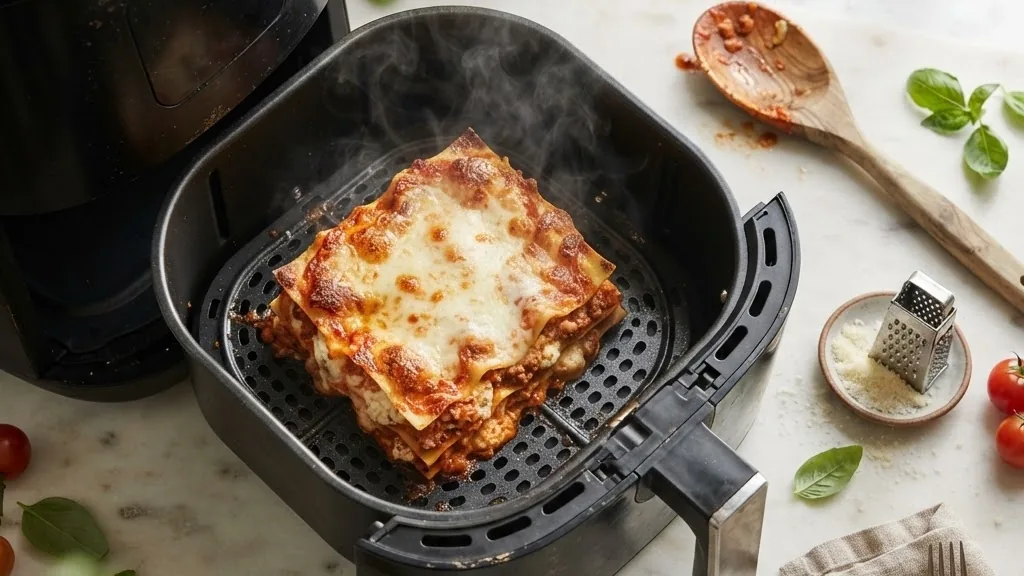
Here is the short version of how to reheat lasagna in air fryer: set the basket to 160 C to 180 C (325 F to 350 F), cover the slice with foil so the cheese top does not dry or burn, and heat a fridge-cold portion for 8 to 12 min. Frozen leftovers need longer, closer to 15 to 20 min. Pull the foil for the last 2 to 3 min to crisp the edges, and check that the center hits 74 C / 165 F on a food thermometer, the safe number the USDA gives for reheated food.
Why the Air Fryer Beats the Microwave for Leftover Lasagna
A microwave heats lasagna from the inside out and leaves you with a rubbery top, a soupy middle, and pasta edges that go stiff. The air fryer works the other way. Hot air moves around the dish, so the cheese firms up again and the noodle corners keep a little chew. That circulating fan is also the reason a bare slice dries out fast, which is why foil does so much of the work here.
The trade is speed. A microwave finishes in 2 minutes but the texture suffers. The basket takes 8 to 12 min for a chilled portion, yet the result tastes close to fresh from the oven. A small metal loaf pan works well for this job, because a dish holds the sauce and stops drips from smoking on the element below.
If you already lean on this appliance for reviving other leftovers, the logic carries over. The same covered-then-crisped trick used for a reheated slice of pizza is exactly what saves a slab of lasagna: trap the steam first, then open it up to brown at the end.
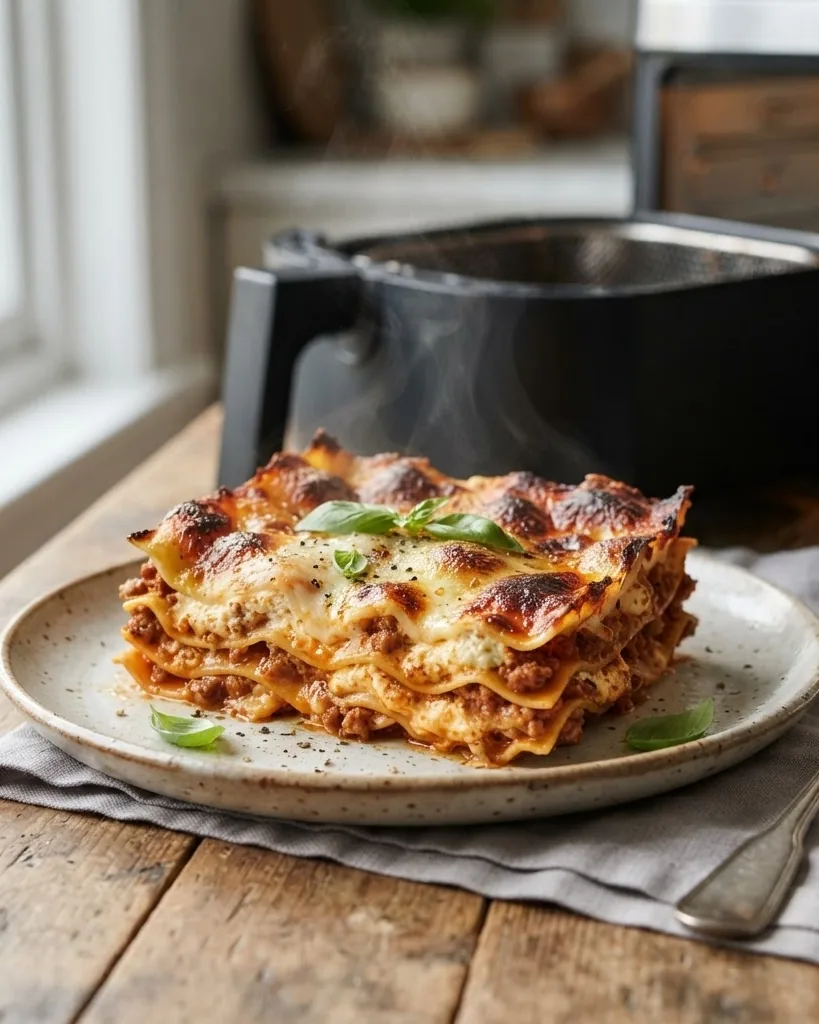
The 5-Step Method
This routine avoids dried-out corners. It works for a single square, a double portion, or two slices side by side. Do not crowd the basket. A single layer heats evenly, while a stacked pile leaves a cold streak right through the middle that no amount of extra time really fixes.
- Take the lasagna out of the fridge while the air fryer preheats to 175 C (350 F). Ten minutes on the counter takes the deep chill off the center.
- Set the slice in a small oven-safe dish or pan, single layer, and spoon a splash of water or leftover sauce over the top, about 15 ml to 30 ml. This is the moisture that keeps it from going leathery.
- Cover tightly with foil and tuck the edges under the dish so the fan cannot lift it. Heat for 8 to 12 min for a fridge-cold portion.
- Remove the foil for the final 2 to 3 min. Let the top color and the cheese bubble. Watch it closely at this stage because the edges can go from golden to too dark quickly.
- Check the center with a food thermometer. You want 74 C / 165 F before you eat. If it is short, cover it again and give it another 2 to 3 min.
That last step is the one most people skip, and it is the only one that actually tells you the dish is safe. The color of the top is a poor guide. A slice can look bubbly and gorgeous on the surface while the middle sits at 50 C, well inside the range where bacteria still grow. A cheap probe thermometer settles the question in five seconds.
If you cook for a full house, the same idea scales to other proteins on the side. A batch of chicken tenders in the air fryer can go in right after the lasagna comes out, while the basket is still hot, so dinner lands on the table together instead of in shifts.
Fridge vs Frozen: Temperature and Time Chart
The single biggest variable is where the lasagna started. A refrigerated portion is already soft and only needs to warm through. A frozen block has to thaw and heat, so it takes roughly double the time and benefits from a longer covered phase before you ever expose the top. Here is the guide worth keeping taped inside a cupboard door.
| Starting state | Temperature | Covered time | Uncovered crisp | Target center |
|---|---|---|---|---|
| Fridge-cold single slice | 175 C / 350 F | 8 to 10 min | 2 to 3 min | 74 C / 165 F |
| Fridge-cold thick corner | 170 C / 340 F | 10 to 12 min | 2 to 3 min | 74 C / 165 F |
| Frozen homemade slab | 160 C / 325 F | 15 to 20 min | 10 to 15 min | 74 C / 165 F |
| Frozen store tray | 170 C / 340 F | 15 to 18 min | 8 to 12 min | 74 C / 165 F |
Notice that frozen portions use a lower starting temperature. If you blast a frozen block at 180 C, the outside scorches long before the middle thaws, and you end up with a burnt top over a cold, icy core. Drop to 160 C, keep it covered longer, and let the heat crawl inward. Only then do you raise the lid to brown things off.
A shortcut worth the planning: move frozen lasagna to the fridge the night before. Once it thaws overnight it heats on the fridge-cold schedule, which cuts the whole job roughly in half and gives you a far more even result. A thawed portion follows the same 3 to 4 day window as any other leftover, so use it within that time.
Food Safety: The 165 F Rule and the 3 to 4 Day Window
Reheating is not only about taste. Lasagna is a dense, layered food packed with meat, dairy, and sauce, and that combination is exactly what food-safety agencies warn about. The USDA is direct on this point: reheat all leftovers to a safe internal temperature of 74 C / 165 F, measured with a food thermometer in the thickest part of the center, not the edge.
The reason is the temperature band the USDA calls the danger zone, which runs from 40 F to 140 F (roughly 4 C to 60 C). Bacteria multiply fastest inside that range. When you reheat, the goal is to push the whole slice through that zone and out the top of it as fast as practical, then hold nothing lukewarm on the counter. You can read the agency’s leftover guidance in its own words at the USDA food data and safety resources, which the FSIS food-safety pages sit alongside.
Storage matters just as much as the reheat. The USDA gives refrigerated cooked lasagna a shelf life of 3 to 4 days at 4 C / 40 F or below. After that, reheating to 165 F will not undo spoilage, so mark the container with the date it went in. Cooked food also needs to reach the fridge within 2 hours of coming out of the oven, or within 1 hour if the kitchen is above 32 C / 90 F, before bacteria get a head start.
The FDA reinforces the same habits from the kitchen-safety side. Its guidance is to cover food while reheating so it heats all the way through, and to bring leftovers to hot and steaming rather than merely warm. You can find the agency’s cooking and reheating advice on the FDA food safety site, which lines up cleanly with the USDA numbers. When two agencies point at the same thermometer reading, that is the number to trust.
Should You Reheat Lasagna More Than Once?
My rule is simple: reheat only the portion you plan to eat, and do not reheat the same slice twice. There is no single law that bans a second reheat, but every time lasagna cools and warms again it passes back through the danger zone, and each trip gives bacteria another window to grow. The safer play is to cut the batch into meal-size pieces before it ever goes in the fridge.
That way you pull one square, heat it once to 165 F, and eat it. The rest of the tray stays cold and untouched at a steady 4 C, which protects it far better than repeated warm-ups. If you know you will not finish a big pan within 3 to 4 days, portion it and freeze the extra on day one, while it is still at its best, instead of gambling on leftovers that keep getting reheated.
This is also why a small dish beats reheating the whole tray. A giant slab takes so long to reach a safe center that the outer inch overcooks and dries while you wait on the middle. Single portions heat evenly, hit temperature fast, and leave the rest of your batch safely in the cold.
Foil vs Parchment: Which Cover Wins
Foil is the default for a reason. It seals tightly, reflects heat back onto the top, and traps the steam that keeps the cheese soft. It is the best tool for stopping both problems at once, the dried surface and the burnt edge. The only cautions are physical: keep foil clear of the bare heating element in the top of some baskets, and weigh it down so the fan does not send it flying into the coil.
Parchment behaves differently. It breathes, so steam escapes and the top browns faster, which is fine when you actually want a crisp finish on an already-thawed slice. What parchment will not do is trap moisture, so it is the weaker choice for a frozen slab that needs a long, gentle, sealed warm-up. Think of it this way:
- Foil for moisture and burn control, especially anything frozen or thick.
- Parchment for a quick crisp on a thin, already-soft slice you are heating for only a few minutes.
- Neither one belongs loose in a basket with an exposed element unless it is anchored under a dish.
- A vented foil tent, folded loosely, is a middle path that lets a little steam out while still shielding the top.
When unsure, reach for foil and simply open it earlier. Starting sealed and finishing open gives you both results in one cycle: a moist interior and a browned top. Starting with parchment gives you only the browning, and once a slice dries out there is no easy way to walk it back.
Keeping It Moist: The Splash Trick and Other Fixes
Dryness is the number-one complaint with reheated lasagna, and it is almost always avoidable. The fix is that spoon of liquid mentioned above, 15 ml to 30 ml of water or spare sauce spread over the top before the foil goes on. As the slice heats, that liquid turns to steam under the cover and rehydrates the pasta and the ricotta layer instead of letting the fan pull moisture out.
If your lasagna was a little dry to begin with, spoon a thin line of marinara down the center as well. It melts into the layers and reads as freshly sauced rather than reheated. A few torn basil leaves or a fresh grate of parmesan added in the last uncovered minute also lift a next-day slice, since heat dulls the herbs that went in yesterday.
One more habit that helps: let the reheated slice rest for 2 to 3 min after it comes out. Straight from the basket the layers are loose and the sauce runs. A short rest lets everything set back up, so it holds its shape on the fork the way a fresh-baked piece does. It is the same patience you would give a lasagna out of the oven, just scaled down.
Common Mistakes and How to Avoid Them
Most bad reheats come from the same handful of errors, and once you name them they are easy to dodge. The first is stacking. Two slices piled on top of each other trap a cold layer in the middle, and the outside overcooks while you chase that center up to 165 F. Lay everything in a single layer, even if it means two rounds.
The second is skipping the cover. A bare slice under moving hot air dries in minutes, and the exposed cheese scorches while the base is still cool. Foil first, always, then uncover to finish. The third is trusting the timer instead of the thermometer. Baskets vary, portions vary, and a fixed number of minutes is only a starting point. The center temperature is the real signal.
The fourth is running frozen lasagna too hot, which burns the top before the core thaws. Lower the heat to 160 C and lengthen the covered phase. The fifth is forgetting the clock on storage. If that container has been in the fridge past 3 to 4 days, no reheat makes it safe again. When in doubt, throw it out and start fresh.
A Quick Word on Nutrition and Reheating
Reheating does not add or remove calories. A typical cup-size portion of homemade meat lasagna lands somewhere around 320 to 380 calories, with roughly 20 g of protein, 12 g to 18 g of fat, and about 30 g of carbohydrate, though your own recipe drives the exact numbers. If you want to check a specific build, the USDA FoodData Central database is the reference nutritionists actually use.
What reheating can change is moisture and, with it, how the dish feels to eat. That is the whole case for the covered method and the splash of liquid. You are not chasing a different nutrition label, you are protecting the texture the calories came in. A dried-out reheat tempts you to drown it in extra cheese or oil to compensate, which is how a sensible portion quietly turns into a heavier one.
Air Fryer vs Oven vs Skillet for Reheating
The air fryer is the first pick for one or two portions, but it is not the only route, and the right tool depends on how much you are heating. For a single slice or a couple of squares, nothing beats the basket for speed and a crisp top. It hits temperature fast, uses no preheat marathon, and gives you that oven-like finish in a fraction of the energy a full oven burns.
For a whole tray meant for four or more, the oven still wins. Cover the pan with foil, set it to 175 C / 350 F, and give it 25 to 30 min so the deep center reaches 165 F evenly. An air fryer basket simply cannot fit a family-size dish, and forcing a huge slab in leads to the same cold-core problem you get from stacking. Match the appliance to the volume.
The skillet is the dark horse for a single slice when you want crisp bottom noodles. Lay the piece flat in a nonstick pan over low heat, add a splash of water to the pan, and cover with a lid for 6 to 8 min. The trapped steam warms the top while the base crisps against the metal. It will not brown the cheese the way moving hot air does, so the basket remains the better choice most nights.
Machine Notes: Basket Size, Preheat, and Cleanup
Not all baskets behave the same, and a couple of machine quirks are worth knowing before you rely on the times above. A small 4 quart basket runs hotter and closer to the food than a large 8 quart oven-style unit, so start checking a few minutes early on a compact model. If your air fryer has a visible heating coil in the roof, keep foil weighted and well clear of it so nothing touches the element.
Preheating is optional for reheating but it helps. Two to three minutes at 175 C means the slice starts cooking the instant it goes in, rather than warming slowly as the chamber catches up, which trims a few minutes off the total and gives a more even result. On a cold start, just add 2 to 3 min to the covered time.
Cleanup is where the dish earns its keep. Reheating lasagna directly on the basket lets sauce drip onto the element and smoke, and cheese welds to the mesh. A small pan or a foil sling catches all of it and lifts out clean. A quick wipe of the basket while it is still warm, not hot, keeps the machine ready for the next round without scrubbing baked-on sauce later.
Frequently Asked Questions
What temperature and time should I use for a single fridge-cold slice?
Set the air fryer to 175 C / 350 F, cover the slice with foil, and heat for 8 to 12 min. Remove the foil for the last 2 to 3 min to brown the top, then confirm the center reads 74 C / 165 F with a thermometer before serving. Thicker corner pieces sit at the longer end of that window.
Can I reheat frozen lasagna in the air fryer without thawing it first?
Yes. Drop the temperature to 160 C / 325 F, keep it covered with foil for 15 to 20 min, then uncover for another 10 to 15 min until the cheese melts and the center is hot. Always check for 165 F in the middle. Thawing in the fridge overnight first cuts the total time nearly in half and heats far more evenly.
How long is leftover lasagna safe to keep before reheating?
The USDA gives cooked lasagna 3 to 4 days in the fridge at 4 C / 40 F or below. Get it into the fridge within 2 hours of cooking, and if you will not eat it inside that window, freeze it on the first day. Reheating an old portion to 165 F does not reverse spoilage.
Why does my reheated lasagna keep drying out?
The moving air in an air fryer pulls moisture from any exposed surface. Cover the dish with foil, add 15 ml to 30 ml of water or sauce before heating, and only uncover for the final 2 to 3 min. That traps steam through most of the cycle and rehydrates the pasta and cheese instead of baking them stiff.
The Bottom Line
Reheating lasagna well is mostly about controlling two things: moisture and the center temperature. Cover with foil to hold the steam and shield the top, work in the 160 C to 180 C band, give a fridge-cold slice 8 to 12 min and a frozen one 15 to 20 min, and never call it done until a thermometer reads 74 C / 165 F. Keep leftovers to the USDA and FDA window of 3 to 4 days, reheat only what you will eat, and you will get a next-day slice that tastes like it just came out of the oven rather than a sad, dried-out square.