How long hot dogs take in the air fryer is a very common question, and the answer is shorter than most people expect: about 5 to 6 minutes at 400F for a standard frank. That is it. In the time it takes to get the buns and toppings out, dinner is basically done, the skin has that grilled blister and snap, and you never lit a grill or boiled a sad pot of water. The air fryer turns the hot dog into one of the fastest hot meals there is.
Times below are compiled from published references for several machines, and the food-safety notes are grounded in the USDA Food Safety and Inspection Service and the FDA.
Quick answer: For how long hot dogs in air fryer, cook standard beef or pork franks at 400F for 5 to 6 minutes, flipping once is optional. Jumbo or thick dogs need 7 to 10 minutes. Frozen hot dogs run about 8 to 12 minutes. Add the buns for the last 1 to 2 minutes to toast them in the same basket. The dogs are pre-cooked, so you are really reheating and browning, but you want the center steaming hot throughout.
The short answer, by hot dog size
Not all hot dogs are the same thickness, and thickness is what really drives the timing. A skinny classic frank and a fat quarter-pound jumbo cook at the same temperature but on very different clocks, so the first thing to know is which one is in your hand.
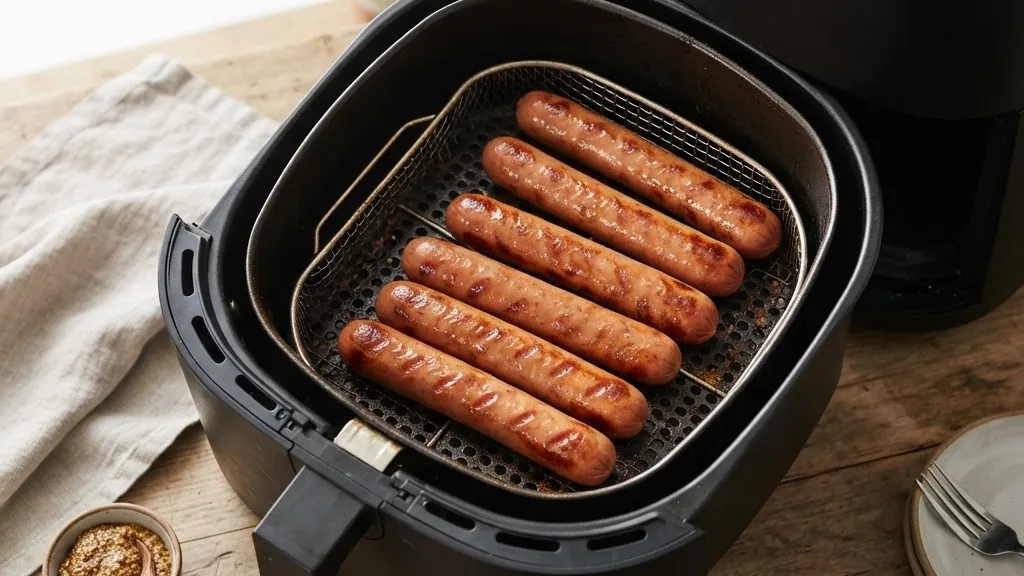
A standard frank, the kind that comes eight to a pack, is done in 5 to 6 minutes at 400F. That gives you a browned, slightly blistered casing with a juicy inside. If you like them barely warmed with no color, you could pull at 4 minutes, but you would be missing the whole point of the air fryer, which is that grilled char without the grill.
A jumbo or bun-length dog, thicker through the middle, needs 7 to 10 minutes because the heat has more meat to drive through to the center. Bratwurst-style and thick sausages sit at the top of that range or even a touch beyond. The rule is simple: thicker means longer, and when in doubt, the center temperature settles the argument, not the clock.
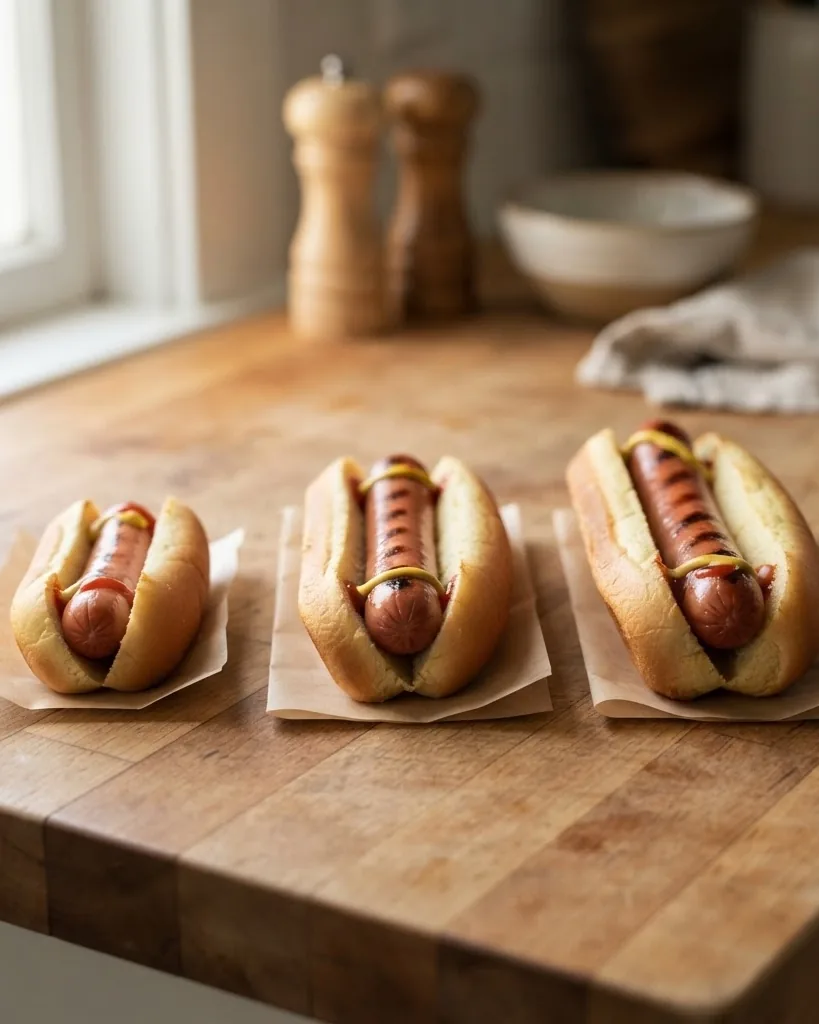
Time and temperature chart
Here is everything on one card. Temperature holds at 400F across the board, which is high enough to render the fat and crisp the casing fast. Only the time shifts with the size and starting state of the dog.
| Hot dog type | Temperature | Time | Notes |
|---|---|---|---|
| Standard frank (thawed) | 400F | 5 to 6 minutes | Browned skin, juicy center |
| Lighter browning | 380F | 6 to 7 minutes | Gentler color, softer casing |
| Jumbo / bun-length | 400F | 7 to 10 minutes | Thicker, needs more time to center |
| Frozen (from solid) | 380 to 400F | 8 to 12 minutes | No thawing needed, add 2 to 3 min |
| Buns (toasting) | 400F | 1 to 2 minutes | Add at the end of the cook |
Every machine has its own temperament, so treat these as a strong starting point rather than gospel. Mine crisps a frank beautifully at exactly 6 minutes; a friend’s slightly weaker unit needs 7 for the same look. Cook one the first time, check it, and adjust in one-minute steps. After a single batch you will know your number cold. A lot of that machine-to-machine variation comes down to airflow and how the chamber holds heat, covered in the guide on how an air fryer works.
Step by step: crisp skin, juicy center
This is about as easy as cooking gets, but a couple of small moves make the difference between a decent dog and a great one.
- Preheat to 400F for 3 to 5 minutes. A cold basket wastes your first few minutes and leaves the timing unpredictable. Preheat for about four minutes so the dogs start browning the instant they go in. My walkthrough on how to preheat an air fryer explains why this matters more than people think.
- Space them out in a single layer. Lay the dogs with a little gap between each one so the air can wrap all the way around. Crowded dogs steam each other and lose that crisp casing.
- Score them if you want extra snap. This is optional, but a few shallow diagonal cuts across the skin open up as they cook, crisp deeper, and stop the casing from splitting in one ugly place. It gives that classic diner look.
- Cook 5 to 6 minutes for standard franks. Flipping once at the halfway mark evens out the browning, though honestly the circulating air does a decent job on its own. For jumbo dogs, run 7 to 10 minutes.
- Add buns for the last 1 to 2 minutes. Tuck the buns in beside or on top of the dogs for the final stretch and they toast just enough to hold up to toppings without going hard.
- Check and serve. The center should be steaming hot all the way through. Dress them and eat.
No oil, no water, no splatter to clean. That combination of speed and low cleanup makes hot dogs an easy default for a lazy dinner. For more of that hands-off style, the routine for hard boiled eggs in the air fryer runs on the same set-and-walk-away idea.
Toasting the buns in the same basket
The bun is where a lot of home hot dogs fall apart, literally, because a cold soft bun collapses under mustard and relish. The air fryer fixes this for free. In the last minute or two of the cook, drop your buns into the basket cut-side up. The same hot air that crisped the dog gives the bun a light toast and a bit of structure.
Watch them, though, because buns go from perfectly toasted to hard and dry faster than you would guess. One minute is often enough for a soft potato bun; a sturdier bakery roll can take two. If your basket is small, you can toast the buns first for a minute, set them aside, then cook the dogs, since the dogs hold their heat better than the bread does. Either way, a toasted bun turns a fine hot dog into one that actually holds together in your hand.
Frozen hot dogs and thick jumbo dogs
One of the quiet wins here is that you do not have to thaw. Frozen hot dogs go straight from the freezer into the basket. Just add roughly 2 to 3 minutes to the normal time, so figure 8 to 12 minutes at 380 to 400F depending on thickness. They may look a little pale at the halfway point; give them the full time and they catch up. This is genuinely useful on a night when you forgot to plan dinner and there is a bag of dogs in the freezer.
Thick jumbo dogs and sausages deserve the same patience. Because the heat has to travel farther to the middle, rushing them leaves a hot skin over a cool center. This is exactly where a food thermometer earns its keep. Poke it into the end and slide it toward the center; if the middle is steaming hot, you are done, and if it is not, give it another minute or two. The clock gets you close, but the thermometer removes the guessing on the fat ones.
Food safety: Listeria and the 165F rule
Here is the part worth taking seriously, because hot dogs are a specific food-safety case. They come pre-cooked, so technically they are ready to eat, but the USDA Food Safety and Inspection Service flags them as a ready-to-eat meat that can carry Listeria monocytogenes, a bacterium that can grow even at refrigerator temperatures. That is why the guidance is to reheat hot dogs until they are steaming hot rather than just warm.
For most healthy adults, cooking a dog to a hot, steaming center in the air fryer handles this comfortably. But for anyone at higher risk, which the agencies define as pregnant people, newborns, older adults, and those with weakened immune systems, the recommendation is firmer: reheat hot dogs to an internal temperature of 165F. Chicken and turkey hot dogs in particular should reach 165F, since poultry carries its own safe-temperature standard. This is one spot with no room for improvisation; the agency line applies exactly.
The practical takeaway is easy. Cook to steaming, and if you are serving someone in an at-risk group, put a thermometer in the center and confirm 165F. Time charts tell you when to start checking; the thermometer confirms safety. The primary sources are the USDA FSIS page on hot dogs and food safety and the FDA cooking guidance for higher-risk eaters.
Air fryer vs grill vs boiling vs microwave
The hot dog is one of those foods everyone cooks a different way, and each method has a personality. Here is how the air fryer stacks up against the alternatives, because knowing the trade-offs helps you pick the right tool on a given night.
| Method | Time | Texture | Effort |
|---|---|---|---|
| Air fryer | 5 to 6 minutes | Blistered, snappy skin, juicy | Low, hands-off |
| Grill | 7 to 10 minutes plus heat-up | Best char and smoke | High, weather-dependent |
| Boiling | 5 to 7 minutes | Plump but soft, no crisp | Medium, watch the pot |
| Microwave | 1 minute | Rubbery, no browning | Lowest, fastest |
The grill genuinely wins on flavor when the weather cooperates and you feel like firing it up, because nothing else gives you that smoky char. But for a random weeknight, the air fryer delivers about 90 percent of the grilled experience with none of the setup and no reliance on the weather. Boiling makes a plump dog but skips the browning entirely, and the browning is arguably the best part. And the microwave is the fastest but leaves you with a soft, sometimes rubbery result and zero crisp. The air fryer is the everyday sweet spot: nearly the grill’s texture, close to the microwave’s convenience.
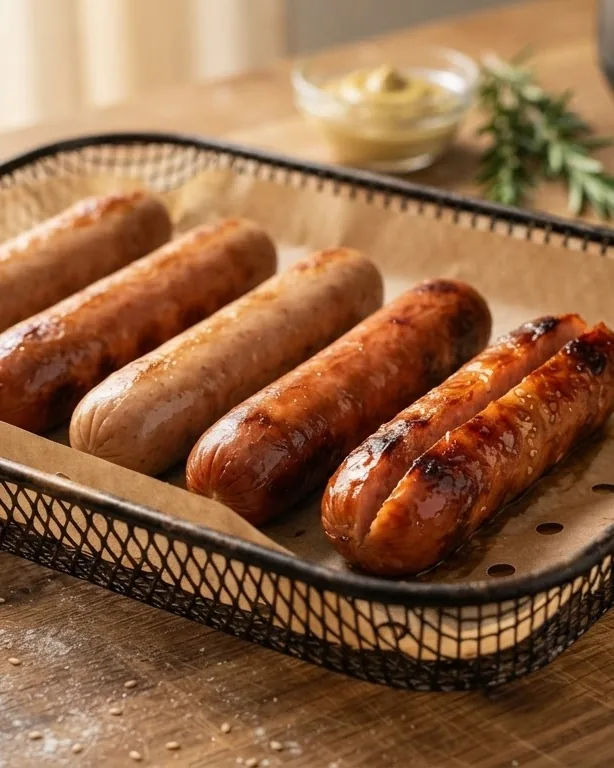
Bun-length dogs, brats, and specialty sausages
Once you have the basic frank down, the same approach handles the whole sausage aisle with small tweaks. Bun-length dogs are just longer, so they fit the standard 400F setting but may need a minute more to heat all the way through. Bratwurst and thicker fresh sausages are a different animal because many of them are raw, not pre-cooked, and that changes the food-safety math entirely.
For raw brats and fresh sausage, you are not reheating, you are cooking from raw, so the internal temperature target matters just as much as it does with chicken. Raw pork or beef sausage should reach 160F internally, and raw poultry sausage should reach 165F, per the USDA. That means longer times, usually 12 to 15 minutes at around 375 to 400F with a flip, and it means the thermometer is not optional. Treat a raw brat with the same care as a chicken breast: cook to temperature, not to the clock. Smoked and pre-cooked sausages like kielbasa, on the other hand, behave like hot dogs and just need heating and browning, roughly 6 to 8 minutes.
Snap and texture also vary by casing. Natural-casing dogs give you that satisfying pop when you bite in, and the air fryer’s dry heat brings that out beautifully, arguably better than boiling ever could. Skinless dogs will not snap the same way but still brown and blister nicely. Either way, the machine’s fast circulating air is what builds that browned exterior, the same convection effect explained in the guide on how an air fryer works.
Toppings, batch cooking, and common mistakes
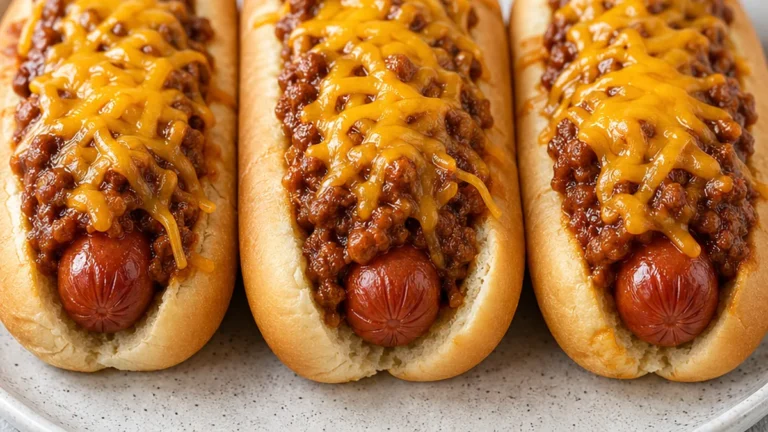
Once the dog and bun are handled, the rest is fun. The classic version is hard to beat, but the air fryer also opens up a chili-cheese version where you cook the dog, then let a spoonful of chili and a pinch of cheese melt over it for the last 30 seconds. Diced onion, mustard, relish, sauerkraut, whatever you like; the base is bulletproof.
Batch cooking scales cleanly as long as you respect the single layer. A standard basket fits five or six dogs with enough spacing; a bigger oven-style unit can take a full pack across two racks. The time does not change with quantity, only the spacing does. Pack them tight and they steam instead of crisping.
The common mistakes are all small. Skipping the preheat, which throws off the timing and leaves the skin pale. Crowding the basket, which trades crisp for soggy. Forgetting the buns until the dogs are already done, so they go on cold. And relying purely on the clock for thick or frozen dogs instead of checking the center. Fix those four and hot dogs become one of the most reliable things you will ever pull out of the machine. If you are still learning your unit’s quirks, the beginner guide on how to use an air fryer fills in the rest.
Corn dogs, cheese dogs, and pigs in a blanket
The hot dog family extends well past the plain frank, and the air fryer handles the whole clan. Frozen corn dogs are a strong candidate because the machine crisps the cornmeal coating far better than a microwave, which just steams it soft. Cook frozen corn dogs at 375 to 400F for about 8 to 10 minutes, flipping halfway, until the coating is golden and crisp and the center is hot. They come out with the kind of crunch you normally only get from a fair.
Cheese dogs are a fun upgrade you can build in the machine. Cook the dog most of the way, then in the last minute or two slit it lengthwise, tuck in a strip of cheese, and let it melt into the split. Do it late so the cheese does not scorch or run out into the basket. Pigs in a blanket, whether homemade with crescent dough or a frozen box, air fry beautifully too: the dough puffs and browns in the dry heat, usually 8 to 12 minutes at 350 to 375F depending on size, and you skip heating a whole oven for a handful of them.
The common thread across all of these is that the air fryer’s dry, moving heat is exactly what a crisp coating or a browned dough wants, which is why it beats the microwave every single time on this category. If you are building a whole spread of these small bites, the beginner guide on how to use an air fryer covers batching and timing so nothing comes out cold.
The bottom line on air fryer hot dogs
Strip it all down and the answer to how long hot dogs in air fryer is refreshingly simple: 5 to 6 minutes at 400F for a standard frank, a few minutes more for jumbo or frozen ones, and buns tossed in for the last minute or two. That is a full, hot, genuinely good meal in under ten minutes with almost nothing to clean. That is why a bag of hot dogs makes good freezer insurance against a night with no plan.
The habits that matter are small but real. Preheat so your timing holds. Space the dogs out so they crisp instead of steam. Score them if you want that extra snap. Toast the buns in the same basket. And for thick, frozen, or at-risk servings, let a thermometer confirm the center rather than trusting the clock, aiming for that steaming hot, 165F middle. Do those things and the air fryer will turn out a blistered, juicy hot dog every single time, batch after batch, which is exactly the kind of dependable everyday cooking the machine is best at.
Frequently asked questions
How long do you cook hot dogs in an air fryer?
Cook standard franks at 400F for 5 to 6 minutes for browned, snappy skin and a juicy center. Jumbo or bun-length dogs need 7 to 10 minutes, and frozen dogs take 8 to 12 minutes. Add the buns for the final 1 to 2 minutes.
What temperature should I set for hot dogs?
400F is the sweet spot for crisp skin and fast cooking. If you prefer a gentler color and a softer casing, drop to 380F and add a minute. Either way the dog is pre-cooked, so you are browning and heating through.
Do I need to flip hot dogs in the air fryer?
It is optional. The circulating air browns them fairly evenly on its own, but a single flip at the halfway mark gives you the most even color all the way around. For thick dogs, a flip helps the underside keep up.
Can you cook frozen hot dogs in an air fryer?
Yes, straight from frozen with no thawing. Add about 2 to 3 minutes to the normal time, so roughly 8 to 12 minutes at 380 to 400F. Check that the center is steaming hot before serving, especially on thicker dogs.
What internal temperature should a hot dog reach?
Hot dogs are pre-cooked, but the USDA advises reheating until steaming hot, and reheating to 165F for at-risk eaters such as pregnant people, older adults, and the immune-compromised, because ready-to-eat meats can carry Listeria. Use a thermometer to confirm.
How do you keep the casing from splitting?
Score a few shallow diagonal cuts across the skin before cooking, and do not run the temperature higher than needed. The cuts give the casing room to expand so it crisps evenly instead of bursting in one spot.nnSources: USDA Food Safety and Inspection Service, hot dogs and food safety, Listeria guidance, and the safe minimum internal temperature chart (poultry 165F); U.S. Food and Drug Administration, cooking guidance for higher-risk eaters. Cooking times are compiled from published air-fryer references.nnAuthoritative references: USDA FSIS hot dogs and food safety and FDA cooking food safety.