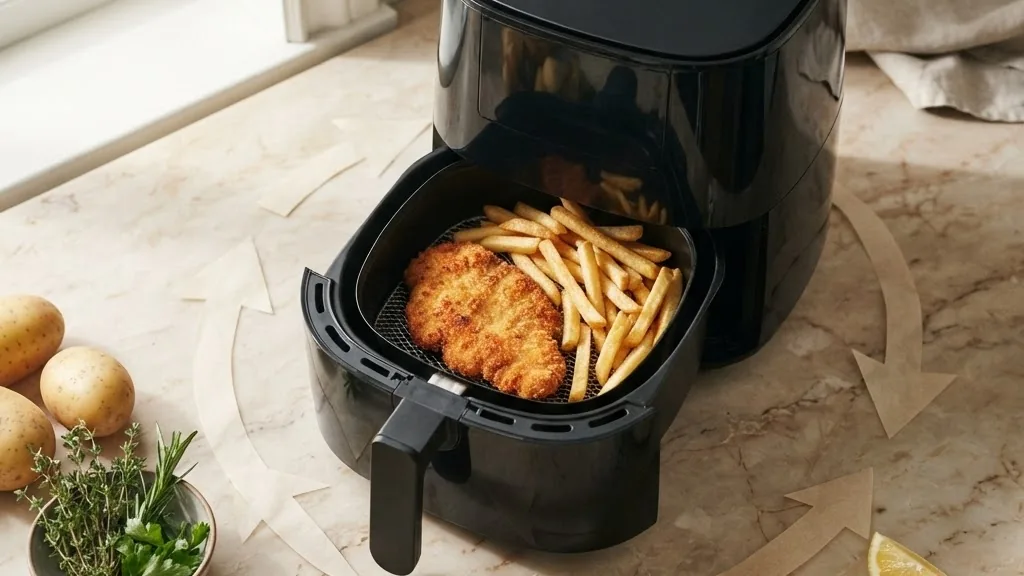
The most common question is simple: how does air fryer work, and why does it crisp a tray of fries that used to need a vat of oil? The short version is that it is a small, aggressive convection oven. A heating element gets hot, a fan slams that hot air around a vented basket, and the moving air does to your food what bubbling oil used to do.
Figures here are grounded in the FDA, USDA FSIS, and published food-science sources.
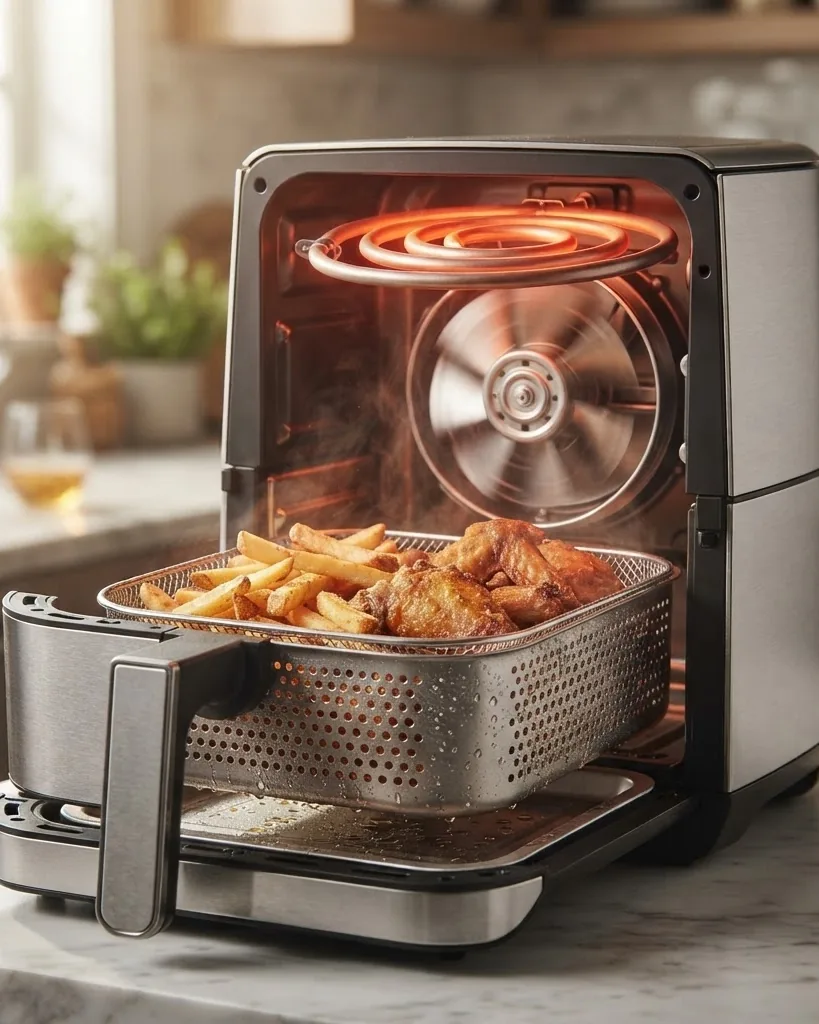
Quick answer: How does air fryer work? An electric heating element near the top of the chamber heats the air, and a large fan just above the food blows that air down and around at high speed. Your food sits in a basket with vents in the bottom and sides, so the hot air circulates underneath and over every surface. Most home units draw about 1400 to 1700 watts and run from 200F up to 400F, moving air as hot as roughly 392F. That fast, dry, close-range heat triggers the Maillard browning reaction quickly, which is why food crisps with a light spray of oil instead of a full fryer basket of it.
What actually happens inside the basket
Strip away the branding and an air fryer is two parts doing one job: a heating element and a fan. The element is an electric coil, usually tucked just under the top of the cooking chamber. Run current through it and it glows hot, throwing off radiant heat the way a toaster coil does. On its own that would scorch whatever sits directly below it and barely touch the rest.
The fan is what turns that into cooking. Mounted right above the element, it pulls the heated air and drives it down onto the food, then that air gets pushed through the vents and channels built into the basket so it wraps around the sides and underside too. Engineers at Philips branded this pattern Rapid Air Technology, and the general term you will see in teardowns is Radiant UpStream Heating, or RUSH. According to BBC Science Focus, the effect of that circulating air is close to submerging food in hot oil, minus the oil.
The geometry is deliberate. In a basket-style unit the element and fan sit in a lid over the drawer, so air travels a short, tight loop: down through the center, out along the perforated floor, up the walls, and back into the fan. That short path is why the chamber recovers heat fast each time you open it. Oven-style units wrap the element around the back or top and use racks, trading that tight loop for capacity. Either way, the perforations are not decoration; block them and you break the circuit that carries heat under the food.
Foil loosely wrapped around a chicken drumstick shows how hard that fan works: the airflow can lift the foil into the element and leave a scorch mark. Light food and loose foil get thrown around in there. That is not a flaw; it is the whole mechanism. Once you understand the airflow path, load the basket with a gap around the edges instead of packing it wall to wall, and the browning evens out.
The parts that do the work
Here is every component that matters and what each one contributes:
- Heating element: a resistive electric coil, typically rated so the whole unit pulls 1400 to 1700 watts. It supplies the raw heat and, being close to the food, adds direct radiant browning on top.
- Fan: larger and faster than the fan in a standard convection oven. It is the reason air moves fast enough near the food to strip away the cool, damp layer that otherwise insulates the surface.
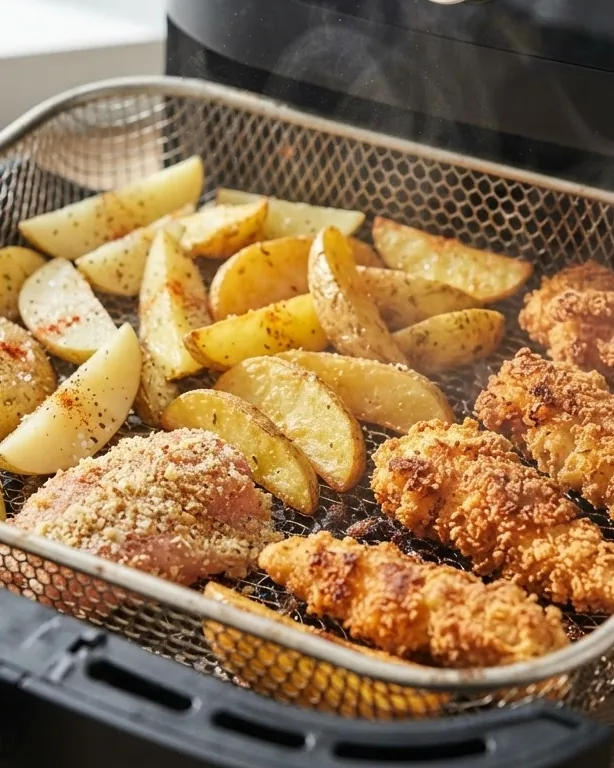
- Vented basket or tray: the channels in the bottom and sides route air under and around the food so heat hits all surfaces, not just the top.
- Small chamber: less air volume to heat means it comes up to temperature fast and holds it cheaply. A big oven cavity cannot circulate air as tightly or as quickly.
- Thermostat and timer: the element cycles on and off to hold your set temperature, which is why the number on the dial is a target the machine chases, not a constant reading.
That last point is worth sitting with. A probe thermometer in an empty basket set to 400F can read closer to 375F at grate level. The dial tells the thermostat what to aim for. What your food feels depends on airflow, how full the basket is, and how often you open the drawer.
Why it crisps like a deep fryer without the oil
Crisping is really about two things: driving moisture off the surface and browning what is left. Deep frying does both because 350F oil is a dense, fast-moving heat bath that surrounds the food. Air is thinner, so it carries far less heat per cubic inch. An air fryer compensates by moving that air quickly and keeping it close, which is why a slow-moving conventional oven at the same temperature leaves fries soft while an air fryer sets them.
The browning itself is the Maillard reaction, where amino acids and reducing sugars in the food react under heat to build brown color and roasted flavor. It runs fast in the roughly 285F to 330F surface range, which is exactly where an air fryer set to 350 or 400F puts the outside of your food. Science Focus notes the Maillard reaction starts sooner in an air fryer than in a conventional oven because the heat transfer is more intense. That head start is the crisp you are paying for.
It helps to see the chemistry as two heat baths. Deep frying transfers heat by conduction from oil, which holds far more energy per unit volume than air and touches every crevice at once, so a fry browns edge to edge in minutes. An air fryer transfers heat by forced convection through a thin gas, winning back the difference with velocity and proximity rather than density. That is why timing is less forgiving: air carries little thermal mass, so an open drawer or crowded basket drops the surface temperature fast and browning stalls. Both crusts run on the same Maillard chemistry; the air fryer just reaches it with a fraction of the fat.
Oil still matters, just far less of it. A light spray or a single teaspoon tossed through helps conduct heat into the surface and carries flavor, and it stops lean foods from drying out. The difference is a teaspoon versus the quart a deep fryer swallows. Swapping a heavy pour of oil for a quick spritz makes the crust better, not worse, because excess oil pooling in the basket just steams the vegetables.
Air fryer vs deep fryer vs convection oven
People ask which of the three they actually need. They share the convection idea but differ in oil, speed, and capacity. Here is how they break down. The values are typical operating ranges, not absolute limits.
| Factor | Air fryer | Deep fryer | Convection oven |
|---|---|---|---|
| How heat moves | Fast fan-driven hot air, close to food | Food submerged in hot oil | Fan-driven hot air, large cavity |
| Added oil | None to about 1 tsp or a spray | Several cups to quarts | None to a light coat |
| Typical temp | 200F to 400F (air up to ~392F) | 350F to 375F oil | 250F to 450F |
| Preheat | About 3 to 5 minutes | 10+ minutes to heat oil | 10 to 15 minutes |
| Power draw | ~1400 to 1700 watts | ~1500 watts plus oil cost | 2000+ watts (full size) |
| Batch size | Small, single layer | Medium, submerged | Large, multiple racks |
| Best at | Fast crisping for one to three people | Even deep-fried crust at volume | Big batches, baking, roasts |
My honest read: the air fryer wins on speed, cleanup, and oil for small households. The convection oven wins the moment you need to feed a crowd, since air fryer capacity is its real ceiling. If you want the deeper comparison, the full breakdown is in the guide on convection oven versus air fryer.
Temperatures and times that actually matter
The dial range on most machines is 200F to 400F. Within that, a few habits do more for results than any single setting. These are the rules to cook by:
- Preheat for 3 to 5 minutes. Food dropped into a cold basket steams before it sears. Preheat four minutes every time, and bacon renders instead of stewing in its own grease for the first five minutes. My walkthrough on how to preheat an air fryer covers the exceptions.
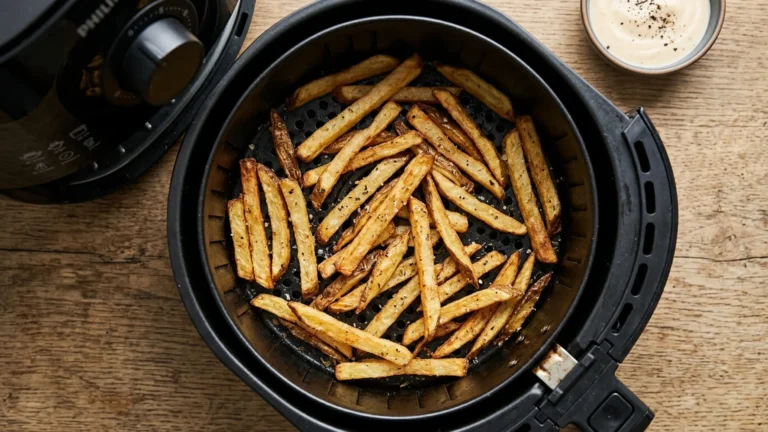
- Cook in a single loose layer. The air has to reach every surface. A pound of fries piled in comes out limp; the same pound spread to one layer crisps in about 18 minutes.
- Shake or flip halfway. The top faces the fan and browns first. Turning evens it out.
- Trust a probe, not the dial, for meat. The set temperature is the air, not the food.
On that last point, doneness is a food-safety line, not a guess. According to the USDA Food Safety and Inspection Service, chicken and all poultry need a safe minimum internal temperature of 165F, ground beef and pork need 160F, whole cuts of beef, pork, lamb, and veal need 145F with a three-minute rest, and fish needs 145F. Chicken thighs that look done at 12 minutes can read 158F on a probe, so they need two more minutes to reach 165F. The air fryer dial cannot tell you that. Only a thermometer in the thickest part can.
The small chamber also explains the energy math. A full-size convection oven often pulls 2000 watts or more and must heat a large cavity before it does any work, which is why it takes 10 to 15 minutes to preheat. An air fryer at 1400 to 1700 watts heats a fraction of that volume and reaches temperature in 3 to 5 minutes, so for a single tray it usually finishes sooner and draws less total energy. That edge shrinks once you need multiple racks, where the oven wins the time back.
The acrylamide question, answered honestly
Because air fryers brown starchy food fast, people ask whether they create acrylamide, a chemical that can form in potatoes, bread, and coffee during high-temperature cooking like frying, roasting, and baking. This is one area where the site sticks strictly to what the agencies say, because it is a health topic and the marketing around it gets loud.
Air frying is often described as cutting acrylamide by roughly 75 to 90 percent compared with deep-fat frying, and a widely cited 2015 Journal of Food Science comparison landed in that range. The nuance is that method is not the whole story. A 2023 study in Frontiers in Nutrition actually measured slightly more acrylamide in air-fried potatoes, about 12.2 micrograms per kilogram, than in deep-fried, 8.9, or oven-fried, 7.4, in that particular test, because air-fryer surface temperatures can spike higher than oil. The lesson is that how brown you cook food matters more than which appliance you use.
The practical steps come straight from the FDA. To reduce acrylamide:
- Soak raw cut potatoes in water for 15 to 30 minutes before cooking, then drain and blot them dry.
- Cook potato products to a golden yellow, not a deep brown; the darkest areas hold the most acrylamide.
- Store potatoes in a cool, dark place outside the refrigerator, since refrigeration can raise acrylamide formed during cooking.
In plain terms, aim for gold, not mahogany. For homemade fries, soak them, pat them bone dry, and pull them at a light amber. They taste better anyway, because past that point you are toasting the sugars into bitterness, not flavor.
Common mistakes that fight the physics
Once you understand that everything depends on fast air reaching the surface, the usual complaints explain themselves. Almost every soggy or uneven result traces back to blocking that airflow:
- Overcrowding. A packed basket turns a convection machine into a steamer. Cook in batches instead.
- Wet food. Surface water has to boil off before browning starts, which wastes minutes and softens the crust. Pat everything dry.
- Skipping the preheat. Cold metal robs the first few minutes of heat and the crust never fully forms.
- Too much oil. Puddled oil in the drawer smokes and steams. A spray is plenty.
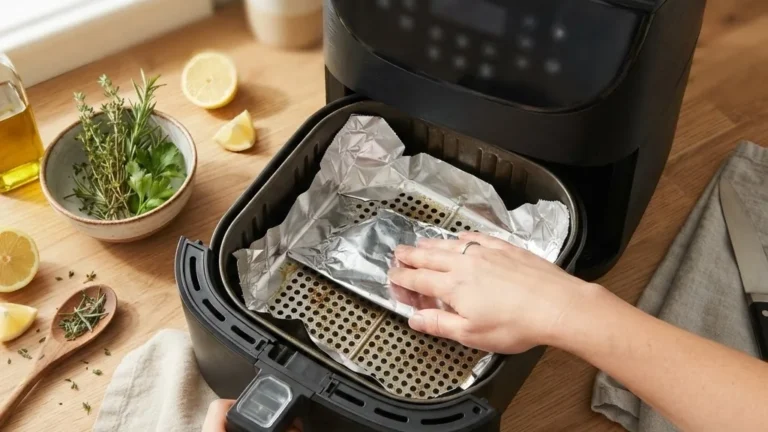
- Loose parchment or foil. The fan will lift it into the element. Weight it with food or skip it.
- Never cleaning the basket. Baked-on grease blocks the vents that route air under the food.
If you are brand new to the machine, the guide on how to use an air fryer walks through the whole first-cook routine. The mechanics above are the why; that guide is the step-by-step.
So is it just a tiny convection oven?
Essentially, yes, and that honest framing is the most useful place to start. An air fryer is a small convection oven with a faster fan, a tighter chamber, and a basket engineered to route air under the food. There is no special ray, no frying without heat, no magic. What you get is intense, close-range, moving hot air that browns fast and crisps with almost no oil.
That mechanism also decides what an air fryer is good at. It shines on foods that want a dry, crisp exterior with room for air to move: fries and wedges, wings and chicken thighs, bacon, frozen breaded items, chickpeas, and firm vegetables like broccoli and brussels sprouts. It is weaker wherever airflow works against you. Wet batter blows around before it sets, so tempura-style coatings suffer. Loose, light items like a bare tortilla lift into the element. Large roasts and whole birds outgrow the basket, and anything meant to stay saucy fights the drying premise.
A few myths are worth retiring. It does not fry; there is no oil bath, so calling it frying is marketing shorthand. It is not exotic radiation cooking; the radiant heat is the same kind a toaster or oven broiler gives off. It does not make food automatically healthy, since a product cooked to a deep brown carries the same concerns from any appliance. And hotter is not always better; past even browning you are just drying the inside.
Knowing that changes how you cook. You stop overloading the basket, you preheat, you dry your food, you reach for a thermometer instead of the dial, and you cook to gold instead of brown. Do those five things and the machine does exactly what the physics promises, batch after batch.
Frequently asked questions
Does an air fryer actually fry food?
No. There is no oil bath, so nothing is fried in the literal sense. It circulates hot air fast enough to brown and crisp the surface, which mimics the texture of frying with a spray of oil or none at all.
How hot does an air fryer get inside?
Most home units dial from 200F to 400F, and the circulating air can reach roughly 392F. Remember that is the air temperature, not the internal temperature of your food, so check meat with a probe thermometer.
How many watts does an air fryer use?
A typical household air fryer draws about 1400 to 1700 watts. That is comparable to a deep fryer but usually less than a full-size convection oven, and it heats a much smaller space.
Why does food come out unevenly cooked?
Almost always it is airflow. Overcrowding or wet food blocks the moving air from reaching every surface. Cook in a single layer, pat food dry, and shake or flip halfway through.
Is air-fried food healthier than deep-fried?
It uses far less oil, and air frying can lower acrylamide versus deep frying, though how brown you cook food matters more than the appliance. Follow the FDA tips: soak potatoes, cook to golden not brown, and store potatoes outside the fridge.
Do I really need to preheat an air fryer?
For crisp results, yes. Three to five minutes of preheating means food starts browning immediately instead of steaming in a cold basket. Delicate baked goods are the main exception.nnSources: U.S. Food and Drug Administration (FDA), acrylamide and food preparation guidance; U.S. Department of Agriculture Food Safety and Inspection Service (USDA FSIS), safe minimum internal temperature chart; BBC Science Focus on air fryer convection; Frontiers in Nutrition (2023) on acrylamide in air-fried potatoes.nnAuthoritative references: FDA on acrylamide and food preparation and USDA FSIS safe minimum internal temperature chart.