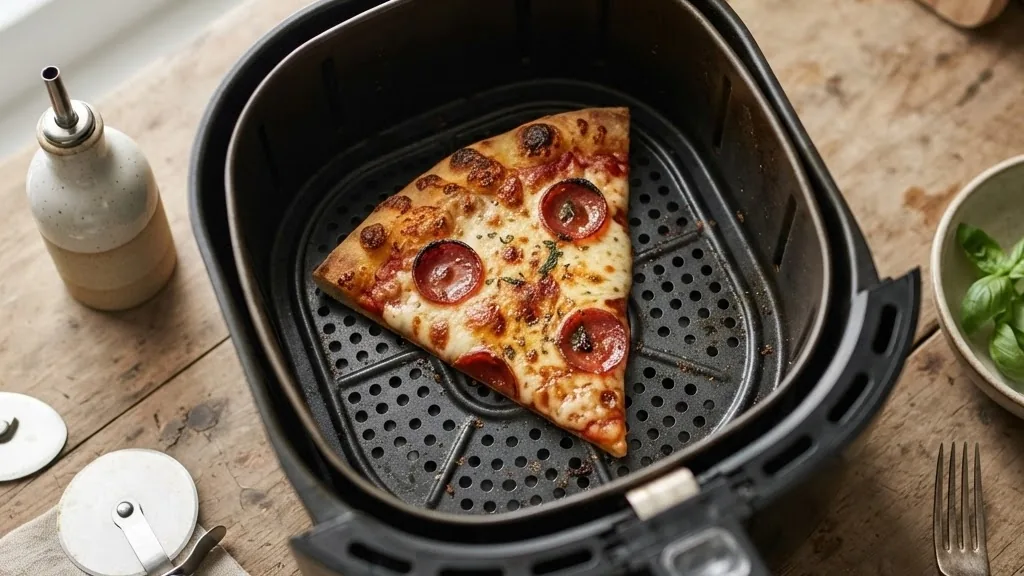
How to reheat pizza in air fryer is the question every cold-slice owner should ask before reaching for a microwave, because the air fryer is the one appliance that rebuilds the crackle a fridge night steals. The short version: 350 degrees Fahrenheit, one flat layer, a few minutes, and a check with your eyes. But crust type changes the math, and food safety changes the stakes. Thin New York foldable slices, dense deep dish, and a frozen wedge you forgot behind the milk each want a different clock. Get the temperature and timing matched to what is actually on your rack and you land somewhere close to a fresh box.
Quick answer: To reheat pizza in air fryer, set it to 350 degrees Fahrenheit and place slices in a single layer without overlap. Thin crust needs about 2 to 3 minutes, regular runs 3 to 4 minutes, and thick crust wants 4 to 5 minutes. A frozen leftover slice takes roughly 5 to 8 minutes. Check early, since brands vary. For safety, reheat until the center hits an internal temperature of 165 degrees Fahrenheit, the level the U.S. Department of Agriculture calls hot and steaming.
The core method: 350 degrees, single layer, no overlap
Set the air fryer to 350 degrees Fahrenheit, lay slices flat in a single layer, and give each one room so the fan can move hot air around every edge. That baseline handles most delivery boxes. Basket-style models usually skip preheating, which is part of why they beat a full oven for one or two slices. The tradeoff is honest: no preheat means the first slice heats a touch slower than it would in a fully warmed chamber, so lean on the low end of your time range and add seconds rather than starting hot and guessing.
- Pull delicate toppings like fresh basil, arugula, or a runny egg before reheating, then add them back after so they do not scorch.
- Leave space between slices and never seal the basket. Blocked airflow is the top cause of a limp reheat.
- Use tongs or a thin spatula to lift slices out cleanly so the cheese does not slide off the tip.
Rest the slice for a minute before biting. The cheese keeps cooking off the heat and the crust firms as steam escapes. If you overcrowd the basket, you force the machine to act like a steamer. Airflow is the mechanism that drives crispness, so if you have four slices and a small basket, perform two separate batches. Your first batch might finish slightly faster because the unit is already warm, so keep a closer eye on the second batch as it goes through the air circulation process.
Time and temperature by crust type
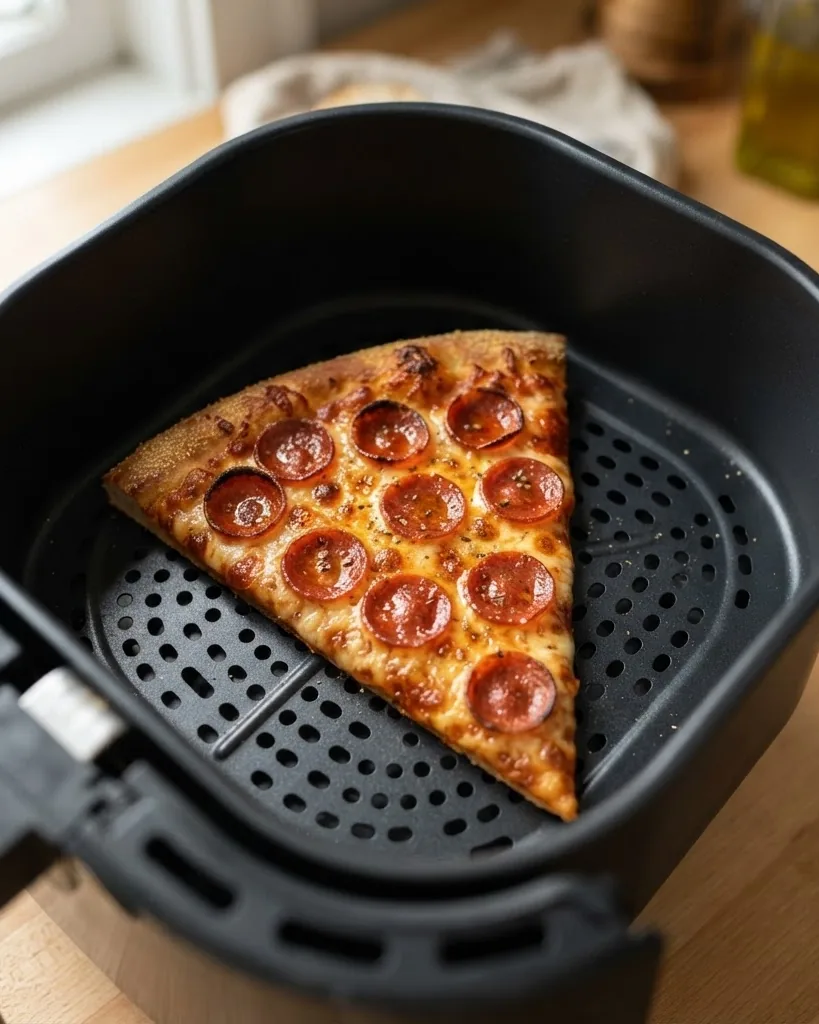
Crust thickness decides everything about your timing, because a thin foldable slice and a deep-dish wedge conduct heat at completely different speeds. The table below runs 350 degrees Fahrenheit as the anchor and adjusts from there. Thin crust can take a hotter, faster route near 400 degrees for roughly 2 minutes, while deep dish needs a gentler climate near 220 degrees so the dense center warms before the crust edge burns, an approach popularized by Julie’s Eats and Treats. Treat crust-specific numbers from recipe blogs as starting points and confirm doneness by feel, since one manufacturer’s 350 runs hotter than another’s.
| Crust type | Temp | Time | Note |
|---|---|---|---|
| Thin crust | 350 to 400 F | 2 to 3 min | Hotter is faster; watch edges |
| Regular | 350 F | 3 to 4 min | The reliable default |
| Thick crust | 350 F | 4 to 5 min | Add 1 to 2 min if dense |
| Deep dish | 220 to 250 F | 5 to 6 min | Low and slow for the center |
| Frozen slice | 350 F | 5 to 8 min | Check early, per Pizza Hut |
For contrast, cooking a raw pizza from scratch is a different job entirely. Papa Johns UK cites roughly 8 to 12 minutes at about 385 to 410 degrees Fahrenheit (195 to 210 degrees Celsius) to air-fry a fresh pie, against just 3 to 5 minutes to warm cooked slices. Reheating is a rescue, not a bake. If you are heating a stuffed crust, treat it like thick crust but expect an extra minute, as the cheese in the border needs time to reach the 165-degree safety mark without the crust edge becoming overly hard or carbonized.
Basket-style versus oven-style air fryers
Not all air fryers behave the same, and the shape of your machine changes your approach more than the brand name on it does. A basket-style unit pulls a tight column of air past a small footprint, heats fast, and rarely needs a preheat, which is why single slices crisp so quickly. An oven-style or toaster-oven-style air fryer holds more slices on a flat rack but moves air more gently across a larger cavity, so it often benefits from a short preheat and a minute of extra time. Match your expectations to your hardware before blaming the recipe.
- Basket-style: best for 1 to 2 slices, faster, skip preheating, watch for hot spots near the fan.
- Oven-style: better capacity for 3 or more slices, preheat briefly, rotate the rack halfway if heating is uneven.
A food scientist quoted by AllRecipes, Bryan Quoc Le, Ph.D., notes that an air fryer reheats more evenly and uses less time and electricity than a conventional or toaster oven, which is the real case for choosing it over both the microwave and a full bake. If you already lean on the appliance for other rescues, the same logic that makes it shine for pizza also revives a batch of leftover fry-ups; see the approach in our guide to reheating fried chicken without the rubber for the same crisp-over-steam principle. Oven-style models provide better surface area for multiple slices, but the heating elements are typically further away from the food, hence the need for a slightly longer dwell time to reach that target temperature.
Food safety: the USDA numbers the recipe cards skip
Reheated pizza is only as safe as the hours it spent before the air fryer, and this is where nearly every recipe blog goes quiet. Leftovers must be refrigerated within 2 hours of cooking, or within 1 hour if the room is above 90 degrees Fahrenheit. When you reheat, bring the center to an internal temperature of 165 degrees Fahrenheit, measured with a food thermometer, not by guessing.
Storage matters just as much as the reheat. The USDA says cooked leftovers keep in a refrigerator at 40 degrees Fahrenheit or below for 3 to 4 days, and stay safe frozen at 0 degrees Fahrenheit with best quality for 2 to 6 months. You can read the agency’s full breakdown in its guidance on leftovers and food safety and its explainer on the Danger Zone temperature range.
One caveat that reinforces the whole rule: reaching 165 degrees Fahrenheit kills active bacteria, but it does not neutralize the heat-stable toxin that Staphylococcus aureus can leave behind if a slice sat out too long. A hot air fryer cannot undo a bad afternoon on the counter. FoodSafety.gov, the federal consumer portal run jointly by the Department of Health and Human Services, the USDA, and the U.S. Food and Drug Administration, publishes the same 2-hour rule and 165-degree target for home cooks. If you want a human answer, the USDA Meat and Poultry Hotline takes questions at 1-888-674-6854. Treat the 2-hour window as the real gatekeeper, since no appliance reverses spoilage.
The practical checklist is short. Refrigerate within 2 hours, hold the fridge at 40 degrees Fahrenheit, eat within 3 to 4 days, and reheat to 165 degrees Fahrenheit before that first bite. If you are ever uncertain about how long a slice sat out, or if it has been stored at room temperature for more than two hours, the safest course of action is to discard it. Food poisoning can occur from toxins that are not destroyed by high heat, making proper storage the most critical step in the entire process.
Liners and accessories: what is safe in the basket
The liner you drop under a greasy slice can either save your cleanup or start a small fire, so pick the right one before the basket heats. Parchment paper works well as long as you poke a few holes so air still flows, and a perforated sheet is the classic airflow trick for a crisp bottom. Foil works with holes poked through it too. Silicone liners are reusable and safe at these temperatures. What you must not do is grab the wrong paper, because that is where the accidents happen.
- Use parchment paper, never wax paper. Wax melts and smokes at air-fryer temperatures.
- Do not use coffee filters as makeshift liners. They are not rated for this heat and pose a fire and smoke risk.
- Poke holes in any parchment or foil so the fan can pull air past the crust, or the bottom steams instead of crisping.
Air fryer manufacturer guidance is the authority to follow here, since accessory ratings vary by model. When in doubt, a bare basket or a perforated crisper plate beats improvising with kitchen paper. If you love pizza flavors beyond the leftover box, the same basket handles our cheesy air fryer pizza garlic bread, which relies on the exact airflow habits above. Always check your model manual to see if your unit requires the crisper plate to be in place; some models use the plate to manage airflow patterns, and removing it can lead to uneven heating or blocked intake vents.
Troubleshooting: soggy, burnt, cold in the middle
Most reheat failures trace back to one of four causes, and each has a clean fix once you name it. A soggy bottom means the crust never got airflow, so it steamed instead of crisped. A burnt edge means the temperature ran too high for that crust, or the slice sat too close to the heating element. A cold center means you rushed a thick or frozen slice at a temperature meant for thin crust. Cheese sliding off usually means the slice moved while molten. Diagnose by symptom, then adjust one variable at a time rather than changing everything at once.
- Soggy bottom: raise the slice off a solid liner, poke holes in parchment, and give it 30 to 60 more seconds with airflow.
- Burnt edges, cold middle: drop the temperature toward 250 degrees Fahrenheit for deep dish and extend the time so the center catches up.
- Cheese sliding: stop opening the basket to peek; let it set, then lift with a wide spatula.
- Uneven heat: rearrange slices halfway and keep them from touching so the fan reaches every side.
The recurring theme is airflow and patience. A slice you check at the 1-minute mark and nudge along beats one you set and forget. For frozen wedges, start at 5 minutes and inspect before adding time, since the surface can look done while the interior is still cool. If the cheese continues to slide, your spatula might be the culprit; use a wider, flat-edged tool to support the entire base of the slice during removal. If you encounter a slice with a heavy topping load, like a meat-lovers style, expect that extra moisture to create steam.
Why the air fryer beats the microwave and the oven
A microwave heats moisture from the inside out, which is exactly why it turns crust rubbery and cheese oily within seconds. The air fryer does the opposite, driving dry convection heat across the surface so the crust re-crisps while the cheese re-melts, closer to how the pie left the pizzeria oven. Against a full oven, the air fryer wins on speed and energy for one or two slices, because it heats a tiny cavity in seconds instead of warming a large box for ten minutes. That is the pattern that makes it the default reheating tool in most modern kitchens for small portions.
- Crispness: dry convection rebuilds crackle the microwave destroys.
- Speed: no long oven preheat for one or two slices.
- Energy: less electricity than heating a conventional oven, per the food-scientist point cited by AllRecipes.
If you are the kind of cook who reheats everything this way, the appliance rewards curiosity. It resurrects a plate of crispy air fryer fried rice with the same dry-heat logic, and it turns leftover dough scraps into fresh snacks. Pizza is simply the slice most people start with. The air fryer essentially creates a controlled environment where the ratio of air speed to surface temperature is optimized for browning. This browning, known as the Maillard reaction, is what imparts that signature toasted flavor to the crust and edges, something a microwave can never replicate regardless of the settings used.
Beyond leftovers: build the habit around better pizza
Once the reheat routine clicks, the natural next move is upgrading what goes in the box in the first place, because a better base reheats better too. Diet and dough choices change how a slice holds up on day two, and there is a wide world of pizza-adjacent cooking that plays well with an air fryer. Whether you are chasing a plant-based night, a gluten-free crust, or a higher-protein plate, the reheating principles stay identical: single layer, airflow, 350 degrees Fahrenheit, and a food-thermometer check to 165 degrees Fahrenheit for anything with cheese or meat.
- Plant-based cooks can raid a stack of vegan air fryer recipes for slices that crisp beautifully the second day.
- Gluten-free eaters get sturdier reheats from a proper base; browse ideas for gluten free pasta and pizza.
- Macro-counters can lean into high protein recipes that survive the fridge and the fan without going leathery.
Understanding what makes a good crust helps too. If pizza is a gateway to broader Italian cooking, the field guide to reading any bag of pasta by its shape pairs neatly with a pizza night, and anyone curious about the business end of dough will enjoy the deep dive on running a pizza truck that actually turns a profit. Both keep you thinking about heat, structure, and timing, which is the whole game with leftovers. Mastering the air fryer reheat is about consistency; once you learn the quirks of your specific machine, you will find that almost any leftover baked good can be improved by following this same temperature-controlled convection approach.
Frequently asked questions
What temperature should I use to reheat pizza in an air fryer?
Use 350 degrees Fahrenheit as your default. You can push thin crust toward 400 degrees for roughly 2 minutes. Always reheat until the center reaches an internal temperature of 165 degrees Fahrenheit, the USDA target for safe leftovers.
Do I need to preheat the air fryer first?
Usually not with a basket-style model, since it heats a small cavity almost instantly. Many recipe sources note no preheat is needed. Oven-style and toaster-oven-style units have larger chambers and benefit from a short preheat plus a little extra time. The tradeoff is minor: skip the preheat and simply lean toward the longer end of your timing range. If you notice your slices are consistently coming out cold in the middle, a 3-minute preheat will solve the problem by stabilizing the environment before the food enters the chamber.
How do I reheat a frozen leftover slice?
Place the frozen slice flat in a single layer at 350 degrees Fahrenheit and give it roughly 5 to 8 minutes, checking early, following the Pizza Hut method. The surface can look ready before the middle warms, so confirm the center hits 165 degrees Fahrenheit with a food thermometer. Add heat in short bursts rather than one long stretch to avoid burning the edges. If the slice has heavy toppings like sausage or pepperoni, check the internal temperature carefully, as these density-heavy items act as heat sinks and require extra time to reach that target internal temperature.
How long is leftover pizza safe to keep?
The USDA says refrigerate slices within 2 hours of cooking, or 1 hour if the room is above 90 degrees Fahrenheit. Kept at 40 degrees Fahrenheit or below, cooked leftovers stay good for 3 to 4 days. Frozen at 0 degrees Fahrenheit, quality holds best for 2 to 6 months. Reheating to 165 degrees Fahrenheit will not fix a slice left out too long. If you suspect your pizza was left out in a warm car or in direct sunlight for more than an hour, the risk of pathogen growth increases significantly, and it should be discarded immediately.
Can I use parchment paper in the air fryer for pizza?
Yes, parchment paper is safe if you poke a few holes so air still circulates under the crust. Never substitute wax paper, which melts and smokes at these temperatures, and skip coffee filters entirely because they are not heat-rated and pose a fire risk. Silicone liners and perforated foil are other safe options that keep airflow moving. Always ensure that the paper is weighted down by the weight of the pizza slice itself; if the paper is loose, the fan might catch it and push it into the heating element, which creates a fire hazard and blocks the flow of air.
Why is my reheated pizza soggy on the bottom?
A soggy bottom almost always means airflow was blocked, so the crust steamed instead of crisping. Do not seal the basket. The dry convection needs a clear path under the crust to rebuild that crackle. If you are using a silicone mat that covers the entire bottom, try switching to a smaller piece or a mesh style mat that allows for maximum air penetration beneath the slice. Excess moisture from the toppings can also contribute to this; if your pizza has heavy veggie toppings, dab them with a paper towel before reheating.
Reheating well is a small skill with a big payoff, and the air fryer makes it nearly foolproof once you match the clock to the crust and respect the safety numbers. Note that food safety is a genuinely important topic; if you are ever unsure whether a slice has been stored safely, the USDA Meat and Poultry Hotline at 1-888-674-6854 can give you a straight answer before you take a bite. Your health and the quality of your meal are both worth the extra few seconds it takes to check the internal temperature and ensure your appliance is set up for success.