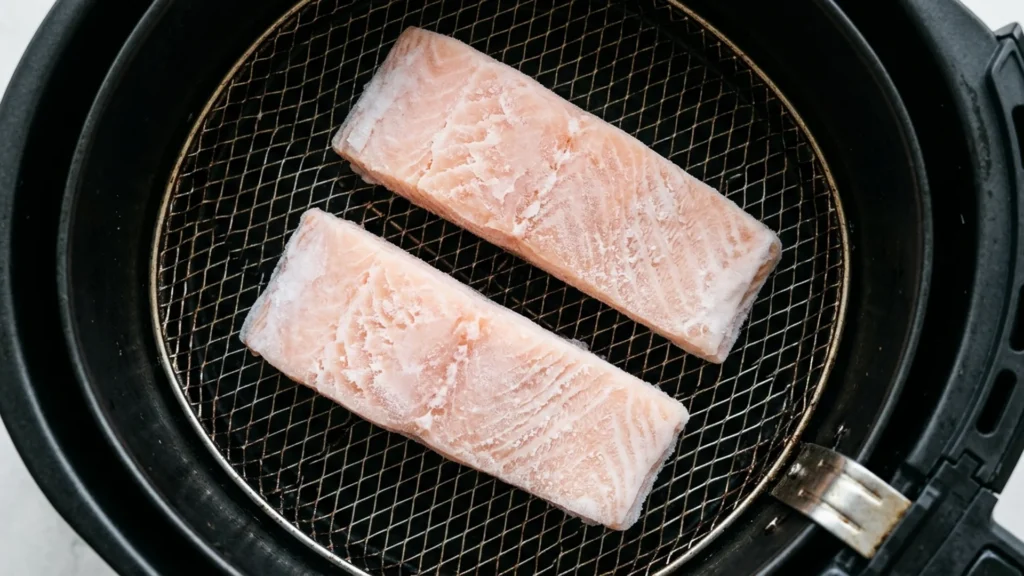
Cooking frozen salmon in air fryer is the kitchen shortcut I lean on most, because it takes a rock-hard fillet straight from the freezer and turns it into flaky, moist fish in about 15 minutes with no thawing at all. The trick is a two-stage cook: a few minutes to melt the surface ice, then a hotter finish to actually cook and lightly crisp the fish. Run it at 390 degrees F, season only after the ice has melted, and pull the fillet the moment it hits 145 degrees F internal.
That “season after the ice melts” detail is the single thing most recipes skip, and it is why so many people end up with bland salmon and seasoning stuck to the basket instead of the fish. Frozen salmon has a thin glaze of ice on the surface, and oil or spices slide right off it. Let the first stage handle the ice, blot the fillet, then season. You get fish that actually tastes like what you put on it, and skin that can crisp instead of steam.
Yes, you can cook salmon straight from frozen
I used to believe you had to thaw fish overnight or risk a raw, cold center. With an air fryer that is simply not true. The circulating hot air thaws the outside while the inside catches up, so a single fillet cooks through evenly without the gummy band of overcooked flesh you get when you blast a half-frozen piece in a skillet. The freezer-to-basket workflow is the whole point: you forget to defrost dinner, you remember at 6 p.m., and you still eat by 6:20.
There is a quality argument for cooking from frozen too, not just a convenience one. A commercial flash-frozen fillet was frozen at peak freshness, often within hours of the catch. When you let it thaw slowly in the fridge, it weeps liquid and the texture softens. Going straight from frozen to the air fryer skips that slow thaw, so the fish holds its structure and stays firm. If you have ever wondered why your thawed salmon turns mushy, the thaw itself is often the culprit, and cooking from frozen sidesteps it.
The only real adjustment is time. Frozen salmon needs roughly 50 percent longer than a thawed fillet of the same size, and you split that time into two stages instead of one. Once you have the rhythm down, it is genuinely easier than thawing, because there is no planning and no soggy fridge thaw to manage.
One safety note worth stating plainly: cooking from frozen is fine for salmon because the fillet is thin enough for the heat to penetrate fully in the time given. This is not true of every frozen protein, and it is the thinness of a salmon fillet, usually an inch or so, that makes the freezer-to-basket trick work so reliably. A thick frozen roast would never cook through evenly this way, but a salmon fillet does, which is part of why fish is one of the best things to keep stocked in the freezer for fast dinners. Buy individually vacuum-sealed fillets so you can pull exactly the number you need without thawing the whole package, and you have a protein that is always ten minutes from the plate.
The two-stage method, step by step
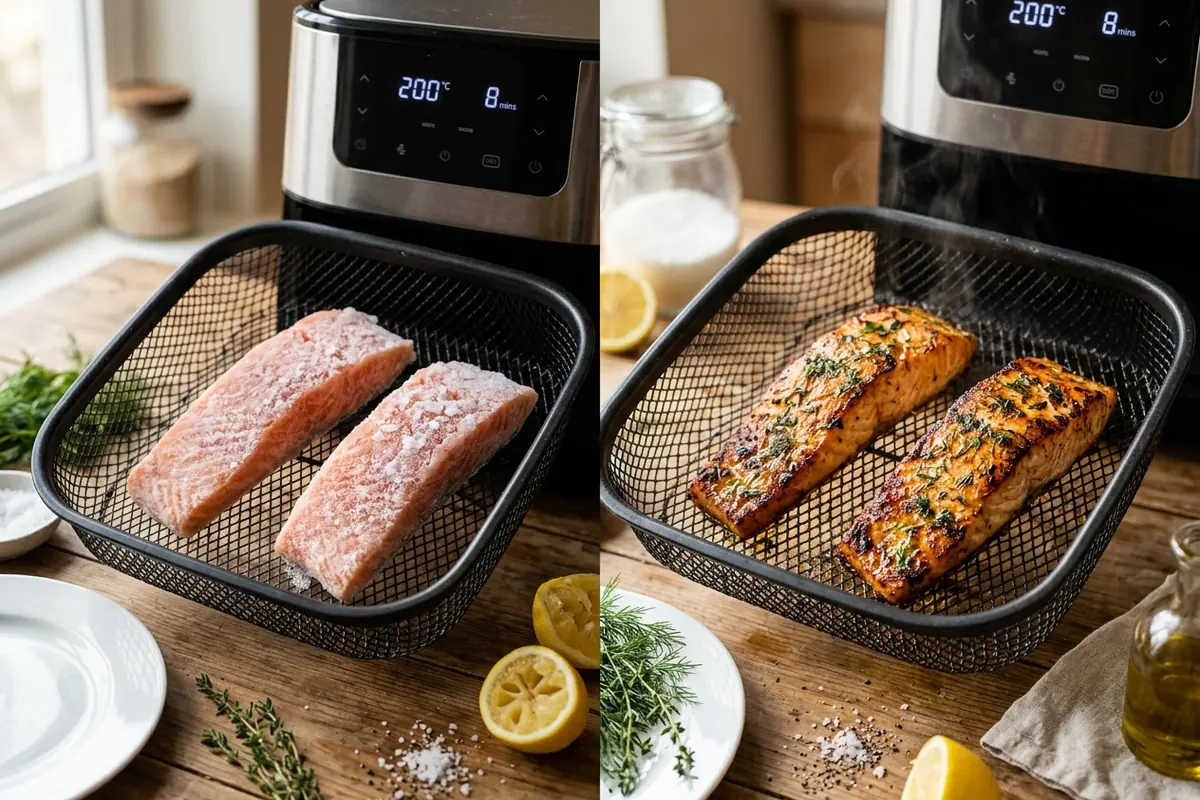
Here is the exact sequence I use for a standard 6-ounce fillet, roughly 1 to 1.25 inches thick at the thickest point. Stage one melts the ice and lets the surface dry. Stage two cooks the fish and crisps the skin or top.
Start by placing the frozen fillet skin-side down in the basket, with a light spritz of oil on the basket itself so it does not stick. Do not season yet. Run the air fryer at 390 degrees F for 5 minutes. When the timer goes off, the surface will look wet and the fillet will have softened slightly. Pull the basket, blot the top with a paper towel, brush on a little oil, and now apply your salt, pepper, and seasonings. They will actually stick.
Slide it back in and run another 7 to 9 minutes at 390 degrees F. Start checking at 7. The fish is done when the thickest part reads 145 degrees F on an instant-read thermometer and the flesh flakes when you press it with a fork. Two signals, not one: temperature and flake. If you only own one of those tools, the flake test is reliable enough on its own, but a cheap probe thermometer removes all guesswork and is the best 12 dollars a salmon cook can spend.
Time and temperature by thickness
Salmon fillets vary a lot in thickness, and that, more than weight, drives cook time. A thin tail-end piece and a thick center-cut piece can differ by 4 or 5 minutes. Use this chart as your starting point, always at 390 degrees F, and always with the two-stage split.
| Fillet thickness | Stage 1 (melt ice) | Stage 2 (cook) | Total time |
|---|---|---|---|
| Thin, under 0.75 inch | 4 min | 5 to 6 min | 9 to 10 min |
| Standard, 1 to 1.25 inch | 5 min | 7 to 9 min | 12 to 14 min |
| Thick center cut, 1.5 inch | 6 min | 9 to 11 min | 15 to 17 min |
| Two fillets at once | 6 min | 9 to 10 min | 15 to 16 min |
Two notes on reading this chart. First, residual heat keeps cooking the fish for a minute after you pull it, so stop at 143 degrees F and let it coast to 145 rather than overshooting. Overcooked salmon dries out fast and turns chalky. Second, if you are cooking two fillets, give them space so air can move between them. Crowding the basket is the most common reason a second fillet comes out underdone in the middle while the first is perfect.
The same temperature logic applies whether you are working from frozen or thawed, and our guide to cooking salmon in the air fryer breaks down the thawed timing if you planned ahead for once. The frozen method here is just the two-stage version of that same approach.
The 375 vs 390 vs 400 question, settled
Search around and you will see frozen salmon recipes calling for 375, 390, and 400 degrees F, which is confusing when you just want dinner. Here is how to think about it. At 400 degrees F you cook fastest, but the outside can dry or even scorch before a thick center reaches 145, especially without the two-stage thaw. At 375 you get gentle, even cooking, but it is slow and the skin rarely crisps. At 390 you land in the sweet spot: fast enough to be a weeknight method, hot enough to crisp the skin and top, and forgiving enough that a minute of overshoot will not ruin the fillet.
If your air fryer runs hot, which many do, treat 390 as 400 and check early. If it runs cool, nudge to 400 for the second stage. The number on the dial matters less than the internal temperature you confirm at the end. The 145-degree target from the FDA is the real finish line, not the clock. The USDA food safety guidance sets 145 degrees F as the safe minimum for fish, and that holds whether you started from frozen or fresh.
Getting the skin crisp, not rubbery
The biggest complaint about frozen salmon is flabby, rubbery skin, and the fix is mechanical, not magical. Rubbery skin happens when the skin steams in its own surface moisture instead of crisping in dry heat. That surface moisture comes from the melting ice glaze, which is exactly why stage one matters. After those first few minutes, the ice has turned to water on the surface. Blot it away. Dry skin crisps; wet skin steams.
Place the fillet skin-side down for the whole cook so the skin sits closest to the basket and gets the most direct, crisping heat. A light film of oil on the skin helps it brown and release cleanly. If your fillet is skinless, the same blot-and-oil step still matters, just for the top surface instead of the skin. You want the exterior dry and lightly oiled before stage two, every time.
One more refinement for crisp-skin devotees: in the last 2 minutes, bump to 400 degrees F. That short, hot finish dries and tightens the skin without overcooking the interior, because the inside is already near temperature by then. It is the same logic a good cook uses on a stovetop sear, just at the end instead of the start. Serious Eats has written extensively about how dry surfaces brown better than wet ones, and that browning is exactly what gives air fryer salmon skin its snap.
Seasoning frozen salmon so flavor actually sticks
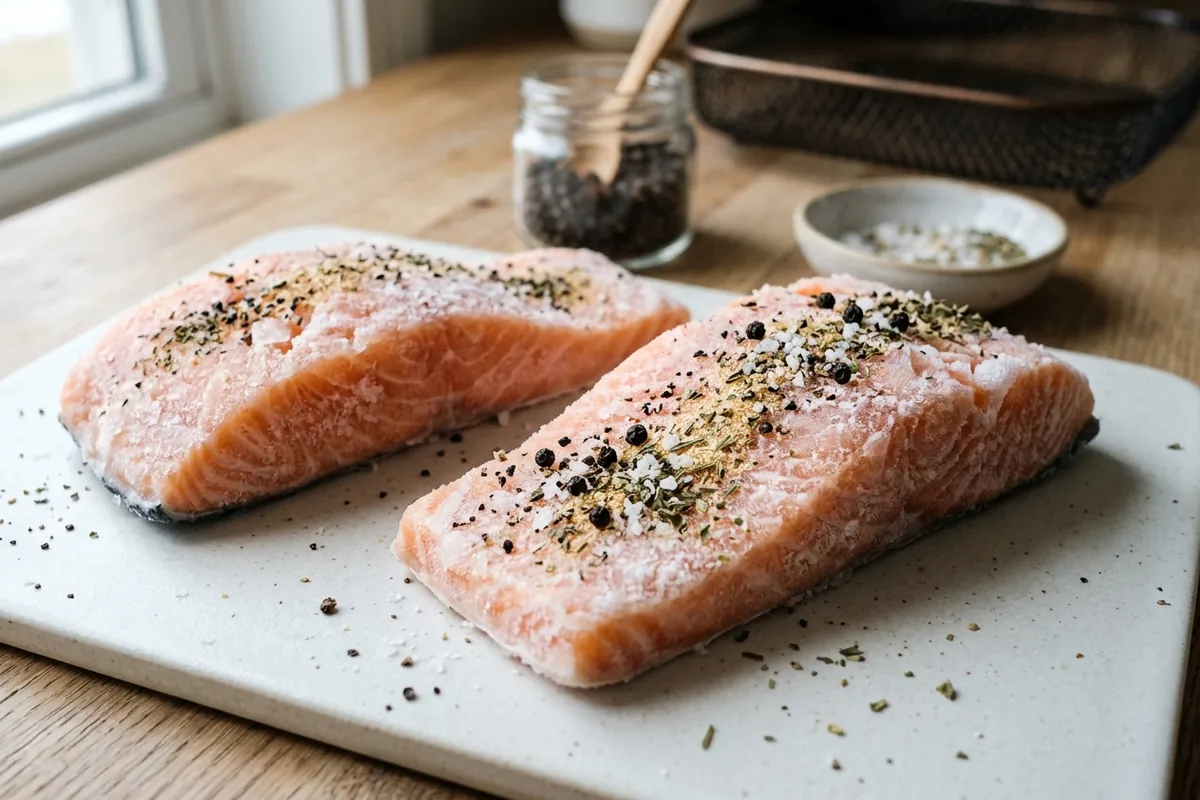
Because you season after the ice melts, you have a clean, slightly tacky surface that grabs whatever you put on it. Keep it simple and it sings: salt, black pepper, a squeeze of lemon, and a brush of olive oil is a complete plan. If you want more, this is where frozen salmon shines, because the post-thaw surface takes a glaze beautifully.
A maple-Dijon mix (equal parts maple syrup and Dijon mustard) brushed on at the start of stage two caramelizes into a sweet-savory crust. A teriyaki or eel-sauce glaze does the same with an umami lean. For a dry approach, a blackening blend or smoked paprika with garlic powder builds a peppery bark. Whatever you choose, apply it after stage one, never on the frozen fillet, because spices simply slide off ice and end up scorching in the basket instead of flavoring your dinner.
Go easy on sugary glazes if you are pushing the temperature to 400, since sugar burns. Brush a thin layer, and if you want it heavier, add a second coat in the final 2 minutes rather than loading it all on at once. That staged glazing gives you a glossy, caramelized top without a bitter, burnt edge.
If you are cooking for a crowd or want variety, you can season different fillets differently in the same batch, since the seasoning goes on individually after stage one. Brush one with maple-Dijon, dust another with a Cajun blend, and leave a third plain with just lemon and salt for the picky eater. They all finish at the same time on the same 145-degree target, so a single batch can feed several palates without any extra work. This flexibility is something a one-pan stovetop sear cannot match easily, and it is a quiet advantage of the staged air fryer method that does not get mentioned often.
Common mistakes and easy fixes
Most frozen-salmon failures trace back to one of four habits, and all four are simple to correct once you know them. Here is the quick reference I wish I had when I started.
| Problem | Cause | Fix |
|---|---|---|
| Bland fish | Seasoned while still iced, so it slid off | Season after stage one, on a blotted surface |
| Rubbery skin | Skin steamed in surface moisture | Blot dry, oil lightly, finish hot for 2 min |
| Dry, chalky center | Cooked past 145 F | Pull at 143 F, let it coast; use a probe |
| Cold middle | Skipped stage one or crowded the basket | Always melt ice first; leave space between fillets |
The thread running through all of these is patience in the first stage and precision at the finish. Melt the ice, then cook. Confirm temperature, then plate. If you internalize just those two beats, frozen salmon stops being a gamble and becomes one of the most reliable proteins you can pull from the freezer. It is faster and tidier than most frozen options, and unlike cooking frozen burgers, there is no flipping required at all.
What to serve with it and storing leftovers
Frozen salmon plays well with fast air-fryer sides so the whole meal stays in one appliance, more or less. Roast a tray of vegetables first, hold them warm, then run the salmon. Our method for crisping zucchini in the air fryer times out nicely alongside fish, and a quick rice or a green salad rounds the plate without any extra heat. For a heartier pairing, a network of recipes like the soups at Simmerstead gives you a warm starter while the salmon cooks.
Leftover cooked salmon keeps in an airtight container in the fridge for up to 3 days. Reheat it gently, because a hard reheat dries fish out fast. I use the air fryer at 300 degrees F for 3 to 4 minutes, just long enough to warm the center, and I add a splash of water or a pat of butter to the container first to keep it moist. Cold leftover salmon is also excellent flaked into a salad or grain bowl, no reheating needed.
Do not refreeze fish that you cooked from frozen. It was frozen once at the source and thawed during cooking, and a second freeze degrades the texture badly. Cook what you will eat within a few days, and pull only the fillets you need from the freezer for the next batch.
FAQ
Do I need to thaw salmon before air frying?
No. Frozen salmon cooks well straight from the freezer using a two-stage method: a few minutes to melt the surface ice, then a hotter finish to cook through. Cooking from frozen often gives firmer texture than slow-thawed fillets, which tend to weep liquid and soften.
What temperature should I cook frozen salmon at in the air fryer?
390 degrees F is the sweet spot. It is fast enough for a weeknight, hot enough to crisp the skin, and forgiving enough that a minute of overshoot will not ruin the fish. For a crisper finish, bump to 400 degrees F for the last 2 minutes.
How long does frozen salmon take in the air fryer?
A standard 1 to 1.25 inch fillet takes 12 to 14 minutes total at 390 degrees F, split as roughly 5 minutes to melt the ice and 7 to 9 minutes to cook. Thin fillets need about 9 to 10 minutes, thick center cuts up to 17.
How do I know when frozen salmon is done?
Use two signals. The thickest part should read 145 degrees F on an instant-read thermometer, and the flesh should flake when pressed with a fork. Pull it at 143 degrees F and let residual heat carry it to 145 so it does not overcook.
Why is my air fryer salmon bland?
You likely seasoned it while it was still frozen, so the spices slid off the ice glaze and stuck to the basket instead. Season after the first stage, once the surface has softened and you have blotted it dry. The seasoning will cling to the fish.
Can I cook two frozen salmon fillets at once?
Yes, as long as they fit in a single layer with space between them for air to circulate. Crowding causes uneven cooking, where one fillet finishes while the other stays cold in the middle. Add a minute or two to the total time for a double batch.
Bottom line
Frozen salmon in the air fryer is one of the most reliable freezer-to-plate meals you can make, and it comes down to two habits: melt the ice before you season, and finish by temperature, not by the clock. Run 390 degrees F in two stages, season on a blotted surface so flavor sticks, and pull the fish at 145 degrees F with a fork-flake confirmation. Do that and you get moist, flaky salmon with crisp skin in about 15 minutes, no thawing and no planning required. Keep an instant-read thermometer nearby, learn how your specific machine runs, and frozen salmon becomes a weeknight default rather than a gamble.