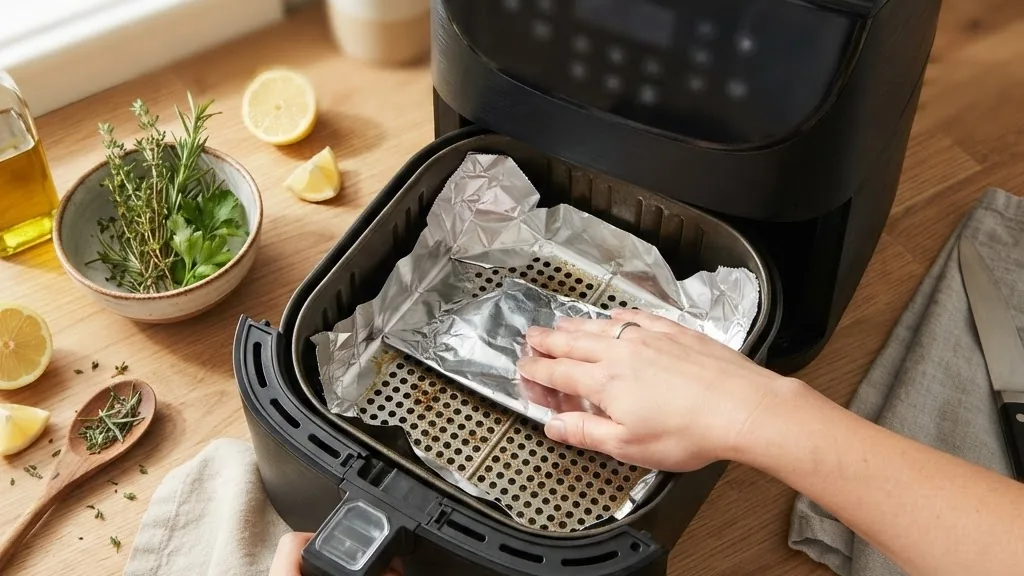
Can you put foil inside air fryer baskets and trays? Yes, in most machines, as long as you follow three rules that keep the foil weighted, clear of the heating element, and away from acidic food. The confusion comes from the microwave, where metal sparks. An air fryer cooks with hot moving air, not electromagnetic radiation, so a sheet of aluminum foil poses no arcing risk at all. The catch is not electrical. It is airflow, aluminum migration into your food, and the specific wording buried in your owner’s manual, which sometimes says no.
That manual matters more than any blog. Philips, for instance, discourages foil outright, while Frigidaire and Ninja allow it under conditions. Below you get the real numbers on how much aluminum ends up on your plate, the safety thresholds set by European and global health bodies, and a side by side comparison so you stop guessing. If you want the neighboring debate on liners, our breakdown of using parchment paper in an air fryer pairs directly with this one.
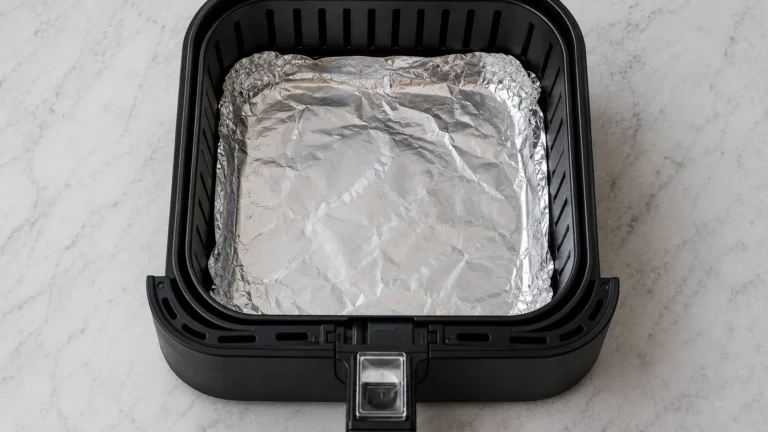
Quick answer: Yes, you can put foil inside an air fryer in the basket or on the drip tray of oven style models, provided you never let it touch the heating element, always weight it down with food so the fan cannot lift it, and keep it away from acidic or heavily salted dishes like tomato, citrus, and vinegar marinades. Never preheat an empty basket with loose foil inside. Check your specific manufacturer manual first, because a handful of brands, including Philips, advise against foil entirely for airflow reasons.
Why Foil Is Safe in an Air Fryer but Not a Microwave
Foil is safe in an air fryer because the appliance heats food with forced convection, not radiation. A heating coil warms the air, a fan drives it across the food at speed, and the metal foil simply sits there like any other pan. A microwave is different. It floods the cavity with electromagnetic waves, and thin metal edges concentrate the field until they spark. No such field exists in an air fryer, so the single most common fear about foil is based on the wrong appliance. This corrects the false premise that trips up most first time users.
What actually goes wrong is mechanical and chemical, not electrical.
- A loose sheet gets sucked up into the fan or against the coil, where it can scorch or block airflow.
- Foil laid across the basket floor covers the perforations, so hot air cannot circulate under the food and crisping suffers.
- Acidic or salty food pulls measurable aluminum out of the foil and into the meal.
The convection physics here is worth understanding on its own, and our explainer on the science behind air fryer convection cooking shows why blocking those bottom vents wrecks texture. Keep the foil weighted, keep the vents open, and the safety question mostly answers itself.
The Three Safety Rules That Actually Matter
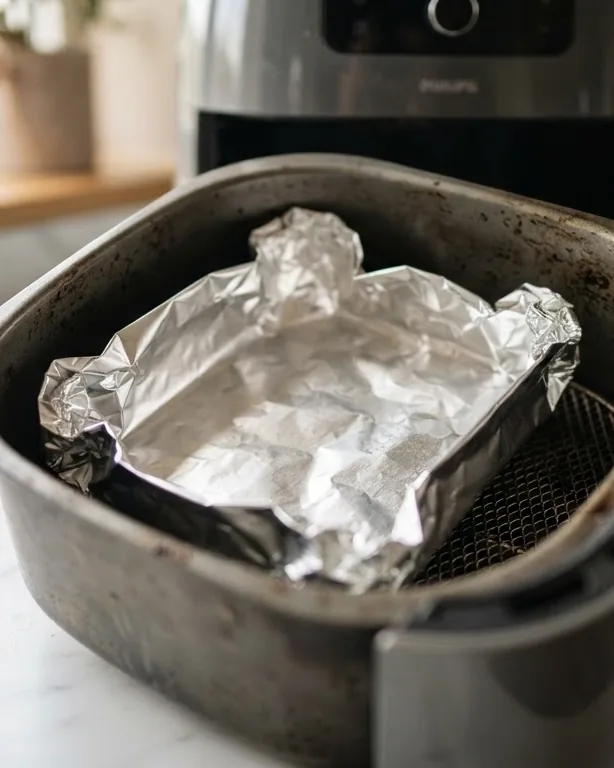
Three rules cover nearly every safe foil use in an air fryer. First, never let foil touch or sit near the heating element at the top of the chamber, because direct contact can scorch the metal and damage the coil. Second, always weight the foil down with the food itself so the fan cannot lift a loose edge into the blades. Third, avoid wrapping or lining acidic and heavily salted foods, since those conditions pull aluminum into the meal and leave a metallic taste. Follow these and foil behaves like any ordinary pan.
The order matters, so here is how they play out during a real cook.
- Clearance: In basket models, keep foil inside the basket and well below the coil. In oven style units, the coil sits at the very top, so the drip tray and lower racks are your safe zones.
- Weight: Press the food onto the foil before the machine starts. A bare, empty foil sheet is the classic cause of a jammed fan.
- Chemistry: Save foil for neutral foods. Lemon fish, tomato bakes, and vinegar marinades are exactly the wrong candidates.
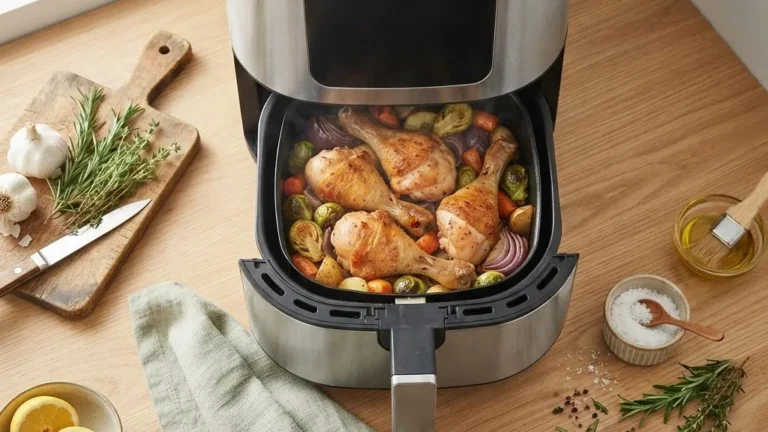
These rules are why reheating works so cleanly. When you are bringing leftovers back to life, as in our guide to reheating fried chicken in an air fryer without the rubber or the rot, a small weighted foil patch under a wing tip stops drips without ever floating free.
The Number One Mistake: Preheating an Empty Basket With Foil Inside
Preheating an empty air fryer with loose foil inside is the fastest way to send that sheet straight into the fan. During preheat, there is no food weighting the foil down, so the full force of the convection fan hits an unanchored piece of metal. It lifts, it flutters, and it can wrap around the blades or press against the heating coil. This applies to parchment paper too. Both materials are lightweight enough to travel, and both belong in the basket only once food is holding them in place.
The fix is simple and costs nothing.
- Preheat the machine empty, with no liner of any kind inside.
- Pull the basket, lay your foil, then set the food on top so it stays put.
- Return the loaded basket and start cooking.
If you skip preheating altogether, add the foil and food together before the fan ever spins. This single habit prevents the most reported foil failure. It also protects your machine’s motor, which is far more expensive to replace than a torn liner. For anyone building good routines from scratch, pairing this with regular maintenance in our walkthrough on how to clean an air fryer the right way keeps grease off the coil, which is the other thing that scorches during preheat.
How Much Aluminum Actually Ends Up in Your Food
Aluminum does migrate from foil into food, and the amount depends heavily on acidity, salt, fat, temperature, and contact time. This is the part almost no one quantifies, so here are the measured figures. A 2020 study published in the International Journal of Environmental Research and Public Health found that meat and fish cooked in foil parcels in an oven at 220 degrees Celsius for 40 minutes leached up to 42 mg of aluminum per kilogram in fish, 40 mg per kilogram in chicken, and 40 mg per kilogram in beef. Seasoning raised the leaching further. Acidity does the same, and dramatically.
The Bassioni study in the International Journal of Electrochemical Science measured the acid effect directly. Ground meat cooked with tomato juice or citric acid transferred roughly 75 to 132 mg of aluminum per person into the liquid phase depending on pH. Tomato sauce came in at 2.7 to 4.9 mg of aluminum per 100 grams, and red cabbage with lemon at a pH of 2.6 hit 5.1 mg per 100 grams.
Now the safety context. The European Food Safety Authority set a Tolerable Weekly Intake for dietary aluminum in 2008 at 1 mg per kilogram of body weight per week. The Joint FAO/WHO Expert Committee on Food Additives, the body that carries the World Health Organization position, set a Provisional Tolerable Weekly Intake in 2011 to 2012 at 2 mg per kilogram of body weight per week, replacing the older 1 mg figure. For a 70 kg adult, the WHO threshold works out to about 140 mg per week.
Average dietary exposure across the European Union runs 0.2 to 1.5 mg per kilogram of body weight per week, rising to 2.3 for toddlers, and the EFSA notes that part of the population already exceeds the Tolerable Weekly Intake before you add any foil at all. The World Health Organization has assessed aluminum in food through the same expert committee. That baseline is the real reason to keep foil away from acidic dishes rather than a reason to panic about a neutral piece of fish.
Two other factors push migration up: thicker foil transfers more aluminum than thin, and longer contact at higher heat compounds the effect. So a quick, neutral cook on standard foil sits at the low end of every one of these ranges.
Manufacturer Rules: They Do Not Agree
Manufacturer guidance on foil is genuinely split, which is why the internet cannot settle the question. Your owner’s manual always outranks any general advice, because the person who designed the airflow path knows where a stray sheet will travel. Philips discourages foil in its air fryers, citing airflow disruption. Frigidaire permits it as long as you line the basket and not the solid bottom. Ninja allows foil in the basket or tray provided it never sits on the floor of the unit, and permits it on the oven tray when firmly pressed flat. Cosori steers users toward parchment liners instead.
The pattern is easier to hold as a list.
- Philips: advises against foil, prioritizing unobstructed convection.
- Frigidaire: foil acceptable if you line the basket, never the base.
- Ninja: foil fine in basket or tray, never the floor, pressed flat on oven trays.
- Cosori: prefers parchment liners over foil.
- Instant: follow the model specific manual, which prevails for any given unit.
Basket style and oven style machines change where the foil belongs. In a basket unit, foil lives inside the basket alone. In an oven style unit, the drip pan below the food is an extra safe spot that basket owners do not have. If your manual is lost, err toward the stricter reading and keep foil off any solid surface that blocks the perforations.
Foil vs Parchment vs Silicone Liners
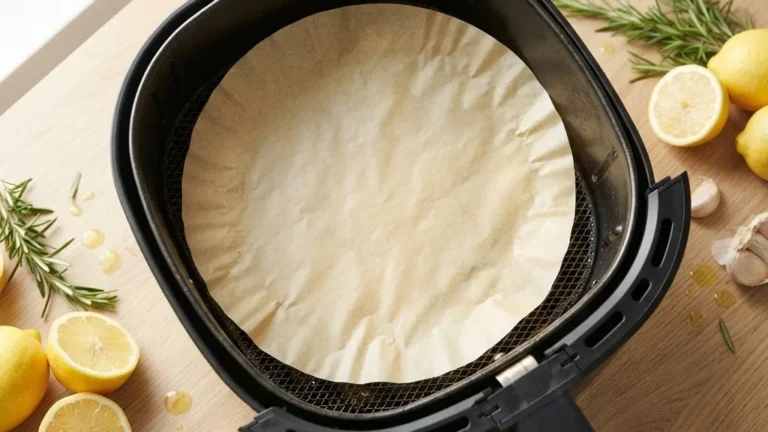
Foil, parchment, and silicone liners each solve a different problem, and picking the wrong one is why food comes out soggy or a liner scorches. Foil excels at drip control and shaping a sling for delicate items, but it can block bottom airflow and reacts with acid. Parchment paper handles heat well, typically rated to 425 degrees Fahrenheit, or 218 degrees Celsius, with some products reaching 446 to 465 degrees Fahrenheit, and it never leaches metal. Perforated silicone and parchment liners preserve airflow best, which protects crisping. Match the tool to the dish and the texture problem disappears.
Here is how the three stack up on the traits that decide a cook.
| Trait | Foil | Parchment | Silicone liner |
|---|---|---|---|
| Crisping | Reduced if floor covered | Good if perforated | Best when perforated |
| Drip control | Excellent | Good | Good |
| Acid safety | Poor | Excellent | Excellent |
| Heat limit | High | 218 C typical | Reusable, high |
One material to strike off entirely: wax paper. It is not heat resistant, it melts, it smokes, and it can catch fire, so it never belongs in an air fryer at any temperature. For foods that must crisp from below, such as breaded cutlets and fries, skip solid liners and cook directly on the perforated basket. That is the same logic behind our timing notes for frozen hash brown patties in an air fryer, where an open basket is what delivers the crunch.
When Foil Genuinely Helps and When to Skip It
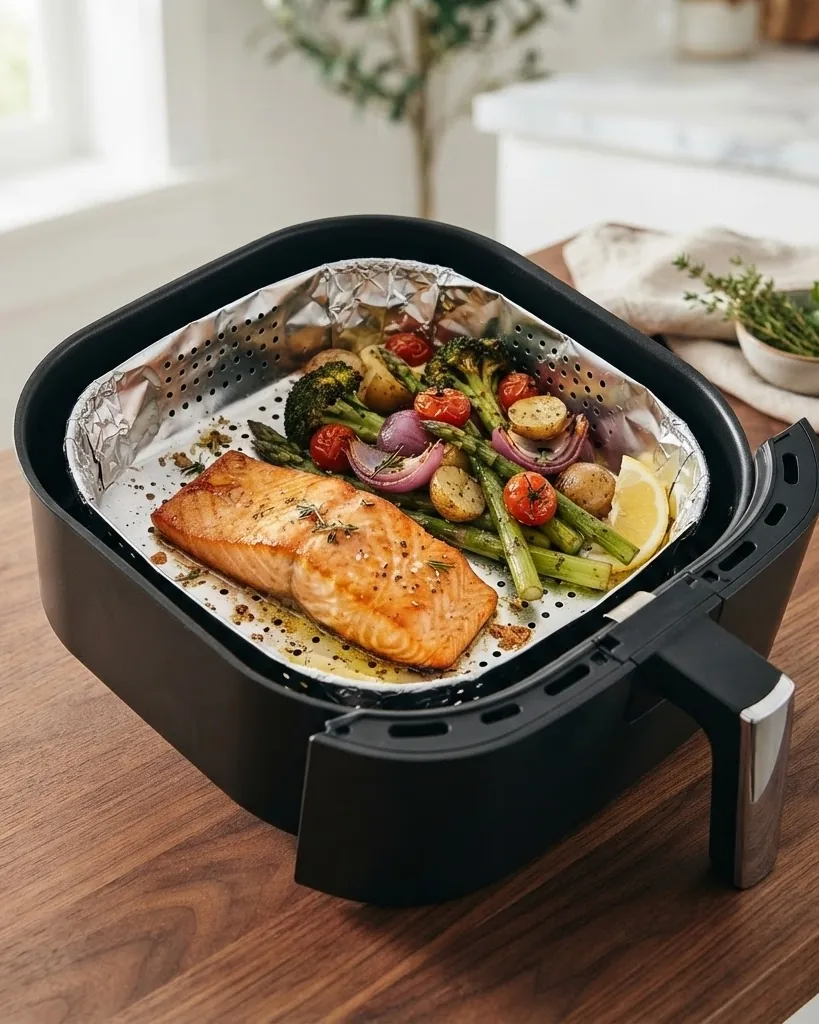
Foil earns its place with delicate and messy foods, not with anything you want crisp on the bottom. A foil sling lifts flaky fish or a soft vegetable bake out of the basket in one piece without it falling through the perforations. Foil under a dripping marinated cut keeps sugar and fat off the basket floor, which saves scrubbing later. On oven style machines, a foil lined drip tray catches grease from a whole batch. Those are the wins. The losses come whenever crisp bottom texture is the goal.
Use foil for these jobs:
- A sling for delicate fish, egg bakes, and soft vegetables that would otherwise slip through.
- Batch cooking where a lined drip tray catches rendered fat.
- Reheating saucy leftovers that would drip and burn onto the coil.
Skip foil for these:
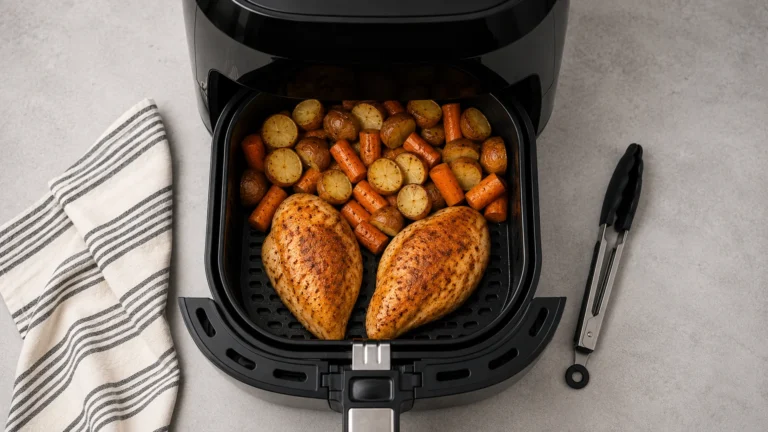
- Breaded chicken, fries, and anything that needs to crisp from below.
- Acidic dishes such as lemon fish, tomato bakes, and vinegar wings.
- Any cook where you plan to preheat with the liner already inside.
Getting the airflow right is the whole game with crisp foods, which is why our guide on air fryer tortilla chips and the habits that keep them crisp puts an open basket first. For anyone still weighing whether these machines are worth the fuss at all, our honest safety rundown on air fryers covers the broader picture beyond liners.
Recipe Context: What Foil Choice Means at the Plate
Foil decisions read differently once you tie them to real dishes rather than abstract rules. A cheesy dip that you want bubbling and set benefits from a foil sling, because you lift the whole ramekin cleanly and never fight the perforations. A crunchy protein wants the opposite: bare basket, full airflow, no liner blocking the bottom. Matching the liner to the dish is the difference between a golden crust and a steamed disappointment, and it is where most home cooks lose texture without knowing why.
Take a saucy shared starter like this air fryer hot crab dip. It sits in a dish, it never needs bottom crisping, and a foil sling makes retrieval painless. Contrast that with crispy air fryer fried chicken, where any foil under the pieces would trap steam and soften the coating you worked to build.
The same split shows up across cuisines. Delicate noodle and broth dishes plated after cooking, like a vegan pho noodle soup, never touch foil at all, while a garlicky pan such as lemon asparagus pasta reminds you that citrus and foil are a poor match thanks to that acid driven leaching.
If you want more no liner air fryer ideas, the roundup of vegan air fryer recipes leans on bare baskets for crunch, the high protein recipes collection shows where drip control actually earns a foil tray, and for the geekier side of heat and extraction, the coffee science notes scratch the same convection itch.
Temperature, Timing, and Foil Together
Temperature and contact time drive both crisping and aluminum migration, so foil and heat settings have to be planned as a pair. Every measured leaching figure rose with hotter cooks and longer contact, which means a fast, moderate cook on neutral food is the safest and tastiest use of foil. Longer, hotter cooks belong on a bare basket or parchment when texture allows. This keeps you at the low end of the migration ranges and off the heavily salted, acidic conditions that push aluminum transfer up.
A few practical anchors:
- Parchment tolerates 218 degrees Celsius routinely, so for hotter or longer cooks it is often the safer liner than foil.
- The 220 degree Celsius, 40 minute oven study is a worst case reminder: long and hot maximizes migration.
- Neutral, quick foil cooks stay far below the 42 mg per kilogram top of that range.
Timing also decides whether a foil sling helps or hurts. For dense items that need a long, even bake, foil under them can slow browning, so pull the food onto a bare basket for the final minutes. Our reference on air fryer baked potato timing by size and temperature shows how that finishing move restores skin crispness after a foil wrapped start.
Frequently Asked Questions
Is parchment paper better than foil in an air fryer?
For most cooks, yes. Parchment tolerates roughly 218 degrees Celsius, never leaches metal, and reacts with nothing, so acidic dishes are safe on it. Foil still wins for slings and drip control on greasy batches. Choose parchment for acidic or long cooks, foil for lifting delicate food or catching rendered fat on an oven tray.
Can I use wax paper instead of foil?
No, never. Wax paper is not heat resistant. Inside an air fryer it melts, smokes, and can catch fire, unlike parchment which is rated for high heat. If you want a paper liner, reach only for parchment. Foil and perforated silicone liners are the other safe options, but wax paper has no place in the appliance.
Should I poke holes in the foil?
Perforating foil helps hot air reach the underside of your food, which improves crisping and lets grease drain. If you are using foil mainly to catch drips or lift a delicate item, solid foil is fine. For anything you want crisp from below, punch several holes or, better yet, switch to a perforated liner or a bare basket.
What temperature is safe for foil in an air fryer?
Foil itself withstands normal air fryer temperatures without issue since aluminum melts far above cooking range. The real limits are aluminum migration, which climbs with heat and time, and airflow. Keep hot, long cooks on neutral food, avoid acidic dishes at any temperature, and remember parchment tops out near 218 degrees Celsius while foil does not.
Can foil damage my air fryer?
Yes, if used carelessly. Loose foil during an empty preheat can be lifted by the fan into the blades or against the heating coil, which risks scorching and motor strain. Foil covering the basket floor blocks perforations and causes uneven cooking. Weight it with food, keep it clear of the coil, and never preheat empty with foil inside.
The Bottom Line
Foil works in most air fryers when you respect three things: keep it off the heating element, weight it down with food, and keep it away from acidic or salty dishes where aluminum migration climbs toward those measured 42 mg per kilogram highs. The microwave fear does not apply, since convection has no arcing field. Your manual is the final word, because Philips, Ninja, Cosori, and Frigidaire genuinely disagree. Use foil for slings and drip control, reach for parchment on acidic or long cooks, and never use wax paper at all.