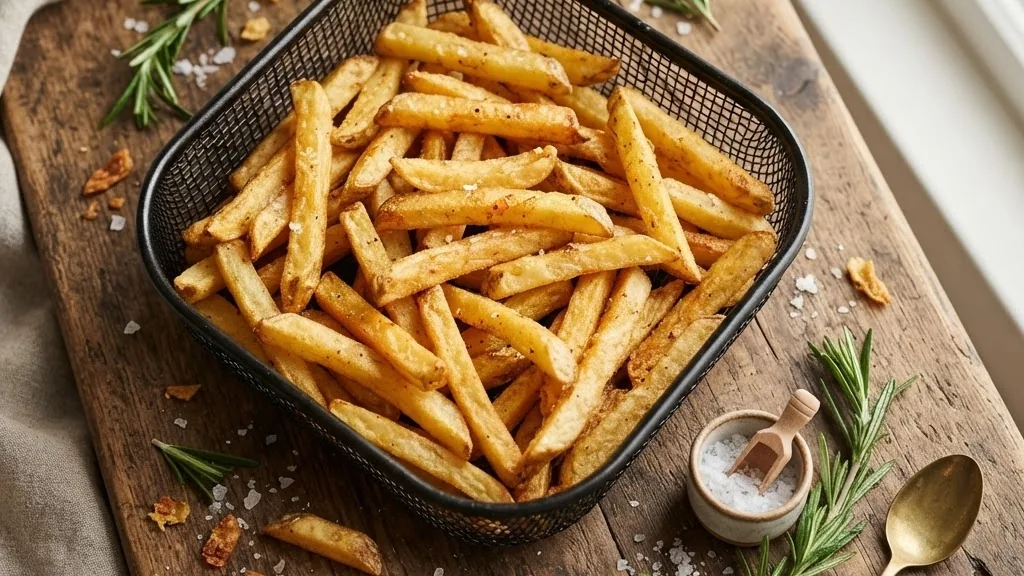
Homemade fries in air fryer form come out crisp only when three variables line up: the cut, the soak, and the heat. Miss one and you get pale, bendy sticks that steam instead of crisp. This guide locks all three down with exact numbers, then goes where most recipes stop, into the food-safety science, the troubleshooting nobody explains, and the frozen-bag shortcut. You will learn why a russet beats a red potato, why 20 to 30 minutes in cold water matters, and why the U.S. Food and Drug Administration cares whether your fries land golden or brown.
Quick answer: To make homemade fries in air fryer form, cut peeled or unpeeled russets into sticks 1/4 inch thick, 1/2 inch wide, and 4 to 6 inches long. Soak them 20 to 30 minutes in cold water, then pat bone dry. Toss with 1 to 2 tablespoons of neutral oil and salt. Cook at 375 to 400F for 15 to 20 minutes total in a single layer, shaking once at the halfway mark. Pull them at golden yellow, never dark brown.
Pick the Right Potato Before You Touch a Knife
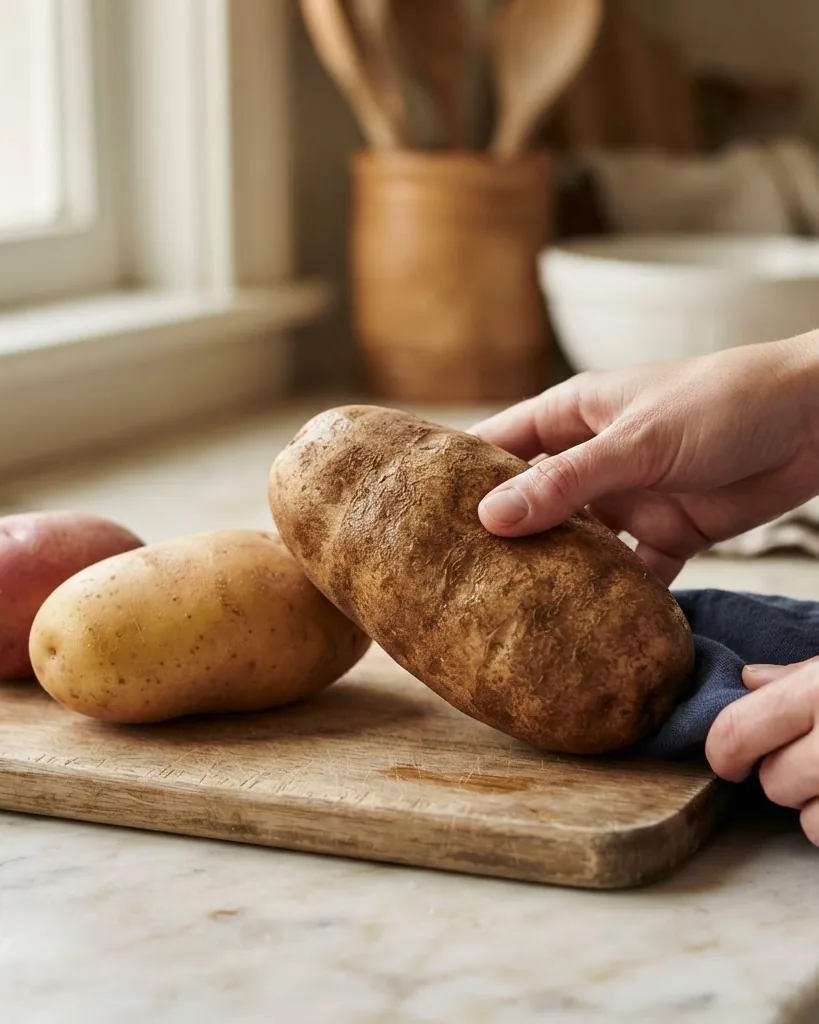
The right potato decides whether homemade fries in air fryer form crisp or collapse. Russet and Idaho potatoes lead because they carry high starch and low moisture, and that combination is exactly what a convection basket needs to drive off water and build a shell. Yukon Gold works when you want a creamier, denser interior, trading a little crunch for a buttery middle. Waxy and red potatoes hold too much water and too little starch, so they turn leathery instead of crisp. Peeling is optional. Leaving the skin on adds fiber and a rustic edge; peeling gives you the classic diner look.
Starch content is the whole story here. A high-starch potato releases surface starch during soaking and firms up its cell walls under heat.
- Russet / Idaho: default choice, driest flesh, best crunch.
- Yukon Gold: creamier center, slightly less crisp exterior.
- Waxy / red: avoid; too much moisture, gummy result.
If you understand the airflow that does the crisping, the potato choice makes even more sense. The mechanics are covered in depth in The Real Science Behind Air Fryer Convection Cooking, which explains why moving hot air behaves so differently from the still heat of an oven.
Cut Geometry: The Numbers That Decide Everything
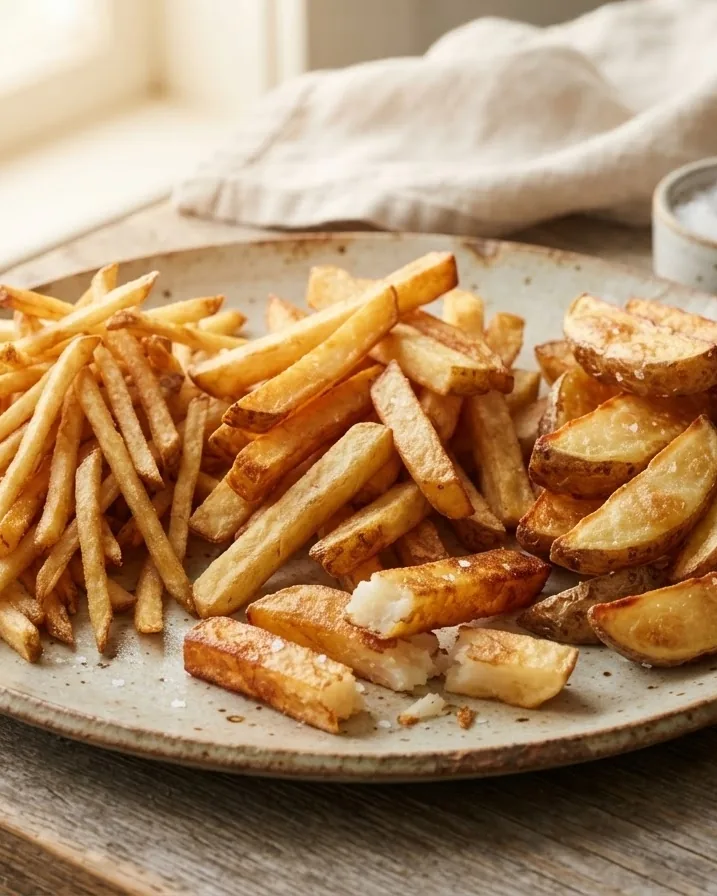
Uniform cuts are the single biggest lever for even cooking. When some fries are twice as thick as their neighbors, the thin ones scorch while the fat ones stay raw in the middle. The dimension spec that works across nearly every basket is 1/4 inch thick, 1/2 inch wide, and 4 to 6 inches long. Hold the width and thickness tight; length can flex to fit your potato. A cheap mandoline or a steady hand with a chef knife both work, as long as you keep the cross-section consistent. Consistency beats speed here, because ten seconds saved on sloppy cuts costs you an unevenly cooked batch.
Think of thickness as a dial for the crisp-to-fluff ratio.
- Thinner than 1/4 inch: crispier, but dries out fast and burns easily.
- 1/4 inch: the sweet spot, crisp shell with a real potato interior.
- Thicker than 1/2 inch: steakhouse wedge territory, needs more time.
Sort your cut fries into rough size groups before cooking. A basket of matched sticks finishes together, which means one shake and one pull, no picking out the burnt ones. That small habit is what separates a good batch from a frustrating one.
Soak, Dry, and Oil: Where Sog Is Won or Lost
Soaking is the crisp driver most home cooks skip, and it is where soggy fries are prevented before heat ever enters the picture. Submerge your cut potatoes in cold water for 20 to 30 minutes. This pulls surface starch off the exterior, and that starch is the sticky layer that otherwise gums fries together and blocks browning. After the soak, the drying step is non-negotiable. Any water clinging to the surface flashes to steam inside the basket, and steam is the enemy of crunch. Pat every stick completely dry with towels before a drop of oil touches them.
Oil comes last and stays minimal. Use 1 to 2 tablespoons for roughly two to three potatoes worth of fries, and reach for a high-smoke-point neutral oil so it can handle the heat without turning acrid.
- Soak: 20 to 30 minutes, cold water, removes surface starch.
- Dry: pat bone dry; trapped water equals steam equals soggy.
- Oil: 1 to 2 tablespoons per two to three potatoes, neutral oil.
Salt the base seasoning before cooking, but hold wet or delicate seasonings until after the cook so they cling instead of scorch. For heavier, high-protein plates that pair well with a fry side, the ideas at high-protein recipes give you a full dinner around them. Vegetable and plant-based cooks will find matching sides in this collection of vegan air fryer recipes.
Temperature, Time, and the Single-Layer Rule
Heat and airflow finish what the prep started, and the baseline is forgiving once your fries are dry. Cook at 375 to 400F for 15 to 20 minutes total, shaking or tossing the basket once at the halfway point. That mid-cook shake redistributes the fries so every side faces the moving air, which is what convection cooking depends on. The rule that most often gets broken is single-layer loading. Pile fries two or three deep and the ones underneath steam in trapped moisture while the top layer crisps, giving you a batch that is half great and half limp. Cook in batches instead, and keep finished fries warm in a low oven.
Preheating for a few minutes gives the fries an even start and a faster jump into browning, though it is not strictly required. Your basket capacity, not the clock, sets your batch size.
- Temperature: 375 to 400F across the cook.
- Total time: 15 to 20 minutes, one shake halfway.
- Load: single layer only; batch the rest.
The doneness cue is golden yellow with crisp edges. That color is not only your quality target, it is also your safety target, which is where the next section earns its keep. Once you nail fries, the same airflow logic scales to mains like this Crispy Air Fryer Teriyaki Chicken.
Are Air Fryer Fries Actually Healthier? The Real Science
Air frying is meaningfully healthier than deep frying, and the difference is measurable rather than marketing. Deep-fried fries carry around 40 percent oil content, while air frying uses only a fraction of that, according to research published in Frontiers in Nutrition. The bigger story is acrylamide, a compound that forms in starchy foods heated above roughly 120C, or 248F, through the Maillard reaction between the amino acid asparagine and reducing sugars. The International Agency for Research on Cancer classifies acrylamide as Group 2A, probably carcinogenic to humans. That single classification is why home technique, not just gadget choice, matters for every batch you make.
Here the numbers get concrete. A controlled French-fry study in Frontiers in Nutrition (2022) found air frying cut acrylamide by up to about 47 percent, and hydroxymethylfurfural by up to about 57 percent, versus a deep-fry baseline of 180C for 6 minutes.
- Deep-fried fry oil content sits near 40 percent by the Frontiers analysis.
- Air frying reduced acrylamide by up to roughly 47 percent in the 2022 study.
- The European Union sets an acrylamide benchmark of 500 micrograms per kilogram for ready-to-eat French fries under Regulation (EU) 2017/2158.
The reductions are real but conditional. A separate line of work, including Sansano et al. (2015), reports up to roughly 90 percent acrylamide reduction for some air-fried potato products, while French fries specifically show closer to 30 to 40 percent, because the exact figure swings hard with temperature and time. Crucially, the Frontiers 2022 data showed acrylamide and HMF rising steadily as air-fry temperature climbed from 180 to 200C and time stretched from 12 to 24 minutes. The practical lesson is blunt: do not chase color past golden. The U.S. Food and Drug Administration lays out the same mitigation logic, including soaking and lower temperatures, in its guidance on acrylamide in foods. Every input in that guide has an exact FDA source.
The golden-not-brown rule, in numbers
The National Institute of Environmental Health Sciences advises frying at or below 170C, which is 338F, to limit acrylamide, and both the FDA and the UK Food Standards Agency push the same doneness message: cook to golden yellow, not brown. One illustrative measurement set, from Giovanelli et al., recorded 91 micrograms per kilogram in air-fried potatoes against 126 in deep-fried and 182 in an acti-fryer, though absolute values shift with potato, soak, and heat.
Simple home mitigations that stack
The FDA and NIEHS converge on the same short checklist, and each step compounds the next. Soak raw slices 15 to 30 minutes in water and pat dry, cook to golden yellow rather than brown, and keep temperatures moderate. The U.S. Department of Agriculture provides the potato-composition context behind these figures. None of it requires special equipment, only attention to color and a timer you actually watch.
Why Are My Fries Soggy, Uneven, or Stuck? Fixes
Most fry failures trace back to one of four causes, and each has a direct fix. Soggy fries almost always mean trapped moisture, from skipping the dry step or overcrowding the basket into a steam trap. Uneven fries come from inconsistent cuts or a load piled deeper than one layer. Sticking usually means too little oil or a fry pulled before its shell set, so it clings to the metal. Burning points to heat that is too high for your particular unit, or fries left in past golden. Diagnose by symptom, correct the one variable, and the next batch reflects the change immediately.
Run through the checklist in order, because the causes stack.
- Soggy: dry the fries harder, load a single layer, batch the rest.
- Uneven: match cut dimensions, sort by size before cooking.
- Sticking: add a light oil toss, let the shell set before shaking.
- Burnt: drop the temperature toward 375F, pull at golden yellow.
Basket versus oven-style air fryers run differently
Not every machine reads its own dial honestly. Compact basket units often run hotter and crisp faster, while larger oven-style air fryers can run cooler and need a few extra minutes. Run a test batch to see how your particular unit behaves: if fries brown quickly, dial the heat back for the next round; if they stay pale, hold steady and give them more time. One test batch teaches you your machine.
Frozen Fries and Reheating: The Two Shortcuts
Frozen bagged fries are the fastest path to crisp because the manufacturer already handled the cut, blanch, and often a par-fry. Skip the soak entirely; the surface starch was managed at the factory, and adding water only reintroduces the moisture you are trying to avoid. Pour them straight into the basket in a single layer, no thawing, and cook in the same 375 to 400F range, shaking once. Reheating yesterday’s fries follows the same anti-moisture logic. A quick blast at 400F for about 2 to 3 minutes drives off the water that softened them overnight and rebuilds the crisp shell far better than a microwave ever will.
Two rules keep both shortcuts reliable.
- Frozen: no soak, no thaw, straight in, single layer, 375 to 400F.
- Reheat: about 2 to 3 minutes at 400F to re-crisp leftovers.
The same reheat trick rescues plenty of other basket foods. It is exactly how you revive a Frozen Burrito in the Air Fryer, Crispy Shell and Molten Center without a soggy tortilla. If you want to build a whole snack spread around your fries, a batch of Air Fryer Chili Crisp Shrimp shares the basket beautifully and needs the same single-layer discipline.
Seasonings, Dips, and Variations Worth Making
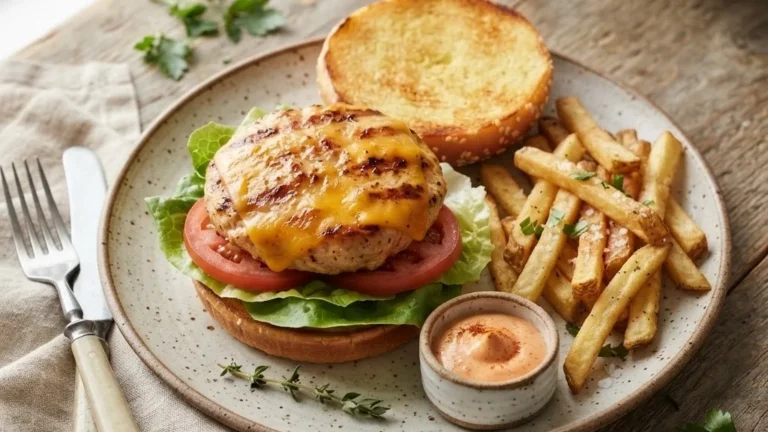
Seasoning timing matters as much as the blend itself. Salt goes on before or right after cooking, but wet and sugary seasonings belong at the end, tossed on hot fries so they cling without burning in the basket. From that base you can build garlic parmesan, cajun, or fully loaded fries with cheese and toppings. Sweet potato fries follow the same soak-dry-single-layer logic, though they brown faster because of their sugar, so watch them closer. The point is that the technique is a platform, and once the crisp is reliable, the flavor directions are wide open.
Dips turn a side into the main event. A few pairings punch above their effort.
- Garlic parmesan: toss hot fries with grated cheese and garlic.
- Cajun: dry spice blend added before the cook for even coverage.
- Loaded: cheese and toppings melted in a final short blast.
For a homemade dip that beats anything bottled, the walkthrough for Homemade Teriyaki Sauce: The Real Technique, Not Just a Bottle gives you a glossy, savory option, and a bright Homemade Green Enchilada Sauce adds a tangy heat that cuts through the salt. Curiously, the same Maillard chemistry that browns your fries is what develops flavor in a dark roast, a process broken down in this look at coffee science. If you want a crunchy snack to round out the table, the Crunchy Masala Seed Crackers use the same basket and the same golden-not-brown restraint.
Frequently Asked Questions
Do I really need to soak the potatoes?
Yes, if you want genuine crunch. Soaking cut potatoes 20 to 30 minutes in cold water strips surface starch, the sticky layer that gums fries together and blocks browning. The FDA also lists soaking, 15 to 30 minutes, as an acrylamide-reduction step. Frozen bagged fries are the exception; their starch was handled at the factory, so you skip the soak and cook them straight from the freezer.
What temperature makes the crispiest fries?
Aim for 375 to 400F for 15 to 20 minutes, shaking once halfway. Within that band, a hotter setting crisps faster but risks browning past golden. Since NIEHS advises frying at or below 170C, which is 338F, to limit acrylamide, lean toward the lower end and stop at golden yellow. Your machine matters too, since basket units often run hotter than oven-style models.
Why are my air fryer fries soggy?
Soggy fries almost always come from trapped moisture. The two usual culprits are skipping the drying step after soaking and overcrowding the basket beyond a single layer. Water on the surface or between piled fries turns to steam, and steam softens the shell you are trying to build. Pat every stick bone dry, load one layer, and cook the rest in batches for consistent crunch.
Are air fryer fries healthier than deep-fried?
Measurably, yes. Deep-fried fries carry around 40 percent oil content, while air frying uses a fraction of that, per Frontiers in Nutrition. A 2022 controlled study found air frying cut acrylamide by up to about 47 percent versus a deep-fry baseline. The catch is technique: acrylamide climbs with temperature and time, so cooking to golden rather than brown keeps the advantage intact.
Can I reheat leftover fries in the air fryer?
Yes, and it is the best method available. About 2 to 3 minutes at 400F drives off the moisture that softened the fries overnight and rebuilds a crisp exterior, something a microwave cannot do because it steams rather than dries. Spread them in a single layer, shake once, and pull them when the edges tighten back up.
What potato should I use for fries?
Russet or Idaho potatoes are the default because their high starch and low moisture crisp best. Yukon Gold gives a creamier interior if you prefer a denser bite, trading a little crunch. Avoid waxy and red potatoes, which hold too much water and turn gummy. Peeling is a matter of taste; skin-on adds fiber and a rustic look, while peeled gives the classic diner style.
The Bottom Line on Basket Fries
Great fries are not luck. They are the sum of a starchy potato, a uniform 1/4-inch cut, a 20 to 30 minute soak, a truly dry surface, a single layer, and 375 to 400F heat pulled at golden yellow. Get those in order and the crunch is repeatable every time. The same restraint that makes fries crisp also keeps them safer, since the golden-not-brown rule limits acrylamide the FDA, NIEHS, and IARC all flag. Master the fresh batch, and frozen bags plus next-day reheats become effortless. For a plated pairing, this crispy Air Fryer Chicken Katsu Bowl makes fries feel like a full meal.