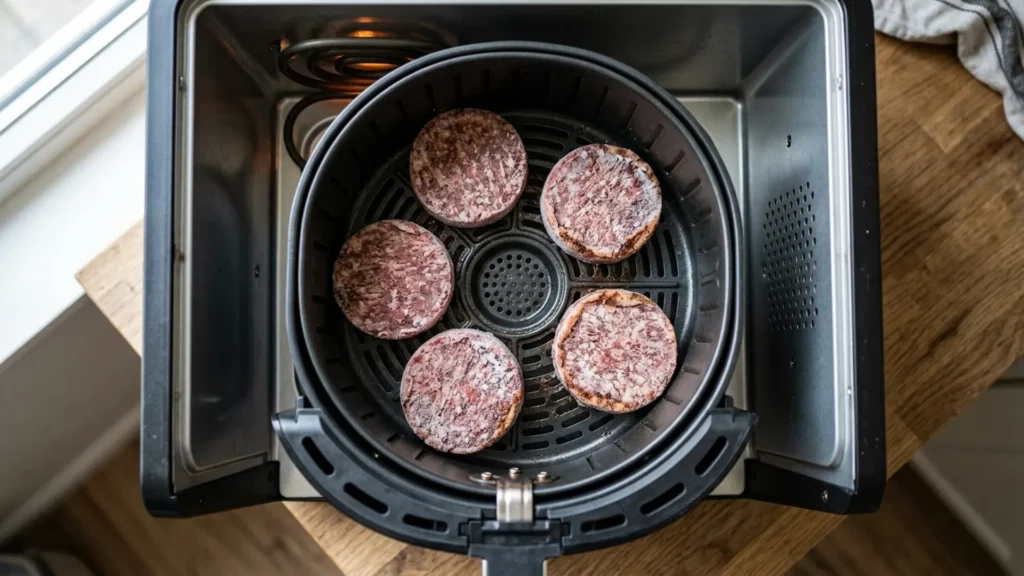
Frozen burgers in air fryer baskets go from rock-solid to dinner-ready in well under 20 minutes, with no thawing, no grease splatter, and no babysitting a skillet. The convection fan circles hot air around the patty so it thaws and browns at the same time, which means you can cook straight from the freezer without that watery, gray result you get from a microwave defrost. The catch is that patty thickness, fat content, and your machine’s true temperature all move the time, so a single number on a bag will leave some people with raw centers and others with hockey pucks. This guide gives you the times by patty size, the food-safe finish temperature, and every fix for the problems that come up.
I am Cole, and I cook these the practical way: an instant-read thermometer in the center, a single layer in the basket, and a flip at the halfway mark. What follows is the method that has worked across thin quarter-pound patties and thick third-pound ones, plus turkey and plant-based versions. No guesswork, just the temperatures and timing that land a juicy burger every time.
Why the Air Fryer Beats the Skillet for Frozen Patties
A frozen patty dropped in a hot skillet sears the outside long before the icy middle warms, so you either burn the crust or pull it raw. The air fryer solves that because hot air hits every surface at once and thaws the patty evenly from all sides while it browns. There is no pool of fat to manage, the rendered grease drips into the drawer instead of spattering your stovetop, and cleanup is one basket instead of a greasy pan and backsplash.
You also get hands-off cooking. Set the time, flip once, and walk away to toast buns or slice tomatoes. The result is closer to a flat-top burger than a grilled one, with a flat, even crust rather than grill marks, and most people cannot tell the difference once it is dressed. For a side that cooks in the same machine while you rest the meat, a batch of french fries in the air fryer rounds out the plate without dirtying another dish.
Frozen Burgers in Air Fryer: Time and Temperature by Thickness
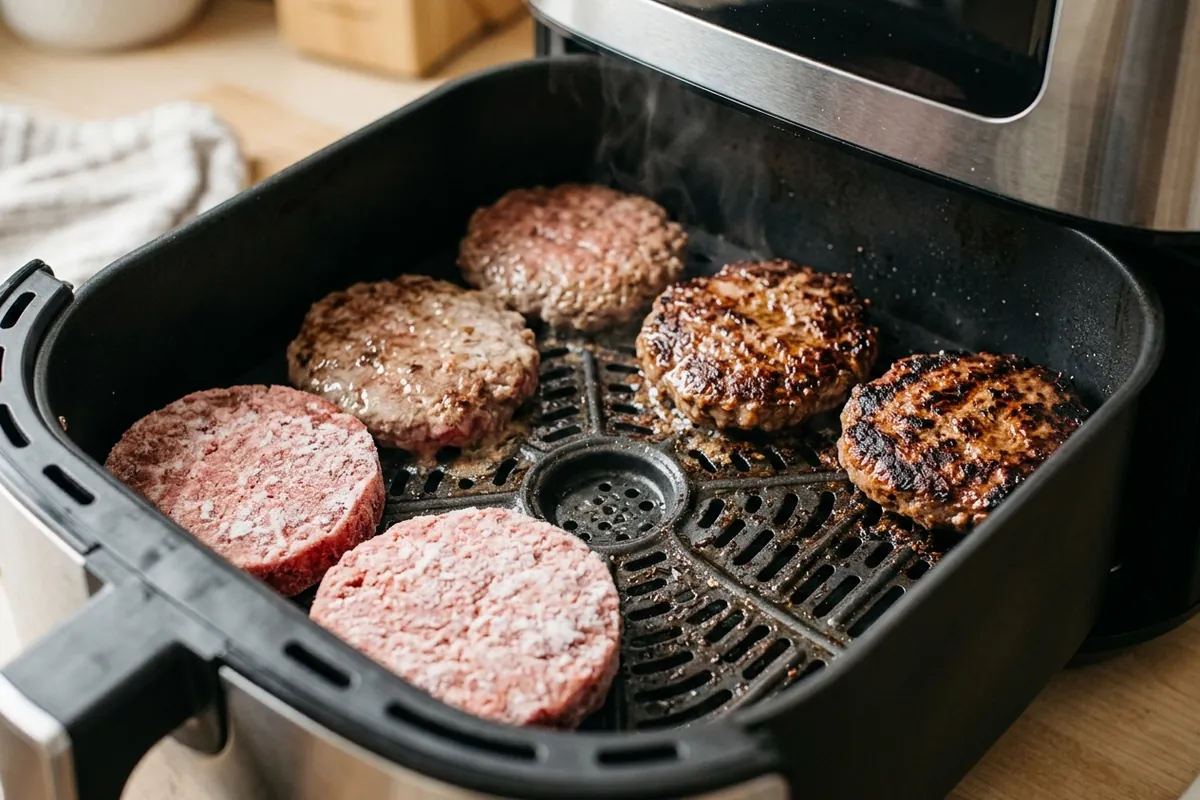
Set the air fryer to 360 degrees F and cook in a single layer with space between patties. Thickness is what changes the clock. Thin quarter-pound patties, roughly a half inch thick, run 8 to 12 minutes total. Standard third-pound patties, closer to three quarters of an inch, run 12 to 16 minutes. Thick half-pound steakhouse patties need 16 to 20 minutes. In every case, flip once at the halfway point so both faces brown and the center heats evenly.
You will see recipes that skip the flip at higher temperatures like 390 degrees F for 8 to 12 minutes. That works for thin patties in a hot compact basket, but on thicker patties it browns the outside before the middle is safe. I stick with 360 and a flip because it is forgiving across patty sizes and machine wattages. A 1700-watt basket runs faster than an 800-watt compact, so treat these as starting points and confirm with a thermometer rather than the timer.
Do not preheat for thick frozen patties. A cold start gives the icy center a head start to thaw while the air comes up to temperature. For thin patties, a brief preheat is fine and speeds the crust. Either way, the thermometer is the final word, not the clock.
The Food-Safe Finish Temperature That Matters Most
Ground beef is not a steak, and this is the one rule you cannot bend. Because grinding spreads any surface bacteria throughout the patty, the only safe target for ground beef is 160 degrees F in the center, measured with an instant-read thermometer pushed into the thickest part. The medium-rare 130 degree finish that is fine for a whole steak is not safe for a ground patty, frozen or fresh. The USDA guidance on ground beef confirms the 160 degree mark, and it is not a number worth rounding down on.
This is exactly where frozen patties trip people up. The outside can look perfectly browned while the middle is still well under temperature, especially on thick patties. Check the center, not the edge. If it reads under 160, give it 2 more minutes and check again; air fryers vary enough that the same patty can need a few extra minutes in a cooler machine. The America’s Test Kitchen guidance on ground beef safety lands on the same 160 degree mark, and a cheap instant-read thermometer pays for itself the first time it saves you from a raw center.
Seasoning Frozen Patties When You Cannot Mix It In
Frozen patties are already formed, so you cannot work seasoning into the meat the way you would with fresh ground beef. That changes your strategy. Season the surface before cooking with salt and pepper, knowing it will mostly flavor the crust rather than penetrate. Then taste and season again after cooking, because frozen meat gives the salt far less time to work its way in. A finishing sprinkle of flaky salt on the hot patty does more than a heavy hand at the start.
For more flavor without mixing, lean on the crust and the toppings. A light brush of Worcestershire or a dusting of garlic and onion powder before cooking builds a savory exterior. Steak seasoning blends work well too. Save anything sugary, like a sweet rub, for the last few minutes or it will scorch in the dry convection heat. The bun, the sauce, and the cheese carry as much of the flavor as the patty itself, so do not over-rely on the meat alone.
Melting Cheese Without a Mess
Cheese added too early slides off and bakes onto the basket. The clean method is to lay a slice on each patty during the final 1 to 2 minutes of cooking, just long enough to melt without running. If your air fryer’s fan is strong enough to blow the cheese around, anchor it with a toothpick or wait until the cook is done and use residual heat: pull the patties, top with cheese, and tent loosely with foil for a minute off the heat.
Hard cheeses like cheddar and American melt cleanly in the last minute. Softer cheeses like brie or fresh mozzarella melt faster, so add them with only 60 seconds left. If you want a real cheese pull, a quick blast at 300 degrees F for 60 seconds after topping does the job without overcooking the meat that already hit 160 degrees F.
Cooking Multiple Patties and Different Burger Types
The single-layer rule is non-negotiable. Patties that touch or overlap block airflow, steam each other, and cook unevenly with pale contact points. Most baskets fit two to four quarter-pound patties in one layer; cook more in batches and hold the finished ones on a wire rack in a 200 degree F oven rather than stacking them on a plate where they steam soft.
Turkey and chicken patties follow the same 360 degree approach but finish at 165 degrees F, the safe temperature for poultry, and they dry out faster so do not overshoot. Plant-based frozen patties brown beautifully but need only an internal warm-through, usually 8 to 10 minutes, and the package temperature is your best guide. Veggie and bean patties can be delicate from frozen, so flip gently with a thin spatula. The same gentle-flip habit helps when you cook other frozen proteins; if you also reheat steak in the air fryer, you treat it as a quick warm-up rather than a full cook.
Troubleshooting: Dry, Raw, Stuck, or Smoking
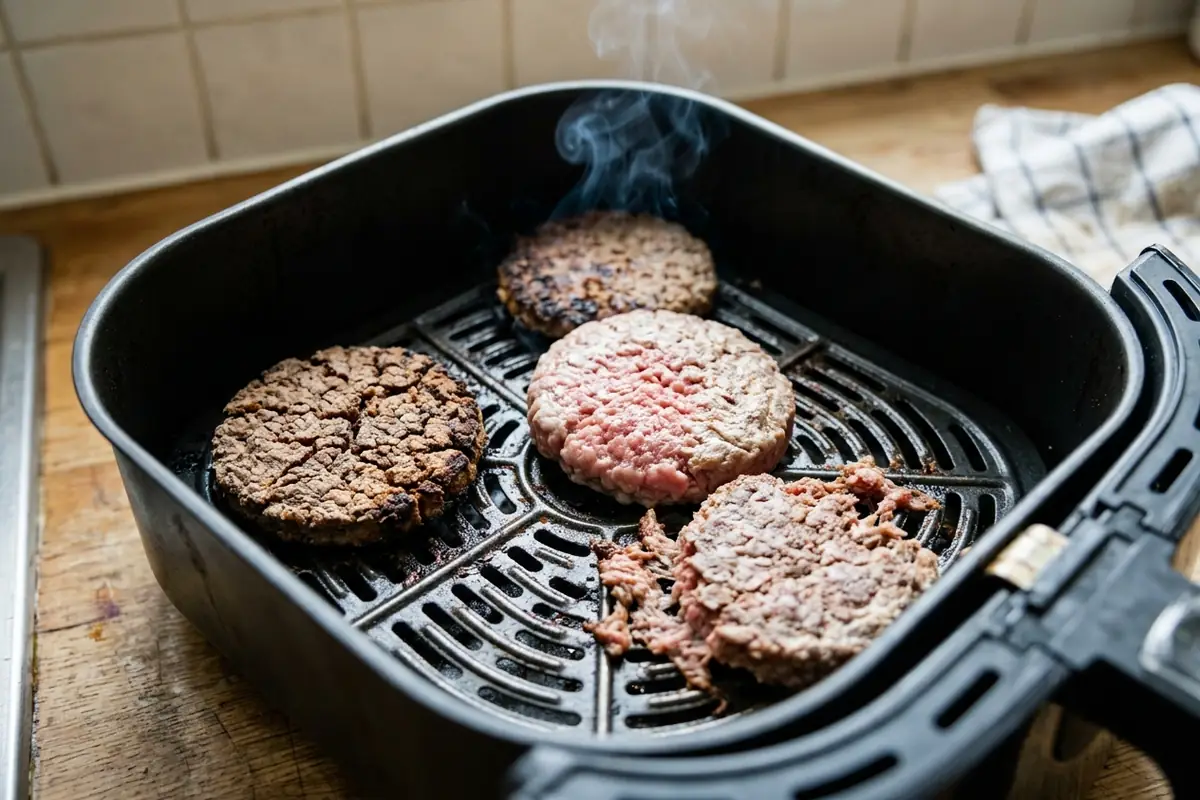
Dry burgers come from overcooking past 160 degrees F or from lean meat. Pull the moment the center hits 160 and rest the patty 2 to 3 minutes so the juices redistribute. If your patties are 90 percent lean, expect them drier; an 80/20 blend stays juicier in the air fryer. A raw or cool center with a browned outside means the temperature was too high or the patty too thick for the time; drop to 360, extend the minutes, and check the middle, not the edge.
Patties sticking to the basket are fixed with a light spray of oil before cooking or a perforated parchment liner with the center left open for airflow. Smoking during the cook is rendered fat hitting the hot drawer; pour a tablespoon of water into the bottom of the drawer beneath the basket to stop grease from smoking, and drain the drawer between batches. Excessive shrinkage is normal as fat renders, but extreme curling usually means the patty was packed too tightly at the factory; a quick press with a spatula early on keeps it flat.
Pre-Formed Frozen Patties Versus Homemade Frozen
There are two very different things people call frozen burgers, and they do not cook the same. Commercial pre-formed patties are pressed at a uniform thickness and often have a slight dimple, which helps them cook evenly and stay flat. They are designed to go straight from freezer to heat and behave predictably at the times above. Homemade patties you formed and froze yourself are usually thicker and less uniform, with denser cold spots that take longer to thaw through, so add 2 to 4 minutes and lean hard on the thermometer.
If you freeze your own patties, two habits make them air-fryer friendly later. Press a shallow thumbprint into the center of each raw patty before freezing so it cooks flat instead of doming into a ball, and freeze them in a single layer on a tray before bagging so they do not fuse into a block you have to pry apart. A patty that is bonded to its neighbor will not separate cleanly and will cook unevenly. Stack frozen patties with a square of parchment between each one and they peel apart in seconds.
Thickness consistency is the quiet advantage of store-bought here. Because every patty in the box is the same, once you dial in the time for that specific brand and your specific machine, you can repeat it without re-checking every single patty. Homemade patties reward you with better flavor and a known meat blend, but they ask for a thermometer check every time because the thickness drifts batch to batch.
Fat Content and How It Changes the Cook
The fat ratio printed on the box does more than affect flavor; it changes how the patty behaves in the basket. An 80/20 blend, meaning 80 percent lean to 20 percent fat, renders enough fat to baste itself and stays juicy even if you slightly overshoot the time. It also drips more grease into the drawer, so expect a little smoke and keep that tablespoon of water under the basket. A 90/10 or leaner blend, common in turkey and some beef patties, dries out fast and gives you a narrow window between cooked and chalky.
Match your technique to the fat. Leaner patties benefit from a light oil spray before cooking and a hard stop the second they hit temperature, with a full rest afterward to keep what moisture remains. Fattier patties need less help and tolerate a wider timing window, but they shrink more as the fat renders out, so do not be alarmed when an 80/20 patty comes out noticeably smaller than it went in. That shrinkage is fat leaving, not the burger drying, and it is exactly why the fattier patty still tastes juicier.
Building the Burger and Serving It Right
A great air fryer burger is built while the patty rests. Toast the buns in the air fryer for the last 1 to 2 minutes of the cook, cut side up, so they crisp and warm without drying. Rest the patty briefly so it does not soak the bottom bun. Layer sauce on both buns to keep moisture off the bread, then stack patty, cheese, and toppings.
For a complete fast dinner from the same appliance, run a tray of crispy potatoes or onion rings after the burgers come out, since the basket is already hot. If you are feeding a mixed crowd, the air fryer makes it easy to cook beef, turkey, and plant-based patties in sequence without cross-contaminating a shared grill. A cold side and a quick sauce finish the meal, and the only thing to wash is one basket.
One overlooked trick is resting the patty on the toasted bun rather than a plate. The bun catches the small amount of juice that escapes during the rest, so nothing is wasted and the bread stays flavorful rather than soggy from sauce alone. If you are making sliders from small frozen patties, the times shrink dramatically; thin slider patties can be done in 6 to 8 minutes at 360 degrees F, so check them early and pull the whole batch at once. Sliders also let you fit more in a single layer, which makes the air fryer a genuinely fast way to feed a group without firing up a grill or crowding a pan. Whatever the size, the rule never changes: single layer, flip once, finish at 160 degrees F, and rest before you build.
Frequently Asked Questions
Do I need to thaw frozen burgers before air frying?
No. Cooking from frozen is the whole advantage. The air fryer thaws and browns the patty at the same time, so going straight from freezer to basket gives a juicier result than thawing first. Thawing on the counter also raises food-safety risk, so skip it and cook frozen.
What temperature should frozen burgers reach inside?
Ground beef must hit 160 degrees F in the center, measured with an instant-read thermometer. Grinding spreads surface bacteria through the patty, so the medium-rare finish that is safe for whole steak is not safe for ground beef. Turkey and chicken patties finish at 165 degrees F.
How long do frozen burgers take in an air fryer?
At 360 degrees F, thin quarter-pound patties take 8 to 12 minutes, standard third-pound patties take 12 to 16 minutes, and thick half-pound patties take 16 to 20 minutes, flipping once halfway. Confirm doneness with a thermometer rather than the timer, since machines vary in power.
Should I flip frozen burgers in the air fryer?
Yes, flip once at the halfway point. Flipping browns both faces evenly and helps the center come up to temperature without scorching the outside, which is especially important on thicker patties. Skipping the flip leaves one pale face and risks an uneven, cooler middle.
When do I add cheese so it does not make a mess?
Add cheese during the final 1 to 2 minutes so it melts without sliding off or baking onto the basket. If the fan blows it around, anchor the slice with a toothpick, or top the patties after cooking and use residual heat under a loose foil tent for a clean melt.
Why do my frozen burgers come out dry?
Dryness comes from overcooking past 160 degrees F or from very lean meat. Pull the patty the instant the center hits 160 and rest it 2 to 3 minutes so juices redistribute. Choose an 80/20 blend over 90/10 for a juicier result, since the extra fat keeps the patty moist.