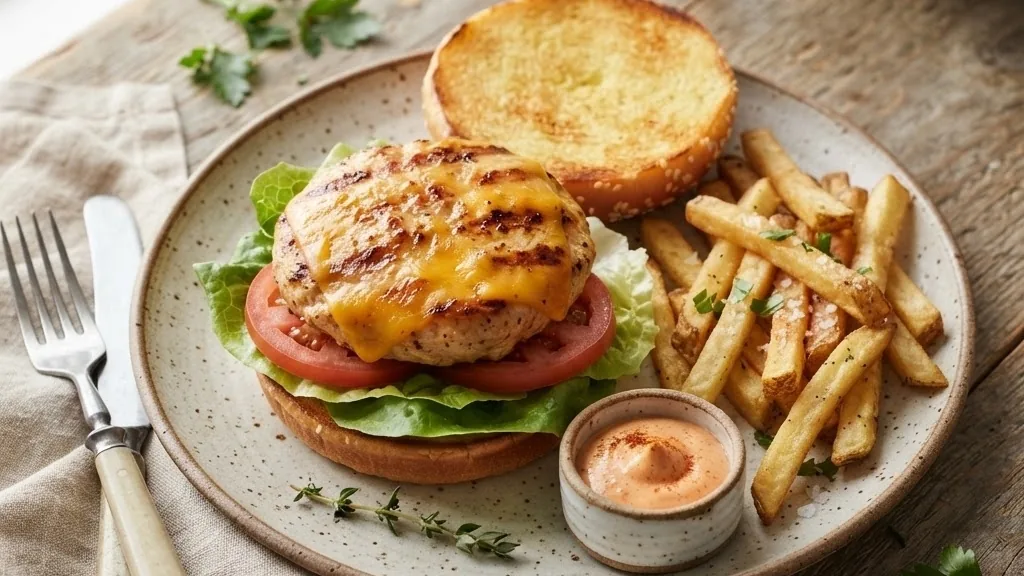
Air fryer frozen turkey burger cooking works best when you never thaw the patty first, because a rock-hard frozen center is actually the friend of even cooking in a high-convection basket. Most recipes tell you a single time and a single dial setting and move on. That leaves out the two things that decide whether you eat a juicy burger or a dry hockey puck: the exact internal temperature the USDA Food Safety and Inspection Service demands, and the way patty thickness and brand quietly change your timing. This guide fixes both, with sourced numbers and a matrix you can bookmark.
The stakes here are higher than with beef. Ground poultry spreads surface bacteria throughout the meat during grinding, so the safe endpoint is not negotiable and not a matter of color. Get the temperature right, keep the leanness working for you instead of against you, and a frozen patty can beat a fresh one for weeknight speed.
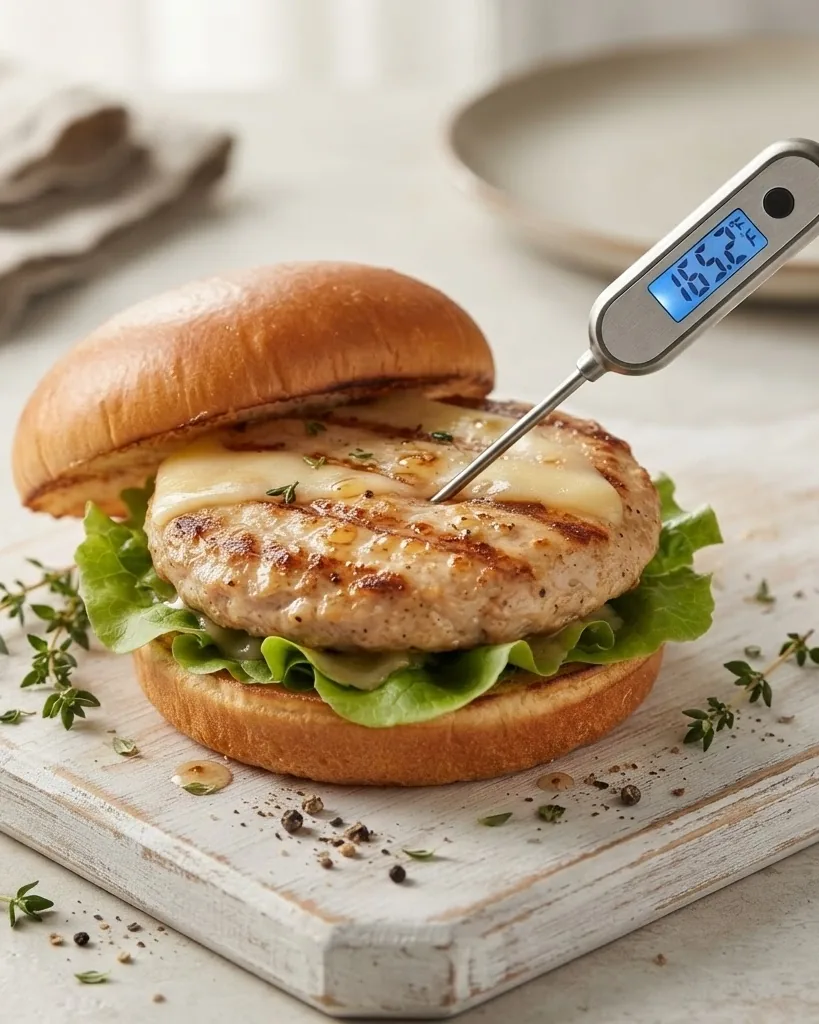
Quick answer: Cook a frozen turkey burger straight from the freezer in a preheated air fryer, flipping once halfway through. Do not judge doneness by color. Instead, insert a food thermometer through the side of the patty into its center and confirm it reads 165F (74C), the minimum internal temperature the USDA Food Safety and Inspection Service sets for all ground poultry. Basket-style and oven-style units differ in airflow, so treat any single time as a starting point and let the thermometer, not the clock, tell you when the air fryer frozen turkey burger is safe to eat.
Why 165F is the only number that decides doneness
The USDA Food Safety and Inspection Service requires ground turkey and all ground poultry products to reach a minimum internal temperature of 165F (74C) before they are safe to eat, and that standard holds no matter which cooking method you use. Color is a poor guide with turkey because a patty can look fully browned outside while the center sits well below the safe endpoint, which is exactly the failure mode frozen cooking invites. The only reliable check is an instant-read food thermometer, and the reading has to come from the true center of the patty, not the surface.
Why so strict with poultry? Grinding is the problem. On a whole-muscle cut, bacteria live mostly on the exterior, so a quick sear handles them. Grinding distributes any surface bacteria throughout the entire patty, which means the geometric center has to hit the safe temperature to be trusted.
The reason that 165F line exists at all is public-health data. The Centers for Disease Control and Prevention tracks foodborne pathogens such as Salmonella and Campylobacter that are commonly associated with undercooked poultry, and those organisms are the reason a visual cue is not good enough for ground turkey.
You can confirm the exact figure yourself on the FSIS Safe Minimum Internal Temperature Chart, which lists 165F for ground poultry alongside every other category.
How to read a thin patty with a thermometer without missing the cold spot
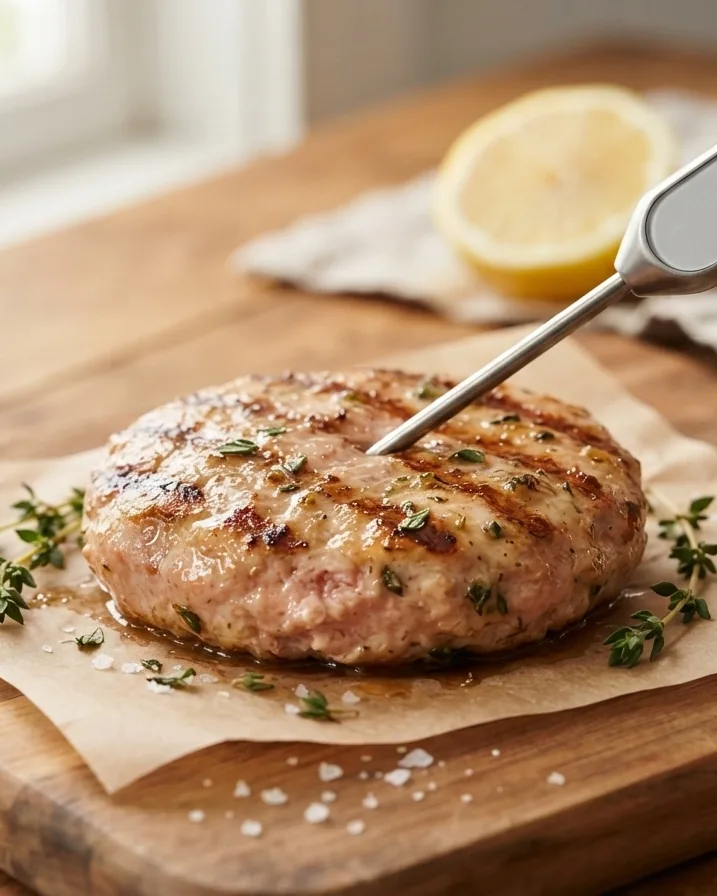
When you check doneness in something as thin as a burger, the FSIS guidance is specific: insert the thermometer probe through the side of the patty and push it toward the center, rather than stabbing down from the top. A top-down insertion in a thin item routinely stops short of the true thickest and coldest point, which is the part most likely to still be under 165F. Side insertion runs the probe tip along the patty’s midline, so you read the exact spot that matters. This single habit prevents most of the “I thought it was done” undercooking that plagues frozen turkey burgers.
Slide the probe in until the tip sits at the patty’s middle. If your thermometer has a dimple or marked sensing zone, keep that zone inside the meat, not poking out the far side.
Two quick habits make the reading trustworthy:
- Check the thickest patty in the basket, not a thin edge one, since airflow and mass vary from patty to patty.
The same side-insertion logic applies to other thin proteins. If you cook a lot of quick cuts, the technique carries over to items like Crispy Air Fryer Chicken Breasts!, where center temperature is just as decisive.
Cook-time matrix by thickness, product type, and air fryer style
One generic time fails because three variables move the target: patty thickness, whether the patty is raw-frozen or fully-cooked-frozen, and whether your machine is a basket-style or oven-style convection unit. A quarter-pound patty carries less mass to the center than a third-pound patty, so it reaches 165F sooner. A fully-cooked-frozen patty only needs reheating to a safe serving temperature, while a raw-frozen patty has to hit the full 165F endpoint from cold. And identical dial settings on a compact basket and a large oven-style cavity do not deliver identical airflow, so the same setting yields different real cook times.
Use the framework below as your decision map, then let the thermometer make the final call:
- Thickness: a 1/4 lb patty finishes noticeably faster than a 1/3 lb patty, so start checking the thinner one earlier.
- Product type: raw-frozen must reach 165F; fully-cooked-frozen needs reheating to a safe serving temperature, which is a shorter job.
- Machine: basket-style units concentrate airflow over a small load; oven-style units spread it across a wider rack and may need a longer set time.
Flip once at the halfway point regardless of category, because a single-side cook leaves the down face pale and the center lagging. Because manufacturer wattage and preheat requirements vary, the appliance makers such as Ninja, Cosori, Instant, and Philips publish frozen-food charts specific to their models, and those charts are your best starting time for your exact unit.
If you want to see how this variable-based thinking looks applied to another freezer staple, the approach mirrors Frozen Pizza in Air Fryer: The Temperature, Timing and Safety Guide Competitors Skip, which breaks timing down the same way.
Basket-style versus oven-style, in plain terms
A basket-style air fryer pulls air down through a small perforated drawer, so heat wraps a few patties tightly and fast. An oven-style convection unit has more volume and a larger fan path, which spreads heat but can dilute it across a bigger load. On the same nominal setting, the oven-style often needs more time to bring a frozen center to 165F. Do not assume a chart written for one type transfers cleanly to the other.
Why store-brand, Butterball, and Jennie-O patties cook differently
Frozen turkey burger brands are not interchangeable, and the differences change your cook time and your dryness risk. The reason sits in a labeling rule: ground poultry products can legally be made from a combination of white meat, dark meat, and skin in varying proportions, which is why commercially sold ground turkey and turkey burger patties commonly range from roughly 85% to 99% lean. A 99% lean patty has almost no fat to buffer against drying, so it punishes overcooking harder than an 85% blend. Thickness and pre-seasoning also vary from one brand to the next, and both shift how the patty behaves in the basket.
Before you set a time, read the box. Two numbers on the package do most of the work:
- Patty weight, which tells you whether you are cooking a 1/4 lb or a 1/3 lb patty and therefore how long the center takes.
- Lean percentage, which predicts dryness risk; the leaner the blend, the tighter your window above 165F.
Butterball, Jennie-O, and store or generic brands each publish their own cooking instructions, sometimes including air fryer guidance, so the package is the most accurate baseline you have before you adjust. Pre-seasoned patties add another wrinkle, which is sodium, covered further down.
You do not need to memorize a brand’s number. You need to check the panel, note the lean percentage, and understand that a 99% lean patty and an 85% patty are effectively two different cooking jobs even at the same weight.
The seasoning-stick trick for a rock-frozen surface
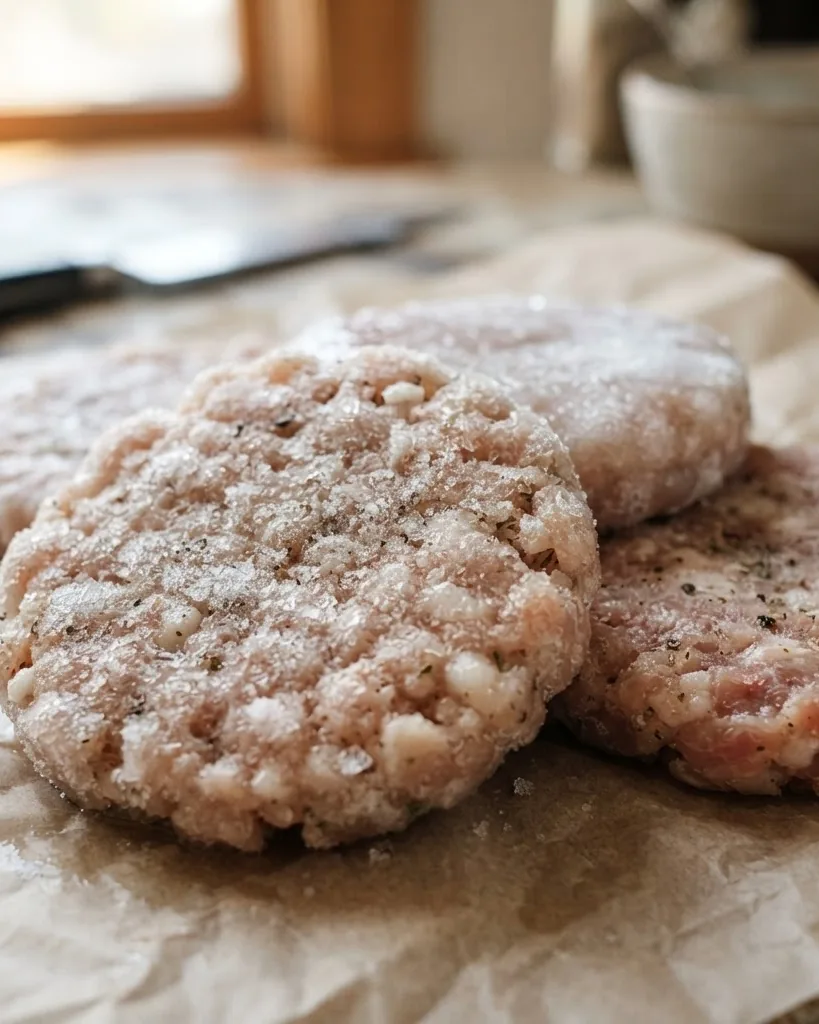
Dry seasoning sprinkled onto a rock-frozen patty simply falls off, because there is no moisture or fat on that glassy frozen surface for salt, pepper, or a spice blend to grab. This is the single most common reason home cooks complain their frozen turkey burgers taste bland. The fix is timing plus a binder. Let the patty cook for a couple of minutes first, until the outer surface has slightly softened and started to sweat, then apply a light mist of an air-fryer-safe oil. That thin film of oil acts as glue: press or shake your seasoning on right after, and it adheres instead of scattering into the basket.
The sequence matters more than the amount:
- Start the frozen patty dry in the preheated basket.
- After a couple of minutes, mist lightly with an air-fryer-safe oil once the surface softens.
- Season immediately while the oil film is fresh, then continue cooking and flip at the halfway mark.
Skip the aerosol cans with additives that can pit some basket coatings; a simple oil mister you fill yourself is safer for the finish. This oil-as-binder idea also rescues seasoning on frozen vegetables, which is why it shows up in the method for Air Fryer Frozen Okra: The Cut vs Whole vs Breaded Guide With Real Specs.
Keeping a lean turkey patty from drying into rubber
Turkey burgers dry out faster than beef because they are leaner, and a high-convection air fryer moves a lot of hot air fast, which pulls moisture from the surface quickly. The defense is not one trick but a stack of small ones, and the most important is restraint at the finish line. Pull the patty as soon as it reaches 165F rather than cooking it well past that point, because every extra degree on a lean patty squeezes out more water. Overshooting the safe minimum by a wide margin is the number-one cause of the rubbery, dry texture people blame on the method itself.
Layer these moisture tactics:
- Light oil or a thin mayonnaise coat on the patty surface, which slows moisture loss and helps browning without adding heavy flavor.
- A splash of water in the basket drawer, which slightly humidifies the cooking environment and takes the edge off the dry convection air.
- A brief rest after cooking, so the juices redistribute instead of running out the moment you bite in.
Rest is genuinely underrated. Even a couple of minutes on a plate lets the internal moisture settle, and the difference between a rested and an un-rested lean patty is easy to taste.
None of this works if you overshoot the temperature, so the thermometer and the moisture tricks are a package deal, not alternatives to each other.
Troubleshooting the browned-outside, still-frozen-inside failure
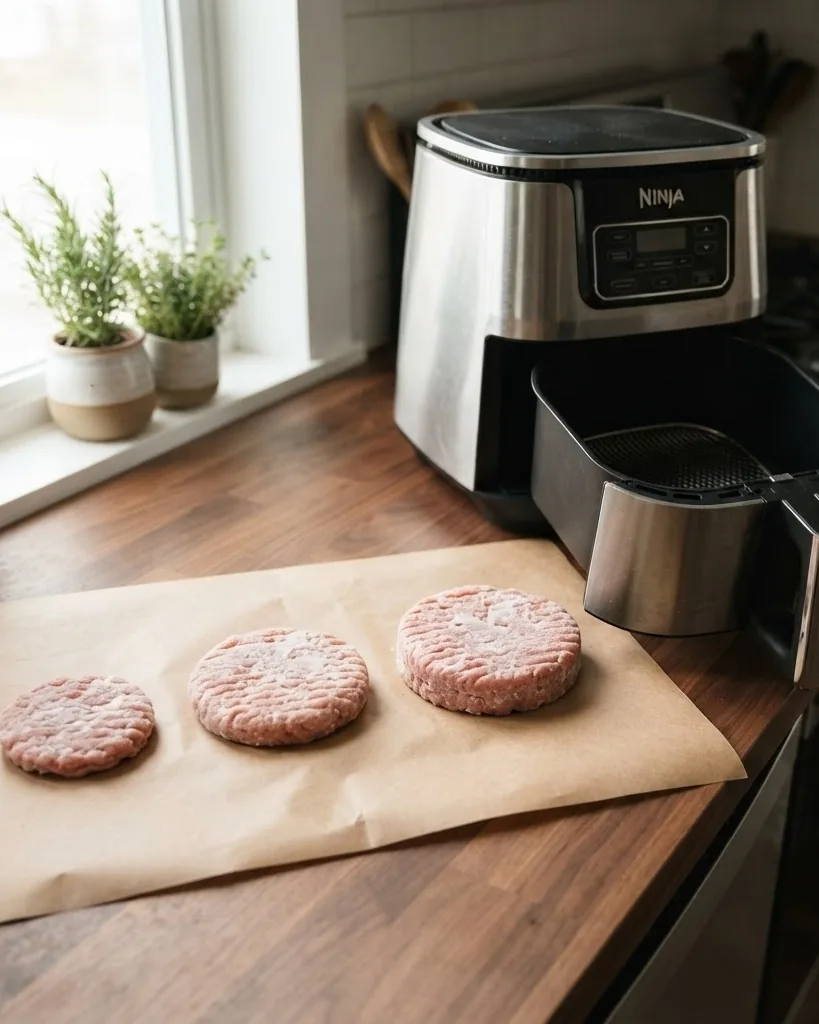
The classic frozen-burger disaster is a patty that browns or even smokes on the outside while the center is still cold, and it has clear causes you can fix. Browning outpaces the center when the temperature is too high for the patty’s mass, when the basket is overcrowded so airflow cannot reach the center, or when accumulated grease from a previous batch starts to smoke. The center stays cold because a frozen patty needs time for heat to travel inward, and cranking the heat only speeds the surface, widening the gap. The cure is patience on temperature, space in the basket, and a clean drawer.
Work through the failures one at a time:
- Smoking: grease from earlier batches is burning; wipe the drawer between rounds and consider a splash of water beneath the basket to keep drippings from scorching.
- Cold center, brown outside: the setting is too aggressive for the frozen mass; lower it slightly and add time so heat reaches the middle before the surface overcooks.
- Sticking: use a parchment liner made for air fryers or start on a lightly oiled bare basket, and do not flip until the patty releases cleanly.
- Uneven results across patties: you have overcrowded the basket; leave space around each patty so convection air can circulate.
Overcrowding deserves its own warning because it is so common. Packing patties in restricts airflow, extends cook time, and produces exactly the uneven, half-cold results people mistake for a broken appliance.
Air fryer versus oven, stovetop, and grill for frozen patties
The air fryer wins for frozen turkey burgers on speed and cleanup, but each method has a trade-off worth knowing before you commit. A stovetop pan gives you the most control over browning and a good sear, but it needs babysitting and splatters. A conventional oven is hands-off and holds many patties at once, yet it is slower to bring a frozen center up to temperature and browns less aggressively. A grill delivers unbeatable char and flavor but struggles with frozen patties that want to stick and fall apart on the grates. The air fryer threads the needle for weeknights.
Here is the practical shape of each choice:
- Air fryer: fastest from frozen, minimal cleanup, good all-around browning, but limited batch size and sensitive to overcrowding.
- Oven: best for large batches and hands-off cooking, slower to a safe center, softer browning.
- Stovetop: best browning control, most active attention and cleanup.
- Grill: best flavor, worst at handling still-frozen patties without sticking or breaking.
For most cooks reaching into the freezer on a Tuesday, the air fryer’s combination of speed and a low cleanup burden is the reason it becomes the default. The same logic drives people toward it for other quick proteins like Crispy Air Fryer Chicken Thighs in 20 Mins!.
The nutrition and sodium angle behind choosing turkey
People pick turkey burgers over beef largely for health reasons, so it is worth being honest about where the real advantage lies and where a hidden catch hides. Turkey is generally leaner than beef, which is the calorie and fat argument, but the leanness only holds if you check the actual blend, since patties range from roughly 85% to 99% lean and an 85% patty is not the lean-protein win a shopper might assume. The bigger surprise is sodium: many frozen turkey burgers are pre-seasoned, and pre-seasoned patties can carry noticeably more sodium than a plain patty you salt yourself at home.
The way to shop with your eyes open is to read two things on the package and one thing online:
- Lean percentage, which drives calories and fat far more than the word “turkey” on the front of the box.
- The sodium line on the nutrition panel, which is where pre-seasoning quietly adds up.
- The USDA FoodData Central entry for the specific product, if you want exact calorie, protein, fat, and sodium figures rather than estimates.
FoodData Central is the official government nutrition database, and you can pull verified numbers for a branded patty from the USDA FoodData Central portal instead of trusting a generic estimate. For a plain-language summary of safe cooking temperatures aimed at general readers, FoodSafety.gov aggregates USDA, FDA, and CDC guidance in one place.
Serving, cheese timing, and toasting the bun
Turkey’s flavor is milder than beef, so the toppings and sauces carry more of the burger, and a couple of timing tricks make the plate better. Add cheese in the final one to two minutes of cooking so it melts without pushing the patty past its safe endpoint while you wait. Toast the buns in the air fryer’s residual heat right after the patties come out, which uses energy you have already spent and gives you a warm, slightly crisp bun without a second appliance. Match sauces to turkey’s gentler profile: something with acidity or punch lifts it more than a heavy, fatty sauce would.
A few pairings that suit the milder meat:
- Buns: brioche for richness, whole wheat for a nuttier bite, or a lettuce wrap for a low-carb plate.
- Sauces: bright, acidic, or spicy condiments that add contrast rather than muffling the patty.
- Cheese: added in the last one to two minutes so it melts on residual heat, not overcooks the meat.
The residual-heat bun trick is one of those small habits that makes the whole meal feel finished, and it costs nothing extra.
Freezer storage and thawing rules that keep the patty safe
How you store and handle a frozen turkey burger before it hits the basket matters as much as the cook. Food kept continuously frozen at 0F (-18C) stays safe to eat indefinitely, though its quality and flavor typically begin to decline after roughly 3 to 4 months in the freezer, so the safety clock and the quality clock are two different things. The bigger rule is thawing. Bacteria multiply most rapidly in the danger zone between 40F and 140F (4C to 60C), which is why a frozen patty should never be thawed by sitting out on the counter, and why cooking straight from frozen is both easier and safer for this method.
Keep these boundaries straight:
- 0F (-18C) storage keeps the patty safe indefinitely; the 3 to 4 month window is about flavor and quality, not safety.
- Never counter-thaw, because the danger zone between 40F and 140F (4C to 60C) is where bacteria multiply fastest.
- Cook from frozen for turkey burgers, which sidesteps thawing entirely and suits the air fryer.
You can read the FSIS thawing guidance in full on the Big Thaw safe defrosting methods fact sheet, which lays out the room-temperature warning in detail.
Lab notes from the cooking desk
The findings below are the recurring truths that separate a good frozen turkey burger from a bad one, drawn from the food-safety standards and product realities that govern this dish.
Frequently asked questions
Do I need to thaw a frozen turkey burger before air frying?
No, and thawing is actually counterproductive here. Cooking straight from frozen suits the air fryer and avoids the danger zone between 40F and 140F (4C to 60C) where bacteria multiply fastest. A frozen center also helps the patty hold together. Whatever you do, never thaw by leaving the patty out at room temperature on the counter.
How do I know a turkey burger is fully cooked?
Temperature, never color. The USDA Food Safety and Inspection Service requires ground poultry to reach 165F (74C) internally. Insert an instant-read thermometer through the side of the patty into its center, since a top-down probe in a thin item often misses the true coldest point. A browned exterior alone does not mean the center is safe.
Why does my turkey burger come out dry?
Turkey is leaner than beef, and the leanest patties reach 99% lean, so they dry fast when overcooked. Pull the patty the moment it hits 165F rather than cooking well past it. A thin oil or mayonnaise coat, a splash of water in the drawer, and a brief rest after cooking all help the patty hold its moisture.
Why won’t my seasoning stick to the frozen patty?
A rock-frozen surface is too glassy for dry spices to grab. Let the patty cook a couple of minutes first, then mist it lightly with an air-fryer-safe oil once the surface softens. Season immediately while the oil film is fresh. The oil works as a binder, so salt, pepper, and spice blends adhere instead of scattering into the basket.
Why is my air fryer smoking while cooking turkey burgers?
Smoking almost always comes from grease burning in the drawer, often left over from a previous batch. Wipe the basket between rounds and add a small splash of water beneath the basket so drippings do not scorch. Overcrowding can also trap fat against hot surfaces, so leave space around each patty to keep airflow moving.
How long do frozen turkey burgers stay good in the freezer?
Kept continuously at 0F (-18C), they remain safe to eat indefinitely. Quality and flavor, however, typically begin to decline after roughly 3 to 4 months. So the patty will not become unsafe from time alone, but for the best taste and texture, aim to use it within that few-month window rather than letting it sit for a year.
The bottom line on frozen turkey burgers
Cook from frozen, flip once, and let a thermometer confirm 165F (74C) through the side of the patty. Read the package for weight and lean percentage before you set a time, mist oil a couple of minutes in so seasoning sticks, and pull the patty the instant it hits temperature to protect the moisture in a lean cut. Handle those few points and the freezer aisle turns into a fast, safe weeknight dinner.
[req:4648718][req:4949299]