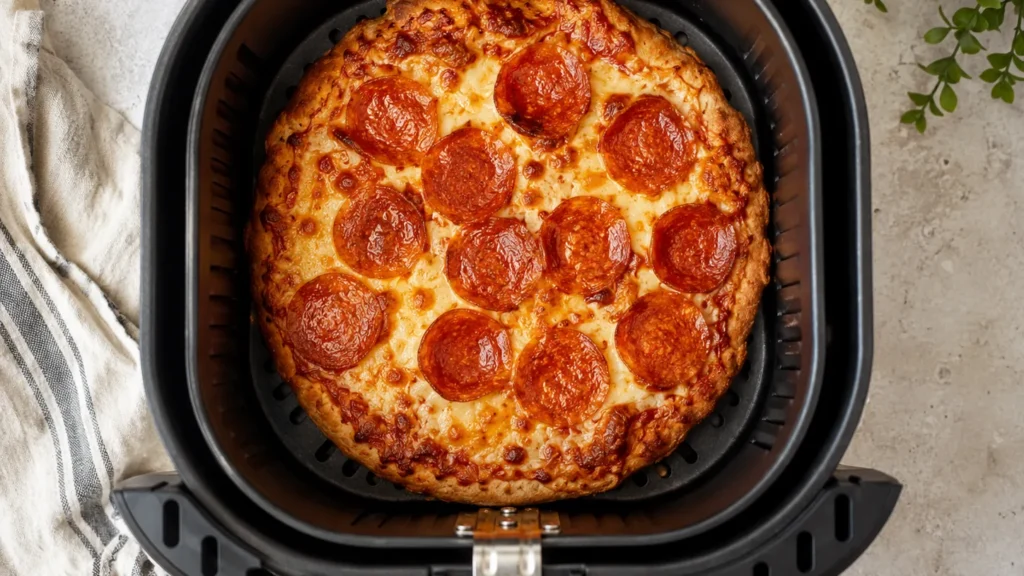
Frozen pizza in air fryer cooking works because the machine treats a supermarket pie the way it was designed to be treated: as a pre-cooked food you finish and crisp, not raw dough you build from scratch. That single fact changes every decision that follows, from how long you run the basket to how you know the center is safe to eat. A personal pie usually lands right around 380 degrees Fahrenheit for roughly six minutes, but the honest answer depends on format, machine style, and whether you are cooking from raw or reheating a slice.
The gap in most guides is not the timing. It is that almost nobody tells you the internal target, why a parchment sheet can fly into the heating element, or how to keep the crust from scorching before the cheese even melts. That is what gets covered here, with figures pulled from the U.S. Department of Agriculture and the U.S. Food and Drug Administration rather than guesswork.
Quick answer: For frozen pizza in air fryer cooking, run a personal or mini pie at about 380 degrees Fahrenheit for roughly six minutes in a basket model, checking visually at the four-minute mark. Because a frozen pizza is pre-cooked, treat it as a reheat: confirm the center reaches an internal temperature of 165 degrees Fahrenheit (74 degrees Celsius) with a food thermometer. Aim for a golden, not dark brown, crust. Larger pies that do not fit should be quartered or cooked in batches rather than crammed in.
Why frozen pizza behaves like a reheat, not a raw bake
A frozen pizza leaves the factory already cooked. The crust is baked, the cheese has been melted once, and the toppings are set. What you are doing at home is warming it through and re-crisping the base, which is why the safety rule that matters is the reheating rule, not the raw-dough rule. FoodSafety.gov, the interagency portal run with the U.S. Department of Health and Human Services, states that leftovers and pre-cooked items should be reheated to an internal temperature of 165 degrees Fahrenheit (74 degrees Celsius). That number is your finish line. Color and bubbling cheese are useful signals, but they are not proof. This distinction also explains why air fryer times are short: you are not waiting for dough to rise or set, only for heat to reach the middle and for moisture to leave the crust surface.
Two practical rules follow from this. First, keep the pizza frozen until it goes in; the box instruction to “keep frozen” exists to keep it out of the bacterial growth range. Second, do not stack pies to save time, because the top one shields the bottom from airflow and neither heats evenly.
What “pre-cooked” changes about your timing
Because the base is already baked, a light golden finish means the job is nearly done. You are chasing texture, not doneness of raw ingredients. If you add extra cold toppings, expect a longer run, since you have introduced food that genuinely needs to come up to temperature. A plain cheese pie behaves very differently from one you have loaded with fridge-cold pepperoni or vegetables.
Exact temps and times by pizza format
Format matters more than brand. A thin personal pie, a French bread half, and a deep dish rising-crust pie all carry different amounts of dough and moisture, so they need different runs. The table below is a starting point for a basket-style air fryer; check visually a couple of minutes before the low end of each range, and always verify the center with a thermometer. Thicker pies benefit from a slightly lower temperature and longer time so the middle catches up before the edge darkens. Snack formats like bagel bites and pizza rolls run hot and fast because they are small and shallow.
- Mini / bagel-style snacks: higher heat, shortest run; watch closely, they scorch fast.
- Personal / single-serve: about 380 degrees Fahrenheit, roughly 6 minutes, visual check at 4 minutes.
- Medium round: slightly longer than a personal pie if it fits without touching the walls.
- French bread pizza: lower and slower so the bread heats through without burning the crust ends.
- Deep dish / rising crust: the longest, lowest run; the thick center is where undercooking hides.
For deep dish and rising crust especially, the thermometer is not optional. The exterior can look perfect while the dense middle sits well below a safe temperature.
Basket air fryer versus toaster-oven style
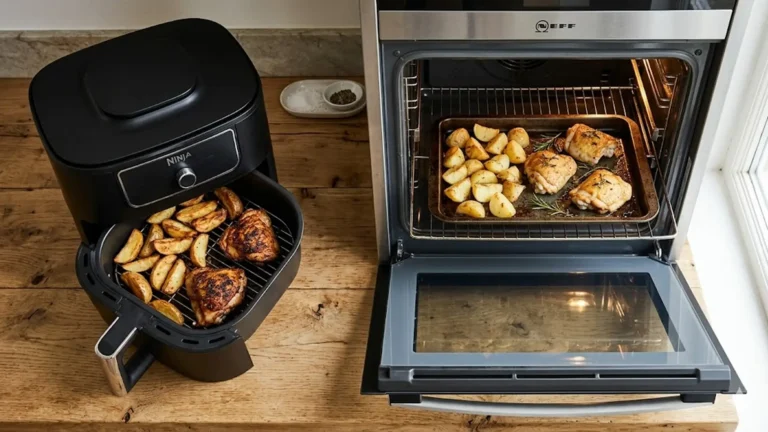
Capacity is the real divide. A basket model concentrates fast air in a small chamber, so it crisps aggressively and often needs the shorter end of any time range. A toaster-oven or oven-style air fryer holds a larger, flatter pie and moves air more gently, so it tends toward the longer end. If you are converting a conventional oven instruction, drop the temperature and start checking earlier, because the moving air cooks faster than still oven heat. Whichever machine you own, leave space around the pizza; a pie pressed against the walls steams instead of crisping.
The 165F safety target no recipe box mentions
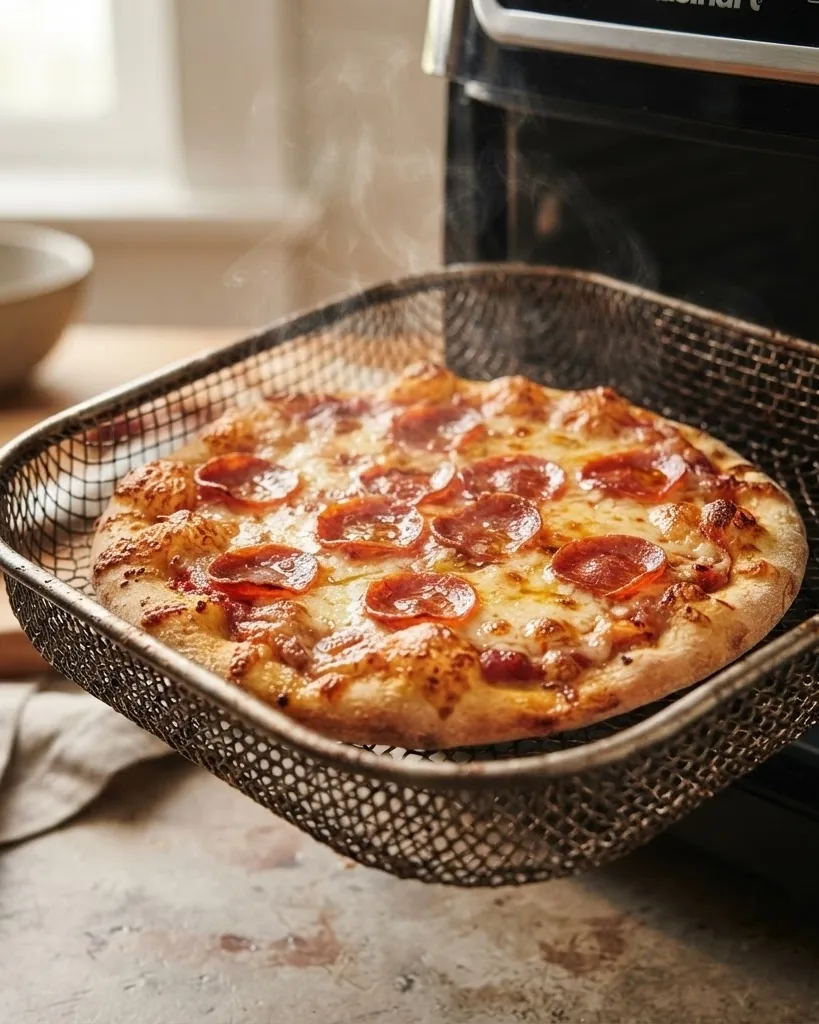
The single most useful upgrade to your pizza routine is a food thermometer. Texas Department of State Health Services guidance is blunt about it: a food thermometer is the only reliable way to confirm a food has reached a safe temperature. Eyeballing bubbling cheese tells you the surface is hot, not that the center has caught up, and the center is exactly where a thick or heavily topped pie lags. For a pre-cooked frozen pizza you are reheating, the target is an internal temperature of 165 degrees Fahrenheit (74 degrees Celsius). Slide the probe into the middle of the pie, through the thickest topping, and read the coldest spot rather than the edge. This matters most for deep dish, rising crust, and any pie you have piled with cold additions, because those are the ones that reach a convincing color long before the middle is genuinely hot.
Handling before cooking counts too. Keep the pizza frozen until it goes in the basket, and do not let it thaw on the counter for an hour first.
Why the danger zone rule applies even to pizza
The U.S. Department of Agriculture Food Safety and Inspection Service explains that bacteria multiply fastest within a specific temperature range, and their numbers can climb quickly once food is left out too long. Leaving a pizza to sit out defeats the point of cooking it properly. You can read the agency’s full breakdown of how temperatures affect food safety for the underlying reasoning on why timing between cold and hot matters.
Fixing soggy, scorched, or flyaway-cheese pizza
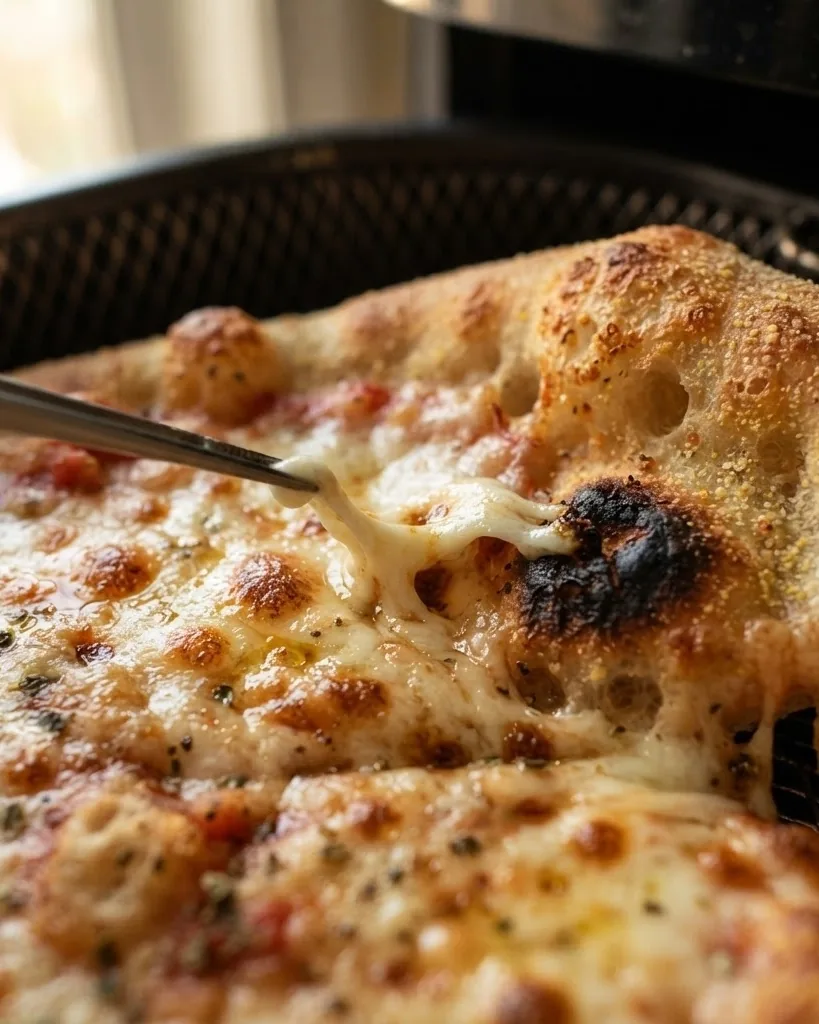
Most first-attempt failures fall into four buckets, and each has a specific cause. A soggy crust usually means the pie steamed instead of crisped: it was crowded against the walls, the machine ran too cool, or it came out a minute early. A crust that is dark at the edges while the cheese is still pale means the heat was too high for the thickness, so the surface raced ahead of the center. Cheese that blows off the top and sticks to the heating element is the airflow doing exactly what it is built to do, and it is the classic reason a light pie needs watching. A parchment sheet that lifts and floats toward the element is the same problem in a more dangerous form. The fixes are mechanical, not mysterious: give the pizza room, match temperature to thickness, and never run loose parchment without the pizza weighing it down.
- Soggy base: raise the temperature slightly, add a minute, and stop crowding the basket.
- Scorched edge, cold center: lower the temperature, extend the time, verify with the thermometer.
- Flyaway cheese: expect it on light pies; add cheese partway if you want more without losing it.
- Floating parchment: only use paper cut to size and pinned under the pizza, never a bare sheet.
When to use parchment and when to skip it
Parchment helps with cleanup and stops sticky cheese from welding to the basket, but an unweighted sheet is a fire and mess risk because fast air lifts it. Cut the paper no larger than the pizza, place the pizza on top immediately so its weight holds the paper down, and never preheat with an empty sheet inside. If your pie has a firm base and you would rather crisp the bottom directly, skip the paper entirely. The choice between crispier base and easier cleanup is genuinely yours; both work.
Fitting a big pizza that will not go in the basket
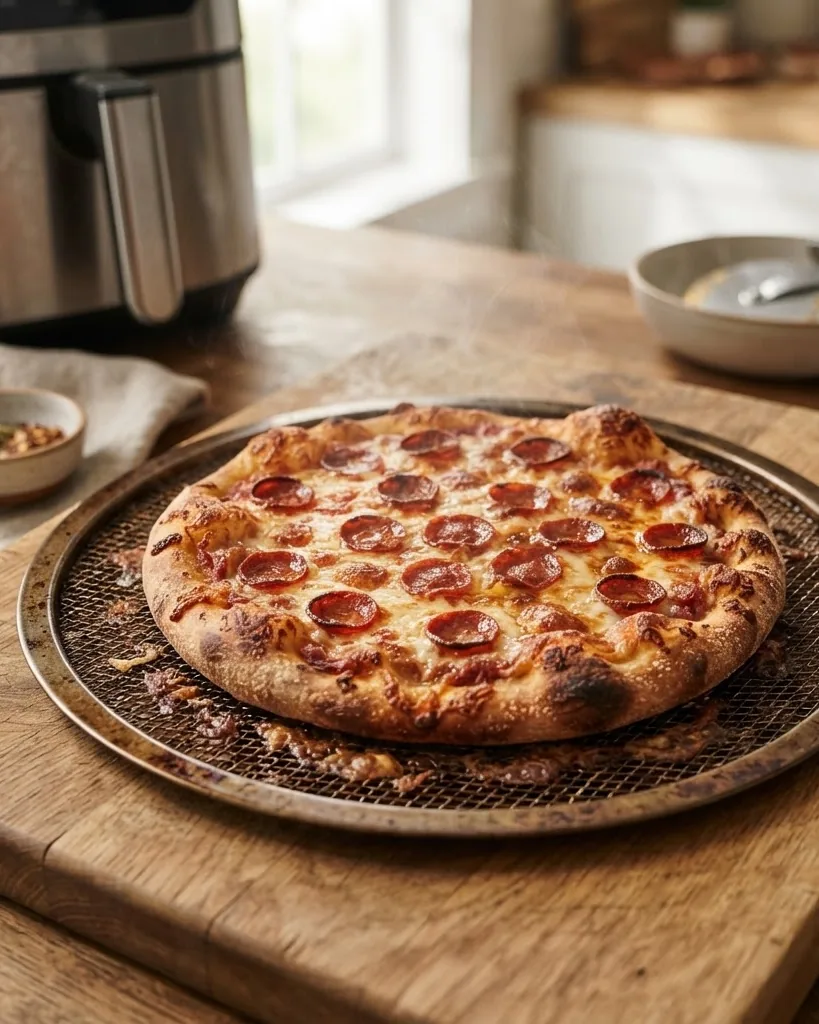
A large pizza that overhangs the basket is the most common dead end, and the answer is not “just add time.” A pie touching the walls steams, cooks unevenly, and defeats the machine. The reliable move is to cut the pizza into quarters before cooking and run them in batches, or to cook two facing halves at a time so air can still circulate around each piece. This is the same approach food writers reach for when a family-size pie meets a small chamber. MEL Magazine covered a chef quartering a large pizza for exactly this reason. Batching costs you a few extra minutes but gives every piece a crisp base instead of one soggy, half-warmed slab. Keep the pieces from touching each other in the basket, and treat each batch as its own cook with its own thermometer check.
If you buy pizza specifically to air fry, choosing a personal or medium size that fits your machine spares you the whole exercise.
Golden not brown: the acrylamide angle everyone ignores
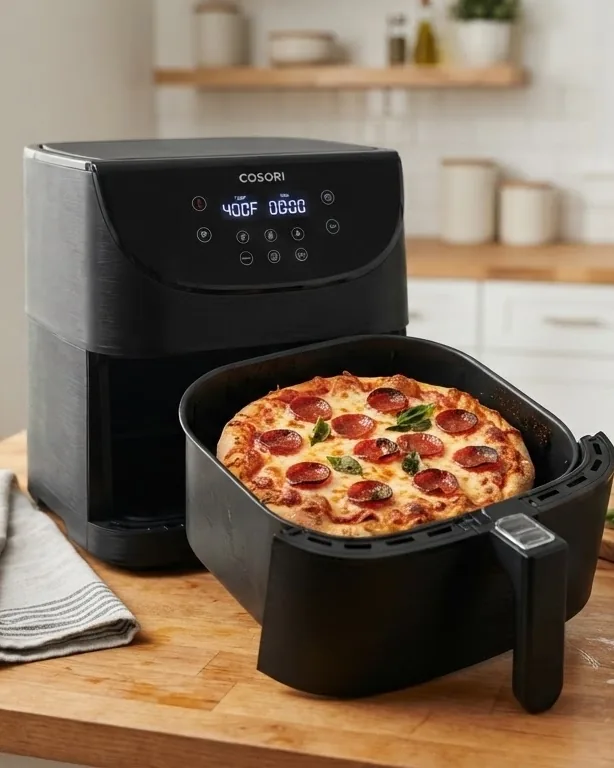
There is a real reason to stop at golden rather than pushing a frozen pizza to dark brown, and it is not just flavor. The U.S. Food and Drug Administration explains that acrylamide, a process contaminant, forms in plant-based foods during high-temperature cooking such as frying, roasting, and baking, generally above about 120 degrees Celsius (248 degrees Fahrenheit) and in low-moisture conditions. Its guidance for industry recommends cooking starchy and cereal-based foods to a light golden color rather than a dark brown one to keep acrylamide lower. A pizza crust is a cereal-based food, so the same logic applies at home: pull it when the crust is golden and the cheese is bubbling, not when the edges have gone deep brown. You can read the agency’s overview of acrylamide as a process contaminant for the fuller picture. The European Food Safety Authority gives comparable home-cooking advice for households in the European Union.
How color relates to your air fryer settings
Because a basket air fryer crisps fast, it is easy to overshoot into dark brown while chasing a firmer base. If your crust keeps arriving too dark, the answer is usually a lower temperature and a slightly longer time, which lets the center warm while the surface stays golden. This is the same fix that solves the scorched-edge, cold-center problem, and it happens to be the healthier finish as well.
Leftover pizza: reheating slices without wrecking them
Air fryers reheat pizza slices beautifully, and the safety math is simpler than cooking from frozen because you are warming something already cooked and chilled. Slices reheat faster than a frozen pie since there is no ice to melt, so start checking early to avoid drying them out. Whatever the timing, the finish target is the same reheating temperature of 165 degrees Fahrenheit (74 degrees Celsius). Storage rules bracket the whole thing. The U.S. Department of Agriculture Food Safety and Inspection Service advises discarding refrigerated cooked leftovers once they are no longer safe to eat, and FoodSafety.gov advises refrigerating leftovers promptly after cooking so they never linger in the danger zone. Its consumer explainer on safe leftover handling and reheating spells out the recommended refrigeration window and the 165-degree reheat target in plain language.
For crisp results, lay slices flat, avoid stacking, and skip the microwave-first shortcut that turns crust rubbery.
Cleaning cheese and grease out of the basket fast
Melted cheese and rendered pepperoni grease are the price of a good pizza, and they set hard if you leave the basket to cool completely. Let the basket cool just enough to handle, then wipe the loose grease with a paper towel before it congeals. Warm soapy water loosens baked-on cheese far better than cold. For stubborn spots, a short soak beats scrubbing. Cleaning promptly also protects flavor, since old grease smokes and taints the next thing you cook. If you regularly cook things that spit fat, the same wipe-then-soak habit that keeps a fry basket fresh applies here; the routine that works for homemade fries in the air fryer transfers directly to pizza night. A clean basket is also a safer one, because trapped grease is what turns into acrid smoke on the next high-heat run.
Field notes on the machine and the science
These are the fixed points worth pinning to the wall next to your air fryer, drawn from federal food-safety guidance rather than folklore.
None of the leading pizza recipes cite these figures, which is why so many home cooks end up guessing. Pin the two that matter most: 165 degrees Fahrenheit at the center, and golden rather than brown on the crust.
Frequently asked questions
Can you stack two frozen pizzas in an air fryer at once?
Stacking is a bad idea because the top pizza blocks airflow to the one beneath it, so neither crisps and the lower pie can stay cold in the middle. Fast-moving air is the whole mechanism, and stacking cancels it. If you need two, cook them in separate batches and verify each reaches 165 degrees Fahrenheit (74 degrees Celsius) in the center with a thermometer before serving.
Can you put aluminum foil under a frozen pizza in the air fryer?
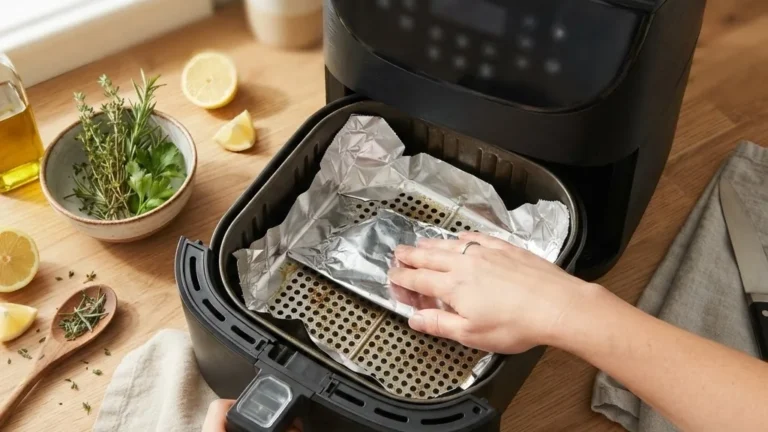
Foil can work as a liner if it is weighed down by the pizza and does not block the airflow holes, but it changes how the base crisps and can trap grease. Loose foil, like loose parchment, risks lifting into the element. For a full breakdown of when foil is safe and when it is not, see the guide on using foil safely in an air fryer before you line the basket.
Can you cook homemade pizza or raw dough in an air fryer?
You can, but raw dough is a different job from a frozen pie because it must actually bake, not just reheat. Store-bought frozen pizza is already cooked, so it finishes fast. Raw dough needs more time to set and rise, and toppings with raw meat must hit their own safe internal temperatures. Treat homemade pizza as a full bake and check the center carefully rather than assuming pizza timings.
Should you preheat the air fryer for frozen pizza?
Preheating helps the crust firm up sooner because the pizza meets hot air immediately instead of warming as the chamber warms. It is not strictly required, and some quick-cook single pies come out fine from a cold start. If your crusts keep landing soggy, a short preheat is one of the first fixes to try, alongside giving the pizza more room in the basket.
How do you convert oven pizza instructions to the air fryer?
Lower the temperature from the box instruction and start checking earlier, because moving air cooks faster than still oven heat. There is no universal formula, so treat the first run as a test and watch the crust color closely. Confirm the center reaches 165 degrees Fahrenheit (74 degrees Celsius) with a thermometer, and pull the pizza at golden rather than dark brown to keep acrylamide lower.
Why does my cheese blow off the pizza in the air fryer?
The fan-driven air that crisps the crust is strong enough to lift loose cheese, especially on light single-serve pies. It is normal, not a fault. If it bothers you, let the pizza cook most of the way first so the cheese has begun to set and grip, then add any extra cheese in the final couple of minutes so it melts in place instead of flying off.
Cook the pizza to 165 degrees Fahrenheit at the center, stop at golden, and give it room to breathe. Those three habits solve almost every problem people run into, and none of them add real time to a meal that already beats waiting on a full oven.
Food safety is an area where guidance from bodies like the U.S. Department of Agriculture and the U.S. Food and Drug Administration is worth following closely. When in doubt about whether reheated food is safe, use a thermometer and follow the package instructions rather than relying on appearance alone.
[req:9868614]