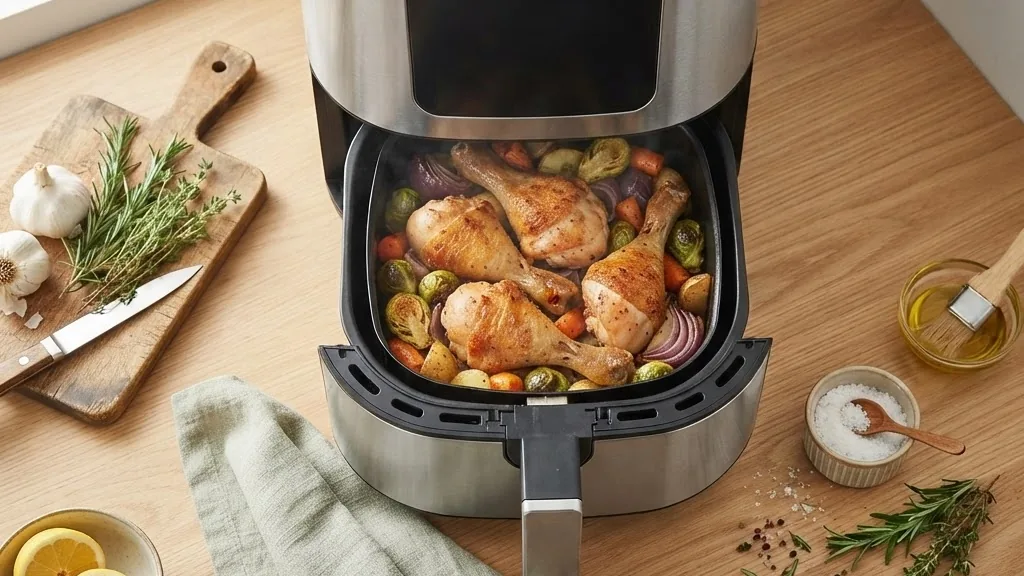
So, are air fryers safe? The short answer is a plain yes for most home cooks, with a few specifics worth understanding before you press start. The worry usually comes from two chemistry words, acrylamide and PFAS, plus the everyday risk of a hot basket. None of them should scare you off the appliance. They should shape how you use it.
Health claims here are grounded in guidance from the U.S. Food and Drug Administration and the American Cancer Society.
Quick answer: Air fryers are safe for everyday cooking when used as directed. They circulate hot air instead of submerging food in oil, so they use up to about 75 percent less oil than deep frying and produce less acrylamide, the browning-related compound flagged as a probable carcinogen. The two things to manage are acrylamide (cook starchy foods to golden, not brown) and PFAS nonstick coatings (they are stable below roughly 500 F, and most fryers top out near 400 F). The most likely injury is a burn from the basket or escaping steam. Handle those and the machine is one of the lower-risk ways to cook crisp food at home.
What actually happens inside the basket
An air fryer is a compact convection oven with an aggressive fan. A heating element sits above the food and the fan drives hot air past it at speed, usually between 350 and 400 F. That fast-moving air pulls moisture off the surface and browns it, which is why a chicken wing or a batch of fries comes out crisp with a light spray of oil instead of a quart of it.
That mechanism matters for safety because nothing here is exotic. It is heat and airflow, the same physics as a toaster oven. There is no radiation, no chemical additive, no pressurized system. The safety questions come from two side effects of high-heat cooking that predate air fryers by decades: what browning does to starchy food, and what the nonstick surface is made of. Both are covered head on below.
If you are brand new to the appliance and want the mechanics of temperatures and timing before the safety details, the beginner guide to using an air fryer covers the habits that make food crisp without guesswork.
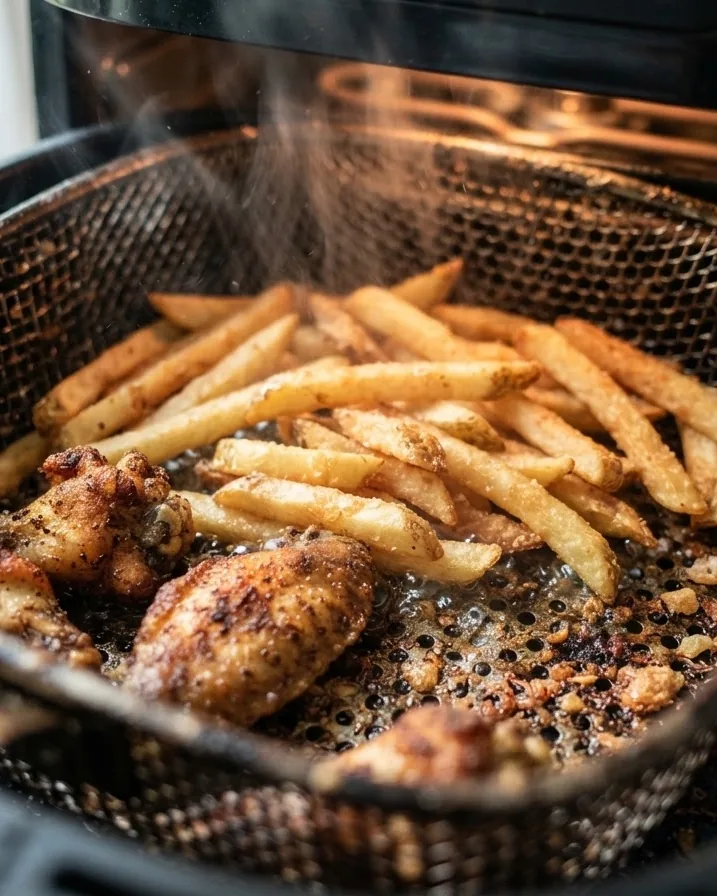
Acrylamide, the real chemical concern
Acrylamide is the one worth understanding properly, because it is the source of most air fryer cancer headlines. It is not added to anything. It forms on its own when starchy foods are cooked at high heat, above roughly 120 C, which is 248 F. According to the American Cancer Society, it comes from a reaction between a natural amino acid, asparagine, and the sugars already in the food, part of the same browning chemistry that makes toast brown.
You are not going to keep food under 248 F in an air fryer, so acrylamide will form to some degree in fries, chips, roasted potatoes, bread, and anything starchy that browns. The American Cancer Society lists French fries, potato chips, breakfast cereals, bread, and coffee among the higher sources. So where does the risk actually stand?
Here is the honest picture. The International Agency for Research on Cancer classifies acrylamide as probably carcinogenic to humans, the National Toxicology Program lists it as reasonably anticipated to be a human carcinogen, and the EPA calls it likely to be carcinogenic. Those labels sound alarming, but they rest mainly on high-dose animal studies. The American Cancer Society is direct about the human side: studies in people “have not given consistent results,” and the link between dietary acrylamide and cancer in humans is not established. Acrylamide in food is not even assigned a legal limit in the U.S.; the FDA issues voluntary guidance to help lower it.
The useful part is that air frying is on the good side of this equation, not the bad one. The FDA notes that among common potato methods, deep frying produces the most acrylamide, while roasting produces less. Because an air fryer roasts with little to no oil rather than submerging food, it lands in the lower-acrylamide range for the same food, and you control the browning directly with time and temperature.
The FDA publishes specific steps to cut acrylamide at home, and they map cleanly onto air frying:
- Soak raw potato slices in water for 15 to 30 minutes before cooking, then drain and blot them dry so they do not splatter.
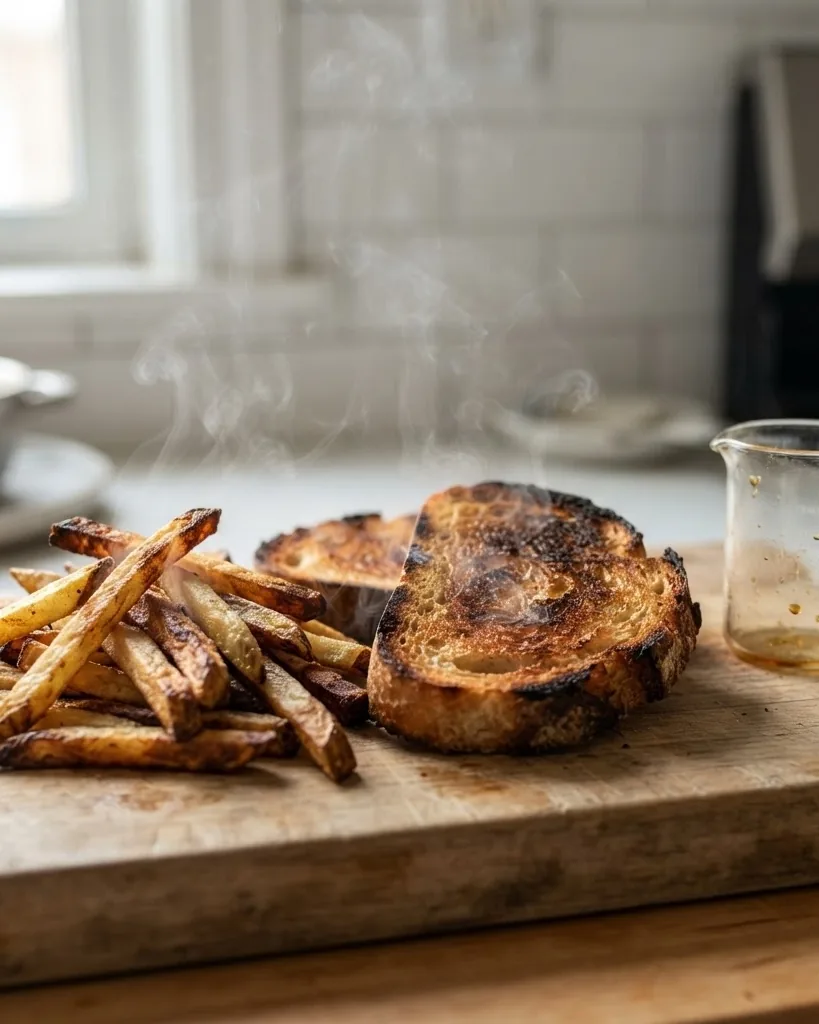
- Cook cut potato products to a golden yellow color, not brown. The brown areas carry more acrylamide.
- Store potatoes in a cool, dark pantry, not the refrigerator. Cold storage raises acrylamide when the potatoes are later cooked.
- Remember that boiling, or microwaving a whole potato with the skin on, produces essentially no acrylamide, so vary your methods.
Compare the soak-and-blot step on the same russets: one batch straight in and one soaked 20 minutes, both at 380 F for 18 minutes. The soaked batch came out paler and, honestly, crispier, because pulling surface starch helps the exterior set. That is the rare case where the safer choice is also the better-tasting one. My full method lives in cooking French fries in an air fryer, and the golden-not-brown rule is baked into it.
PFAS and the nonstick coating question
The second concern is the basket itself. Many air fryers use a PTFE nonstick coating, the Teflon-type surface, and PTFE belongs to the PFAS family, the so-called forever chemicals. The EPA links broad PFAS exposure to effects including raised cholesterol, changes in immune response, developmental effects, and increased risk of certain cancers, so the family name earns its caution.
The important nuance is temperature. PTFE is chemically stable at normal cooking heat. It only starts to break down and release fumes above about 260 C, which is 500 F. Most consumer air fryers top out near 400 F, and a few reach 450 F, both below that degradation threshold. Overheated nonstick fumes can cause temporary flu-like symptoms sometimes called polymer fume fever, but that is an empty-pan, way-too-hot scenario, not a batch of wings at 400 F.
What actually damages a coating in real kitchens is not the set temperature, it is scratching. Once the surface is gouged and flaking, you lose the barrier and you are eating flecks. A basket showing bare metal at the corners is due for retirement. A few habits keep the coating intact:
- Use silicone or wooden tools, never metal tongs or forks against the coated surface.
- Skip aggressive cooking sprays with propellants; they can build a sticky, hard-to-clean film that tempts you to scrub harder. Brush oil on instead.
- Hand-wash with a soft sponge rather than running the basket through a harsh dishwasher cycle.
- Never run the unit empty on high to “burn off” residue.
If you want to sidestep PTFE entirely, that is a legitimate choice and the market now supports it. Stainless steel baskets, borosilicate glass basins, and verified PFAS-free ceramic coatings all avoid the chemistry. A stainless rack is the better choice for anything acidic or when cooking for someone who asks. For a related surface question people always raise, whether you can drop in a liner, see the breakdown on using aluminum foil in an air fryer safely.
It is worth being honest about the tradeoff, because the PFAS-free options are not free wins. Ceramic coatings, the mineral-based sol-gel type you see on Cosori and Ninja ceramic lines, contain no PTFE and no PFAS, which is the selling point. They also tend to lose their nonstick slickness faster than PTFE, often within a year of daily use, so you end up spraying more oil to compensate. Stainless steel and glass never degrade chemically, but food sticks harder and they are heavier to handle. Glass-bowl models let you watch the food, though the bowls are fragile and can chip. There is no surface that is simultaneously the most nonstick, the most durable, and the most inert. You are picking which two matter to you.
One coating point that gets missed: the phrase PFAS-free on a box is a marketing claim, not a certification. If avoiding PFAS is the whole reason you are buying, look for a specific statement that the coating is free of PFOA and PTFE, not just a vague label. Some boxes say non-toxic while quietly still using a fluoropolymer basket.
Plastic parts and what heat does to them
The basket coating gets all the attention, but air fryers also have plastic housings, handles, and sometimes plastic-topped baskets, and heat plus plastic is a fair question. The good news is that the plastic on a reputable unit sits in the housing and handle, away from the heating element, and is rated for the appliance’s temperature range. The food chamber itself is metal or coated metal, not plastic. Problems come from misuse: melting a plastic handle by resting it against the hot body, or putting a non-oven-safe plastic accessory inside the drawer. A silicone-and-plastic tong tip left draped over the rim during a cook can melt, so keep accessories out until you need them. Keep plastic accessories out of the running chamber unless the manufacturer rates them for it, and never microwave-style improvise with random containers inside the basket.
Burns, steam, and the risks people underrate
Here is the part the cancer headlines skip: the injury you are actually most likely to get from an air fryer is a burn. The basket, the drawer, and the food inside all sit at cooking temperature, often 350 to 400 F, and a blast of superheated air escapes the second you pull the drawer. A hot rim easily catches the back of a hand, and the worst burns come from leaning over the open drawer straight into the steam.
These are ordinary hot-appliance hazards, and they are entirely manageable:
- Pull the drawer, then wait two or three seconds and step back before reaching in. Let the first rush of hot air clear.
- Set the basket on a trivet or heat pad, never straight onto a laminate counter.
- Give the unit 4 to 5 inches of clearance from walls and cabinets so the exhaust vent is not blowing hot air into wood.
- Do not overfill. A packed basket blocks airflow, cooks unevenly, and can push food against the element.
- Do not run it unattended for long stretches, and keep the cord clear of the hot body. Overloaded outlets and trailing cords are the usual small-appliance fire causes.
One food-safety point sits above the appliance entirely. Poultry has to reach an internal temperature of 165 F to be safe, per USDA, and a crisp brown exterior tells you nothing about the inside. An air fryer browns fast, which can fool you into pulling chicken early. Keep an instant-read probe next to the machine and check the thickest part every time. Crisp is not the same as cooked.
Concern-by-concern safety table
This table is built from the sources above, to put every worry next to its real risk level and the fix.
| Concern | Real risk level | How to mitigate it |
|---|---|---|
| Acrylamide in starchy foods | Low to moderate; human dietary link unproven | Soak potatoes 15-30 min, cook to golden not brown, vary methods (boil, microwave) |
| PFAS from PTFE coating | Low in normal use; stable below ~500 F | Stay under 450 F, avoid metal tools, replace scratched baskets, or buy stainless/glass/ceramic |
| Burns from basket and steam | Highest everyday risk | Wait before reaching in, use trivets and mitts, keep face clear of the drawer |
| Undercooked poultry | Moderate if you judge by color | Probe to 165 F internal (USDA), never trust the brown crust alone |
| Fire or electrical fault | Low with proper setup | 4-5 in clearance, do not overfill, clear the cord, do not run unattended long |
| Overheated nonstick fumes | Very low; empty-pan scenario | Never run empty on high; keep food or liquid in the basket |
How to keep your own use safe
None of this requires a chemistry degree. My routine is short. Soak or pat starchy food dry, cook to a golden finish instead of chasing dark color, and keep temperatures in the 350 to 400 F range where both browning and coating stability are comfortable. Probe every piece of chicken, wash the basket by hand, and swap it the moment the coating shows wear. When someone in the house is pregnant or cooking for a baby, reach for the stainless rack and lean harder on the FDA browning rules.
It is also worth remembering that a full-size oven cooks by the same hot-air browning, so the acrylamide and doneness rules here carry straight over to any high-heat method. The air fryer is not a special case to fear; it is a smaller, faster version of cooking you already do.
Who should take a little more care
For the average adult, air-fried food is a normal part of a varied diet, and the acrylamide exposure from a reasonable amount of it is small. Two groups have reason to be more deliberate. People who eat a lot of fried starches every day are stacking acrylamide from all sources, so the golden-not-brown rule matters more for them. And anyone specifically avoiding PFAS, often parents cooking for infants or people managing certain health conditions, has a clean path in the PTFE-free baskets now on the market. That is a preference worth respecting, not a defect in the appliance.
What the evidence does not support is treating the air fryer as uniquely dangerous. Every high-heat cooking method, grilling, roasting, deep frying, pan searing, creates browning compounds. The air fryer, because it needs so little oil and lets you dial the browning precisely, tends to sit at the safer end rather than the risky one.
Frequently asked questions
Do air fryers cause cancer?
No credible evidence shows that normal air fryer use causes cancer. The concern traces to acrylamide, which the American Cancer Society notes has not shown a consistent link to cancer in human dietary studies, though it is classified as a probable carcinogen based on animal data. Cook starchy food to golden rather than brown to keep it low.
Are the nonstick coatings in air fryers toxic?
The common PTFE coating is stable at normal cooking temperatures and only degrades above about 500 F, while most air fryers stay near 400 F. The real risk is a scratched, flaking basket, so use soft tools and replace worn ones. If you want to avoid PFAS entirely, choose stainless steel, glass, or verified PFAS-free ceramic.
Is air frying healthier than deep frying?
For fat content, yes. Air frying uses up to roughly 75 percent less oil, and the FDA notes deep frying produces the most acrylamide among common potato methods while lower-oil roasting produces less. That makes air frying the lower-fat, generally lower-acrylamide option for the same food.
What temperature should I avoid in an air fryer?
You do not need to fear a specific setting on a standard unit, since most max out around 400 to 450 F, below the roughly 500 F where PTFE breaks down. Avoid running the appliance empty on high heat, which is the scenario that can overheat a coating.
How do I reduce acrylamide when air frying potatoes?
Follow the FDA steps: soak raw potato slices in water for 15 to 30 minutes, drain and blot them dry, cook to a golden yellow color instead of brown, and store potatoes in a pantry rather than the fridge. These lower acrylamide without changing your recipe much.
Is it safe to use an air fryer every day?
Yes, for most people, as long as you vary what you cook and follow basic doneness and browning rules. Daily use is fine; the caution is about eating large amounts of dark-browned starchy food day after day, not about the appliance running often.
Sources: U.S. Food and Drug Administration (Acrylamide and Diet, Food Storage, and Food Preparation); American Cancer Society (Acrylamide and Cancer Risk); U.S. Environmental Protection Agency (PFAS health effects); USDA safe internal temperature guidance.
For the primary references, see the FDA guidance on acrylamide in home cooking and the American Cancer Society summary on acrylamide and cancer risk.