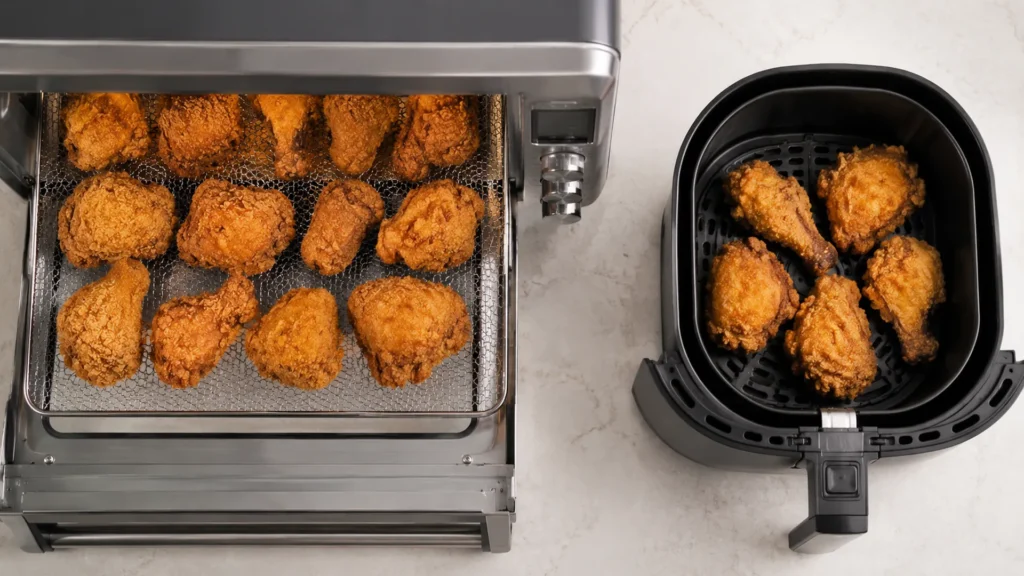
In the convection oven versus air fryer debate, the honest starting point is that they are the same machine at two different sizes. Both cook by using a fan to blow hot air around the food, and that moving air is what browns and crisps the surface. An air fryer is essentially a small, turbocharged convection oven: a tight space, a powerful fan, and a basket that lets air reach the bottom of the food. So the real question is not which technology is better, but which size and shape fits how you cook.
This guide breaks down how each one works, where the air fryer genuinely beats a full oven and where the oven wins, which foods favor which appliance, what the air fry setting on a modern oven actually does, and whether you need one, the other, or both. By the end you will know exactly which to reach for, and which to buy.
They Work the Same Way (Mostly)
A standard oven heats with elements alone, and the hot air just sits there until you open the door. A convection oven adds a fan that circulates that heat, which cooks food faster and more evenly and browns it better. An air fryer takes the same fan-forced idea and shrinks it into a countertop box, where the small cavity and strong fan move air far more aggressively over a smaller amount of food. That is the whole difference in one sentence: same method, different scale and intensity. Understanding that airflow is the key to getting good results out of either one, and our guide on how to use an air fryer covers the habits that make fan-forced cooking work.
Because the air fryer moves air so much faster across less food, it crisps more intensely and preheats in two or three minutes instead of ten or fifteen. The convection oven moves air more gently across a much larger cavity, which is gentler on delicate bakes and can hold far more food at once. Neither is doing anything the other cannot in principle; they are just tuned for different jobs.
Side by Side
 side-by-side.webp” alt=”Convection oven versus air fryer — Side by Side” title=”Side by Side” width=”1200″ height=”800″ loading=”lazy” />
| Feature | Air fryer | Convection oven |
|---|---|---|
| Capacity | Small, 1-2 servings | Large, full meals and trays |
| Preheat | 2-3 minutes | 10-15 minutes |
| Crispiness | Very high, fryer-like | Good, less intense |
| Best for | Fries, wings, snacks, reheating | Baking, roasting, batch cooking |
| Energy use | Low, heats a small space | Higher, heats a big cavity |
| Cleanup | Small basket, quick | Racks and trays, more work |
Where the Air Fryer Wins
The air fryer is the better tool any time speed and crisp matter more than volume. Its concentrated airflow and small cavity give food a deep-fried crunch that a convection oven only approaches, which is why fries, wings, breaded items, and frozen snacks come out noticeably better. It preheats almost instantly, so a quick weeknight side or a single portion is ready before the oven would even be warm. It uses less energy because it heats a tiny space rather than a large one, a real consideration in summer when you do not want to heat the whole kitchen. And reheating is where it truly shines, reviving leftover fried food and pizza far better than a microwave; our guide to reheat pizza in air fryer shows just how much better. For a fast, crunchy result like crispy potato wedges, the air fryer beats the oven on both time and texture.
Where the Convection Oven Wins
The convection oven takes the lead the moment you need capacity or gentler, more even cooking across a large surface. It can roast a whole chicken, bake several trays of cookies, or cook a sheet-pan dinner for a family, none of which fit in a typical air-fryer basket. Its larger, calmer airflow is kinder to delicate baked goods like cakes and pastries, which the aggressive fan of an air fryer can dry out or blow around. It handles tall and large items an air fryer cannot, and it lets you cook a main and a side together. If you regularly cook for more than two people, the oven is not optional. Big-batch baking in particular, from a tray of cookies to a holiday roast, belongs in the oven, and a session of cookies makes the case better than any spec sheet.
Which Foods Favor Which Appliance
The simplest way to choose in the moment is to think about the food. Anything you want crispy and quick in a small amount, like fries, wings, nuggets, roasted vegetables for one or two, bacon, or reheated leftovers, goes in the air fryer. Anything large, delicate, or in bulk, like a whole roast, a casserole, several trays of cookies, a sheet-pan meal, or a layer cake, goes in the convection oven. There is a big middle ground where either works, such as a couple of chicken breasts or a small batch of roasted potatoes, and there you simply pick based on whether you value speed or capacity that day.
| Reach for the air fryer | Reach for the convection oven |
|---|---|
| Fries, wings, frozen snacks | Whole roast or chicken |
| Reheating fried food and pizza | Several trays of cookies |
| Roasted veggies for one or two | Sheet-pan dinners for a family |
| A fast single-portion side | Cakes, pastries, delicate bakes |
The Air Fry Setting on a Convection Oven
Many newer ranges and countertop ovens now include an air fry setting, which blurs the line between the two appliances. That setting simply runs the convection fan at a higher speed, often paired with a perforated tray, to mimic the aggressive airflow of a basket air fryer. It works reasonably well, and for someone who already has such an oven it can remove the need for a separate machine. The catch is that a full oven cavity is still large, so the airflow is less concentrated than a true air fryer, and crisping is usually a step behind, especially for small batches where a dedicated air fryer really excels. It also still takes longer to preheat. For light, occasional crisping it is a fine all-in-one; for someone who air fries constantly, a standalone unit is still faster and crisper.
Energy, Speed, and Cost
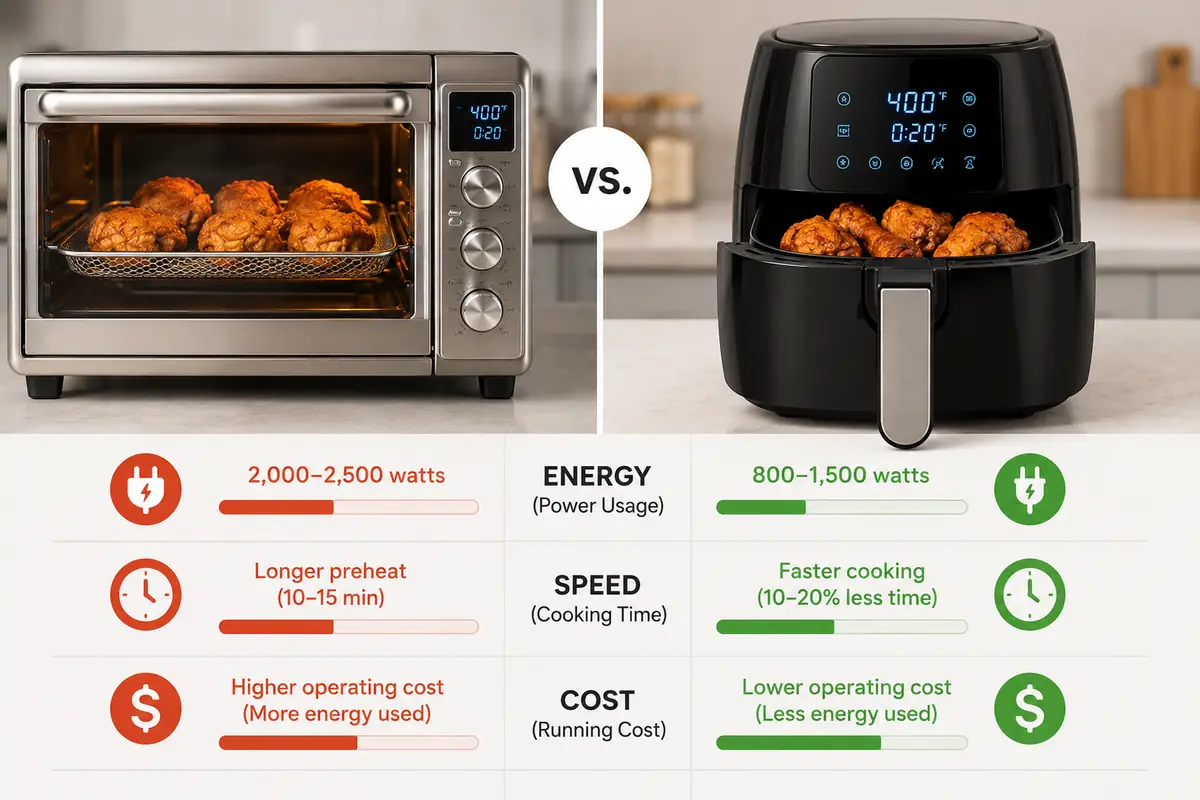
For small jobs the air fryer is the more economical choice by a clear margin. Heating a tiny cavity for a few minutes uses far less electricity than bringing a full oven up to temperature, and the faster preheat saves real time on a weeknight. A countertop air fryer is also cheaper to buy than a convection range and adds capability to a kitchen without a renovation. The math flips for large meals: cooking one big tray in the oven is more efficient than running multiple back-to-back batches in a small basket, which wastes both time and energy. So the cost-effective answer depends entirely on portion size, which is the theme of this whole comparison. To go deeper on the testing behind these appliances, America’s Test Kitchen is a reliable source, and Consumer Reports publishes independent ratings of both air fryers and ranges.
Air Fryer Ovens, Toaster Ovens, and the Middle Ground
The two-way comparison is really a spectrum once you look at what is on store shelves. At one end is the basket air fryer: small, fast, and the crispiest of the bunch for one or two servings. At the other is a full convection range built into the kitchen. In between sit a growing number of hybrids that muddy the labels. An air fryer oven is a countertop box, larger than a basket model, that uses racks instead of a basket and markets itself on air frying while really being a small convection oven with a strong fan. A convection toaster oven is the same idea from the other direction, an oven-first appliance that happens to circulate air well. These middle options trade some of the basket air fryer’s intense crisp for more capacity, which is exactly the compromise many kitchens want. If you are choosing among them, decide first whether you care more about maximum crunch on small batches or about fitting more food, because that single preference points you to the right end of the spectrum.
How to Convert Recipes Between Them
Because the two appliances share a method, moving a recipe from one to the other is mostly arithmetic. The general rule for an air fryer is to set it about 25 degrees Fahrenheit lower than a conventional oven recipe and to cut the time by roughly twenty percent, because the concentrated airflow cooks faster and browns sooner. So a tray of vegetables that a recipe says to roast at 425 degrees for 25 minutes in a regular oven would start at about 400 degrees for around 18 to 20 minutes in an air fryer, checked early. A convection oven uses a similar adjustment from a conventional recipe, usually 25 degrees lower with a modest time reduction, since the fan does some of the same work less aggressively. Going the other direction, from air fryer to oven, you nudge the temperature back up and add time, and you should expect a slightly less crisp result unless you use the oven’s own air fry or convection setting. Whichever way you convert, the safest habit is the same one that governs all fan-forced cooking: check early, because these appliances reach doneness sooner than the recipe writer assumed, and a thermometer settles any doubt on meat.
One more practical note on batching. An air fryer basket cooks a single layer at a time, so if a recipe makes more than fits, you are committing to multiple rounds, and the food from the first batch cools while the second cooks. A convection oven sidesteps that by fitting everything on one or two racks at once, which is why large gatherings tilt toward the oven even when the air fryer would crisp each individual piece a little better. Match the appliance to the quantity and you avoid the most common frustration people have after buying an air fryer, which is discovering how little fits in the basket at once.
Do You Need Both?
For many kitchens, the answer is that they complement each other rather than compete. Most homes already have an oven, convection or not, so the practical decision is usually whether to add an air fryer alongside it. If you cook small portions, crave crispy food, reheat a lot, or want to avoid heating the kitchen, a countertop air fryer is a cheap, high-impact addition that handles the jobs the oven does slowly. If you mostly cook large meals and bake in volume, the oven already covers you and an air fryer is a nice-to-have rather than a need. The one situation where you might skip the air fryer entirely is if you have a newer oven with a strong air fry setting and rarely cook for just one or two. For most people, though, the air fryer earns its counter space precisely because it does the fast, crispy, small-batch work that a big oven is clumsy at.
Frequently Asked Questions
Is an air fryer just a small convection oven?
Essentially, yes. Both use a fan to circulate hot air, which is what browns and crisps food. An air fryer concentrates that airflow in a small cavity with a powerful fan, so it crisps more intensely and preheats faster, while a convection oven spreads gentler airflow across a much larger space.
Which is better for crispy food, an air fryer or a convection oven?
The air fryer, in most cases. Its small cavity and aggressive fan give food a deep-fried crunch that a convection oven only approaches, especially for small batches of fries, wings, and breaded items. A convection oven crisps well too but is better suited to roasting and baking.
Does a convection oven cook faster than an air fryer?
Generally no for small portions. The air fryer preheats in two to three minutes versus ten to fifteen for an oven, and its concentrated heat cooks small amounts quickly. A convection oven can be more efficient for large meals because it cooks everything in one big batch.
Can a convection oven replace an air fryer?
It can come close, particularly one with a dedicated air fry setting and a perforated tray. For light or occasional crisping it may remove the need for a separate machine, but a standalone air fryer still preheats faster and crisps small batches better because its airflow is more concentrated.
Is an air fryer more energy efficient than a convection oven?
For small jobs, yes, because it heats a tiny space for a few minutes rather than a large cavity. For big meals the oven is more efficient, since cooking one large tray beats running several small batches back to back in an air fryer.
Should I buy an air fryer if I already have a convection oven?
If you cook small portions, love crispy food, or reheat often, an air fryer is a cheap, high-impact addition that does those jobs faster than the oven. If you mostly cook large meals and your oven has a strong air fry setting, you may not need one.
Which should I buy first, an air fryer or a convection oven?
Most homes already have an oven, so for the majority of people the practical first purchase is a countertop air fryer, which adds fast, crispy, small-batch cooking that a standard oven does slowly. If you are furnishing a kitchen from scratch and can buy only one cooking appliance, a convection oven or a convection-capable range is the more essential choice, because it can roast, bake, and cook full meals that an air fryer basket cannot hold. In short, the oven is the foundation and the air fryer is the high-value upgrade most kitchens add on top.
Do convection ovens and air fryers use less oil than frying?
Both do, because they crisp with circulating hot air rather than submerging food in oil, so you need only a light coating or none at all. The air fryer tends to get closest to deep-fried texture with the least oil thanks to its concentrated airflow, while a convection oven gives a similar benefit across larger batches. Either way, you cut most of the oil a deep fryer would use.
Bottom Line
The convection oven versus air fryer choice is less a rivalry than a question of scale, because both cook with the same fan-forced heat. The air fryer wins on speed, crispiness, energy use for small jobs, and reheating, while the convection oven wins on capacity, batch baking, and delicate or large dishes. If you cook for one or two and want crunch fast, the air fryer is the smarter buy; if you feed a family and bake in volume, the oven is essential. For most kitchens the happiest answer is both, letting each do the work it was built for. Match the appliance to the portion in front of you, lean on the air fryer for speed and crisp and the oven for size and baking, and you will rarely reach for the wrong one twice.