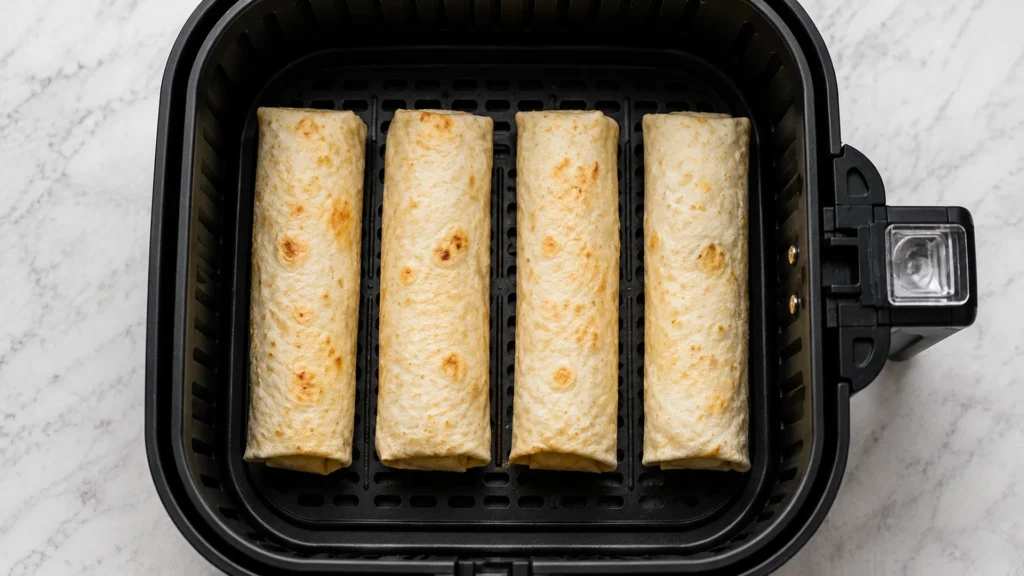
Frozen burritos in air fryer cook in 12 to 15 minutes at 350 degrees Fahrenheit, flipping once, and come out with a crisp, golden tortilla and a filling that is hot all the way to the center. No thawing, no soggy microwave tortilla, no waiting 30 minutes for the oven. The air fryer is the single best way to cook a frozen burrito, because it crisps the outside while the steady heat thaws and warms the dense frozen filling from every side. This is the upgrade that takes a frozen burrito from a sad desk lunch to something you actually look forward to.
Below you will find the exact time and temperature, the trick to a crisp shell versus a soft one, how to keep the center from staying cold, brand-by-brand notes for the burritos people actually buy, and the fixes for the two things that go wrong. Frozen burritos are one of the most forgiving things you can make in an air fryer, and once you dial in the method you will never microwave one again.
The Exact Time and Temperature for Frozen Burritos
Cook frozen burritos at 350 degrees Fahrenheit for 12 to 15 minutes, flipping once at the halfway mark. The lower temperature is deliberate: a frozen burrito is dense, so you need time for the heat to reach the frozen center without scorching the tortilla. If you run it too hot, the outside browns and even burns while the middle stays icy. Patience at a moderate temperature is what gets you hot-all-the-way-through.
The pattern is simple: denser and larger burritos with meat need more time to thaw through, breakfast and mini burritos are lighter and finish faster, and you adjust the time rather than the temperature. Let the burrito rest 1 to 2 minutes after cooking before you bite in, because the filling comes out screaming hot and the rest lets the heat even out.
Why the Air Fryer Beats the Microwave for Burritos
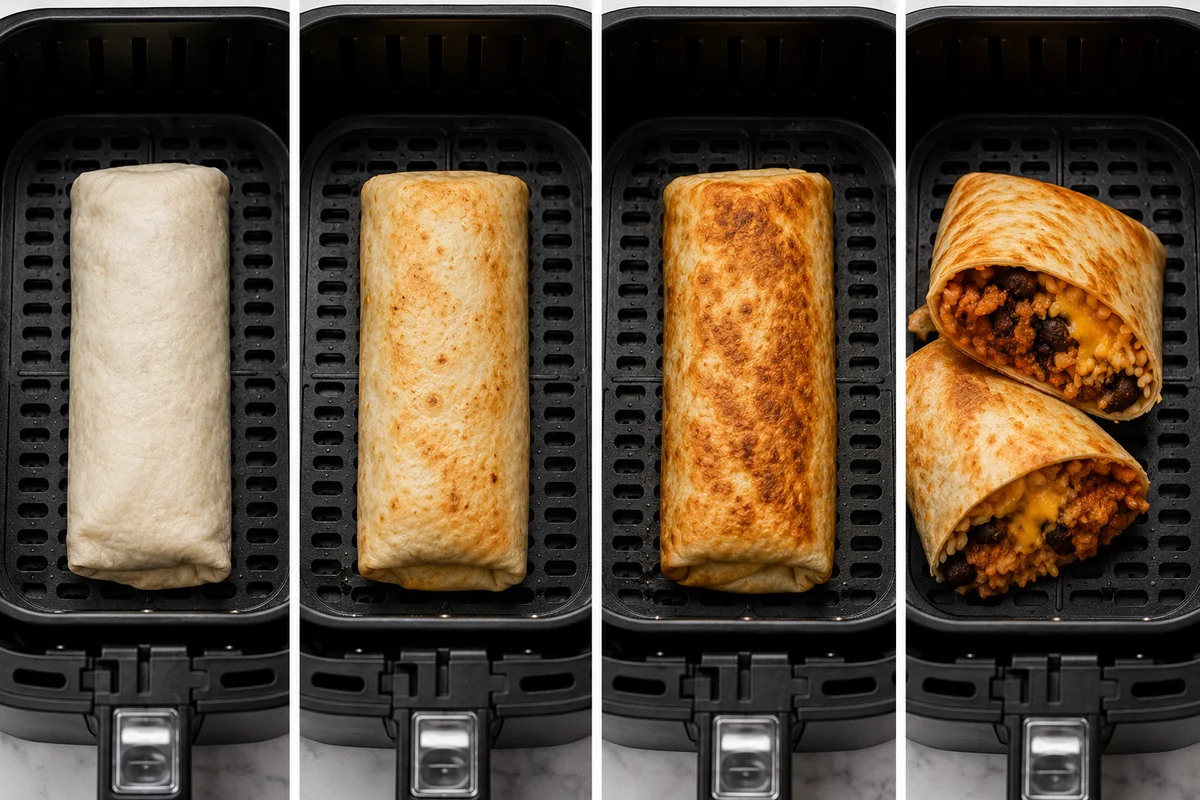
A frozen burrito is a texture puzzle: you want a crisp tortilla and a hot filling at the same time, and most methods give you one but not the other. The microwave heats the filling fast but steams the tortilla into a damp, chewy wrapper, and it famously leaves a molten edge with a frozen core. A full oven gets a good crisp but makes you wait through a long preheat for one burrito. The air fryer surrounds the burrito with moving hot air that crisps the tortilla on every side while the steady heat soaks into the frozen center, so you get both at once in about the same time the oven takes just to warm up.
That all-around airflow is why the tortilla browns evenly instead of crisping on one side, and why the filling thaws through rather than cooking only at the edges. If you are still learning how your machine moves heat, our guide to how to use an air fryer walks through preheating and basket spacing, both of which help burritos cook evenly. The short version: a single layer and a flip are all it takes.
Step by Step
- Take the burritos out of all packaging, including any plastic wrap. Do not cook a burrito in its wrapper or in a paper sleeve.
- Preheat the air fryer to 350 degrees for 3 minutes if your model preheats. A warm basket starts crisping the tortilla right away.
- Place the burritos in the basket in a single layer, seam-side up so any filling that leaks does not pool on the basket. They can be close but should not overlap.
- Optionally spray the burritos lightly with oil for a crispier, more golden shell. Skip the oil if you prefer a softer tortilla.
- Cook for 6 to 7 minutes, then flip each burrito and cook another 6 to 8 minutes until the tortilla is golden and crisp and the burrito feels hot and firm in the middle.
- Let them rest 1 to 2 minutes before eating, since the filling is extremely hot straight out of the basket. Then add your toppings and dig in.
The seam-up tip is worth following, because frozen burritos sometimes leak a little filling as they heat, and seam-up keeps that from welding to the basket. If you are cooking several, leave a little space between them so the air can circulate; crammed burritos crisp unevenly and the touching sides stay pale.
Crispy Shell or Soft Tortilla: You Choose
One of the best things about cooking burritos this way is that you control the texture. For a crisp, golden, almost-fried tortilla, spray the burrito lightly with oil before cooking and give it the full time at 350. The oil helps the surface brown and crisp into a satisfying crunch that contrasts with the soft filling inside. This is the version that wins people over from microwaved burritos.
For a softer tortilla closer to a steamed burrito, skip the oil entirely and pull the burrito a minute or two earlier, as soon as the filling is hot. Without oil and with slightly less time, the tortilla warms and softens rather than crisping. You can also split the difference: most people land on a light oil spray and the full time, which gives a tortilla that is crisp on the outside but still pliable enough to bite cleanly. There is no wrong answer here, just preference.
Keeping the Center From Staying Cold
The classic frozen-burrito failure is a hot, crisp outside with a still-frozen core, and it is almost always caused by cooking too hot for too short a time. A burrito is dense and frozen solid, so the heat needs time to work its way to the center. Cooking at 350 rather than 400, and giving the full time with a flip, solves this for nearly every burrito. The flip matters because it exposes both faces to the airflow and helps the heat reach the middle evenly.
If you cut into a burrito and the very center is still cool, you have two easy fixes. Put it back in the air fryer for another 2 to 3 minutes, which is the cleanest option, or microwave it for 20 seconds to finish the center without overbrowning the now-crisp outside. For especially thick or stuffed burritos, some people microwave them for 30 to 60 seconds first to take the deep chill off, then air fry to crisp the shell; this hybrid approach guarantees a hot center on the densest burritos. The bigger the burrito, the more this matters.
Notes on Popular Frozen Burrito Brands
Different brands behave a little differently, and a few notes help. El Monterey burritos, the bean-and-cheese and beef-and-bean varieties that are the most common, are on the smaller side and crisp up well at 350 for 12 to 15 minutes. Amy’s and other organic or veggie burritos tend to have thicker tortillas and denser fillings, so give them the longer end of the range and consider the microwave-first trick if the center lags. Breakfast burritos with egg, cheese, and potato are lighter and cook faster, usually done at 10 to 13 minutes.
Larger stuffed burritos, the meal-sized ones, need 15 to 18 minutes and really benefit from a flip and a rest. Whatever the brand, the method is the same: single layer, seam-up, 350 degrees, flip once, and check the center before serving. Homemade frozen burritos work exactly the same way, though their timing depends on how thickly you packed them, so check a minute or two early the first time and note what works. If you batch-make and freeze your own, the air fryer is the easiest way to cook them one or two at a time.
Troubleshooting: Cold, Burnt, or Soggy Burritos
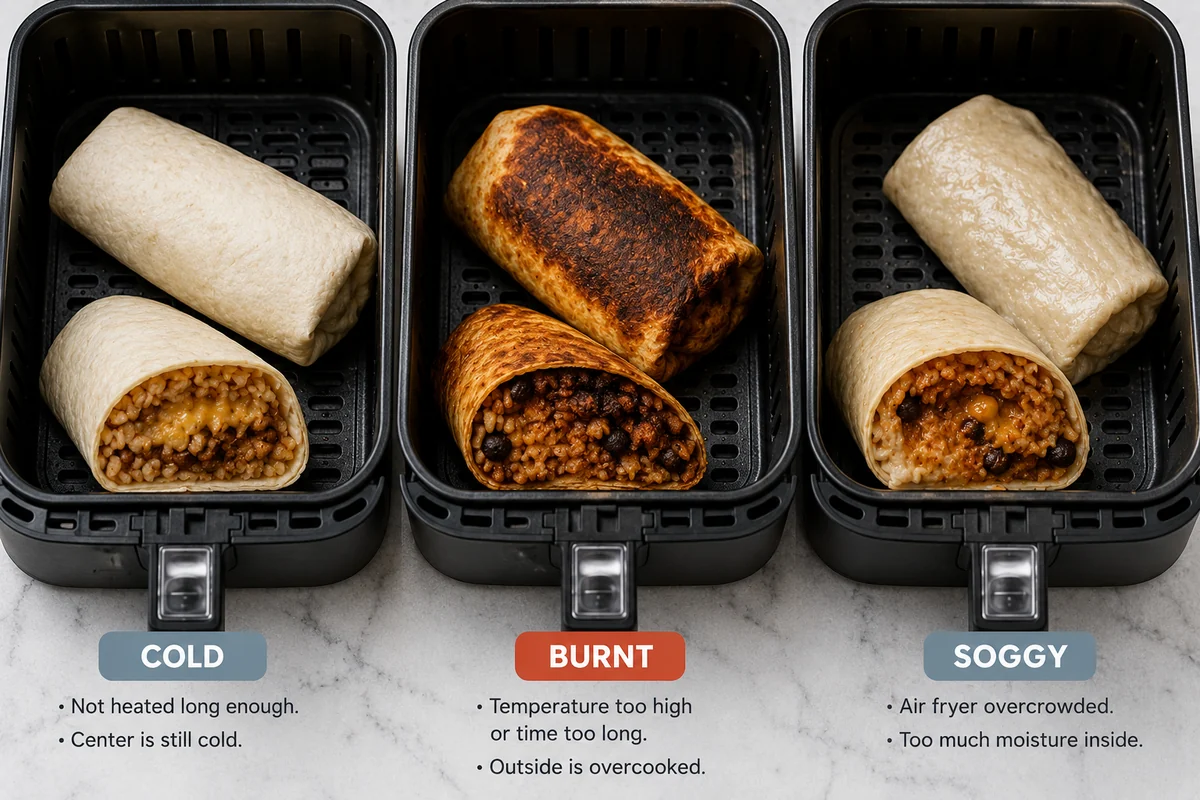
Nearly every burrito problem comes down to temperature, time, or crowding. Here are the fixes for the issues people actually hit, the part most recipes skip.
| Problem | Cause | Fix |
|---|---|---|
| Cold or frozen center | Too hot, too little time | 350 F, full time, flip once |
| Burnt or dark tortilla | Temperature too high | Drop to 350, check at 12 min |
| Soft, not crisp | No oil or basket crowded | Light oil spray, single layer |
| Filling leaking out | Seam down or overcooked | Cook seam-up, do not overcook |
| Uneven, one side pale | Never flipped | Flip at the halfway mark |
The cold-center problem is the most common, and the answer is almost always lower heat and more time, not the reverse. People crank the temperature thinking it cooks faster, but all that does is burn the tortilla before the middle thaws. The second issue, a soft tortilla when you wanted crisp, is fixed by a light oil spray and making sure the burritos are not crowded so the air can crisp every side.
Leaking filling deserves a quick note, because it is the messiest issue. Burritos leak when the seam faces down, so the gap in the tortilla opens against the basket and filling oozes out and bakes onto the metal. Cooking seam-up keeps the fold on top, so even if it opens slightly the filling stays put. Overcooking also causes leaks, since the filling expands and bursts a weak seam, which is one more reason to pull the burrito as soon as the center is hot rather than letting it ride. If a burrito does leak, a quick wipe of the basket while it is still warm cleans it easily before the spill hardens.
Making Your Own Freezer Burritos for the Air Fryer
If you cook frozen burritos often, making a batch of your own is cheaper and tastes better, and the air fryer cooks them perfectly. Fill flour tortillas with cooked rice, beans, seasoned meat or sauteed vegetables, and cheese, but keep the fillings on the drier side, since wet fillings make a soggy tortilla and can leak as they cook. Drain and cool any cooked fillings before rolling so condensation does not build up inside the wrap.
Roll each burrito tightly with the ends folded in, then wrap it individually in foil or parchment and freeze on a tray until solid before bagging them together. When you want one, unwrap it completely and cook from frozen at 350 degrees for 13 to 16 minutes, flipping once, adjusting for how thickly you packed it. Homemade burritos are often denser than store-bought, so check the center the first time and note the timing that works for your size. The reward is a from-scratch burrito ready whenever you want it, with a crisp shell the microwave could never give. A light oil spray before cooking gives homemade burritos the same golden crunch as the oiled store-bought version.
Air Fryer Model and Wattage Differences
Air fryers vary in power, and burritos are sensitive to it because they are dense and frozen. A high-wattage basket around 1700 watts heats fast and cooks burritos in the times above, while a lower-wattage budget unit moves air more gently and may need a couple of extra minutes for the center to thaw through. If your machine runs hot, which many compact baskets do, check the tortilla at 12 minutes so it does not overbrown before the inside is ready.
Larger oven-style air fryers with racks cook burritos well but heat less evenly than a small basket, so rotate the tray or move it to a different shelf at the flip. The flip itself matters more on lower-power machines, where the airflow needs help reaching both faces. The first time you cook a particular brand of burrito in your machine, treat it as a test: check at the early end of the time range, note when the center is hot and the shell is crisp, and you will have your number for next time. After one batch the guesswork disappears.
Toppings, Sides, and What to Serve
A frozen burrito becomes a real meal with a few toppings. Once it is out and rested, pile on salsa, guacamole, sour cream or Greek yogurt, shredded cheese, hot sauce, or pico de gallo. For a fuller plate, serve it with Mexican rice, refried beans, a side salad, or a few air fryer veggies cooked right after the burrito in the same basket. Because the air fryer handles multiple jobs, you can crisp a side or warm a batch of air fryer hard boiled eggs for extra protein alongside a breakfast burrito.
If you are deciding whether your countertop convection oven could cook burritos as well as a basket air fryer, the airflow design changes how evenly the tortilla crisps, and we lay out the differences in our comparison of the convection oven versus air fryer. For one or two burritos, a basket model usually crisps faster and more evenly. For testing-backed technique on frozen foods and reheating, America’s Test Kitchen is a reliable reference, and Consumer Reports independently tests air fryer models if you are still shopping.
Frequently Asked Questions
How long do you cook frozen burritos in an air fryer?
Cook standard frozen burritos at 350 degrees Fahrenheit for 12 to 15 minutes, flipping once halfway through. Beef and bean burritos take 13 to 16 minutes, breakfast burritos 10 to 13, and large stuffed burritos 15 to 18. Check that the center is hot before serving, and let it rest 1 to 2 minutes.
What temperature for frozen burritos in an air fryer?
Use 350 degrees Fahrenheit. This is lower than you might expect, and on purpose: a frozen burrito is dense, so a moderate temperature gives the heat time to reach the frozen center without burning the tortilla. Higher heat browns the outside before the middle thaws, leaving a cold core.
Do you need to thaw frozen burritos before air frying?
No, cook them straight from frozen. Thawing is unnecessary and can make the tortilla soggy. Just remove all packaging, place the burritos seam-side up in a single layer, and cook to the times above. For very thick burritos, a quick 30-second microwave first helps the center, but it is optional.
Why is my frozen burrito still cold in the middle?
A cold center means the burrito cooked too hot for too short a time, so the outside finished before the heat reached the frozen middle. Cook at 350 degrees for the full time and flip once. If the center is still cool, return it to the air fryer for 2 to 3 minutes or microwave it for 20 seconds to finish.
How do you make frozen burritos crispy in an air fryer?
Spray the burrito lightly with oil before cooking and give it the full time at 350 degrees, flipping once. The oil helps the tortilla brown into a crisp, golden shell. Make sure the burritos are in a single layer with space around them, since crowding leaves the touching sides soft instead of crisp.
Can you cook multiple frozen burritos at once?
Yes, as long as they fit in a single layer without overlapping. Leave a little space between them so the air can circulate and crisp every side, and add 1 to 2 minutes to the time for a full basket. Most standard baskets fit three to four burritos comfortably.
Bottom Line
Frozen burritos in the air fryer are about as easy as cooking gets, and the result beats the microwave every time: 350 degrees for 12 to 15 minutes, seam-side up in a single layer, flipped once. Keep the temperature moderate so the center thaws through before the tortilla burns, spray with oil for a crisp shell or skip it for a soft one, and rest the burrito a minute before that first hot bite. Pile on your toppings, serve it with rice and beans, and the frozen burrito earns its place as a fast meal worth making on purpose.