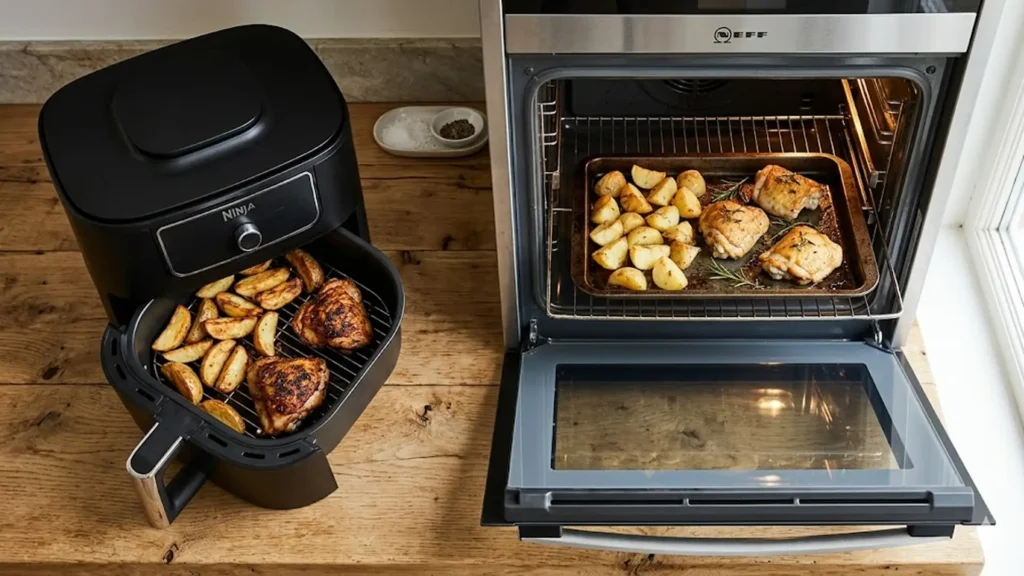
Air fryer vs conventional oven comes down to one physical difference that drives everything else: an air fryer blows hot air across your food with a fan, while a standard conventional oven heats with still, radiant air that just sits in the cavity. That single factor is why the air fryer crisps harder, preheats in two to three minutes instead of ten to fifteen, and cooks small portions faster, while the conventional oven holds far more food and bakes delicate items more gently. If you only remember one thing, remember that the fan is the whole story.
This guide goes past the marketing copy. We will cover exactly how each appliance moves heat, real preheat and cook-time numbers, how much electricity each one draws, a temperature and time conversion you can actually use, a food-by-food breakdown of which machine wins, the most common mistakes people make switching between them, and a clear answer to whether you should own both. Everything here is set in US units and the kind of time and temperature detail you need to cook with confidence.
How Each One Actually Heats Food
A conventional oven cooks with radiant heat. The bake element at the bottom and the broil element at the top warm the air in a large cavity, and that hot, mostly still air slowly transfers heat to whatever you put inside. Because the air is not moving much, the spot nearest an element runs hotter, which is why a conventional oven has real hot spots and why you rotate trays halfway through. The large cavity also takes a long time to come up to temperature, and every time you open the door a big slug of heat escapes.
An air fryer is a small chamber with a powerful fan at the top and a heating element right beside it. The fan forces hot air down and around the food at high speed, and the perforated basket lets that air reach the underside too. Fast-moving air strips away the cool, damp layer that normally clings to a food’s surface, so moisture evaporates quickly and the outside browns and crisps the way deep frying does, but with little or no oil. That aggressive convection is the reason an air fryer turns out a crunchier fry than a still-air oven ever will. If you want the habits that make fan-forced cooking reliable, our guide on how to cook in an air fryer walks through the basics.
Speed and Preheat: The Air Fryer’s Biggest Edge
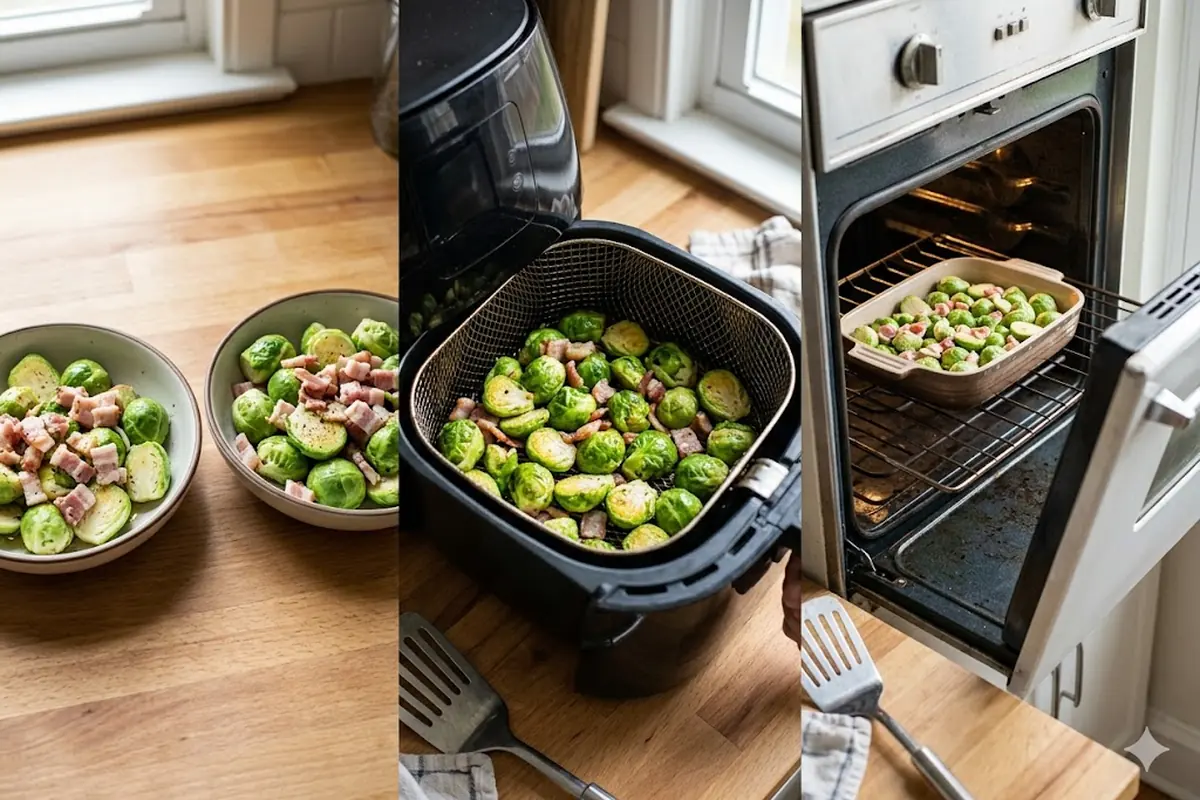
For everyday cooking, the largest practical gap is preheat time. A conventional oven needs roughly 10 to 15 minutes to reach 400 degrees Fahrenheit, and larger or older ovens can take longer. An air fryer reaches the same temperature in about 2 to 3 minutes, and many cooks skip a formal preheat entirely for forgiving foods like frozen fries. On a weeknight that difference alone can shave 10 minutes off dinner.
Cook time follows the same pattern for small portions. Because the air fryer concentrates fast-moving heat on a single layer of food, a batch of wings or a couple of chicken thighs finishes noticeably sooner than in a still-air oven, often 20 to 25 percent faster. The advantage shrinks or disappears once you need volume, because the basket only holds one layer at a time and you end up cooking in rounds. A conventional oven loses the preheat race but wins on throughput, cooking a full sheet pan in one shot.
Energy and Running Cost
People assume the bigger appliance always costs more to run, and for small jobs that is true. A typical countertop air fryer draws about 1,400 to 1,700 watts, similar to a single oven element, but it heats a chamber a fraction of the size and runs for far less time. Heating a tiny cavity for 15 minutes uses a small fraction of the electricity it takes to bring a full oven up to temperature and hold it there, especially once you count the long preheat. In summer the air fryer has a second cost advantage: it barely warms the kitchen, so your air conditioner is not fighting a hot oven.
The math flips for large meals. A full-size oven pulls more power, often the equivalent of 2,000 to 5,000 watts across its elements, but it cooks a whole tray, a roast, or several dishes at once. Cooking one large batch in the oven beats running three or four back-to-back rounds in a small basket, which wastes both time and energy and leaves the first batch cold. So the honest answer on cost is the same as on everything else: the air fryer is cheaper for small portions, the oven is cheaper per serving for big ones.
If you want a rough rule of thumb, the crossover point is around three to four servings. Below that, the air fryer almost always uses less total energy because the long oven preheat dominates a short cook. Above that, the oven pulls ahead because you are heating one cavity once instead of cycling a basket several times. None of this is a huge sum on a single meal, but over a year of weeknight dinners the habit of grabbing the small appliance for small jobs and the big one for big jobs adds up, and it keeps your kitchen cooler in the process. The point is not to obsess over watts but to stop running a full oven for ten minutes of food.
Temperature and Time Conversion You Can Use
Because the air fryer moves heat so aggressively, you cannot just drop an oven recipe in at the same settings or you will scorch the outside before the inside is done. The reliable rule is to lower the temperature by about 25 degrees Fahrenheit and cut the time by roughly 20 percent, then check early. Going the other way, from an air fryer recipe to a conventional oven, you raise the temperature back up by 25 degrees and add time, and you should expect a slightly less crisp result.
| Conventional oven recipe | Air fryer setting | Time change |
|---|---|---|
| 350 F | 325 F | Cut about 20 percent |
| 375 F | 350 F | Cut about 20 percent |
| 400 F | 375 F | Cut about 20 percent |
| 425 F | 400 F | Check at 70 percent of time |
| 450 F | 425 F | Check at 70 percent of time |
A concrete example: a tray of vegetables a recipe says to roast at 425 degrees for 25 minutes in a conventional oven would start at about 400 degrees for 18 to 20 minutes in an air fryer, checked at the 14-minute mark. For anything with meat, ignore the clock and trust a thermometer, because the faster appliance reaches doneness sooner than the recipe writer assumed.
Which Foods Favor Which Appliance
The fastest way to choose in the moment is to look at the food. Anything you want crispy, fast, and in a small amount belongs in the air fryer. Anything large, delicate, or in bulk belongs in the conventional oven. Most of the daily wins for the air fryer are exactly the foods people miss from a deep fryer.
| Reach for the air fryer | Reach for the conventional oven |
|---|---|
| Fries, wings, nuggets, frozen snacks | Whole roast or whole chicken |
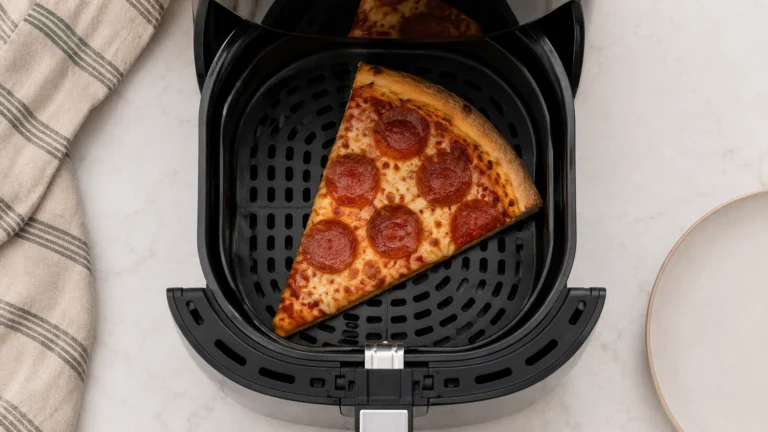
| Reheating fried food and pizza | Several trays of cookies or a layer cake |
| Roasted vegetables for one or two | Sheet-pan dinners for a family |
| Bacon, sausages, a couple of thighs | Casseroles and anything tall |
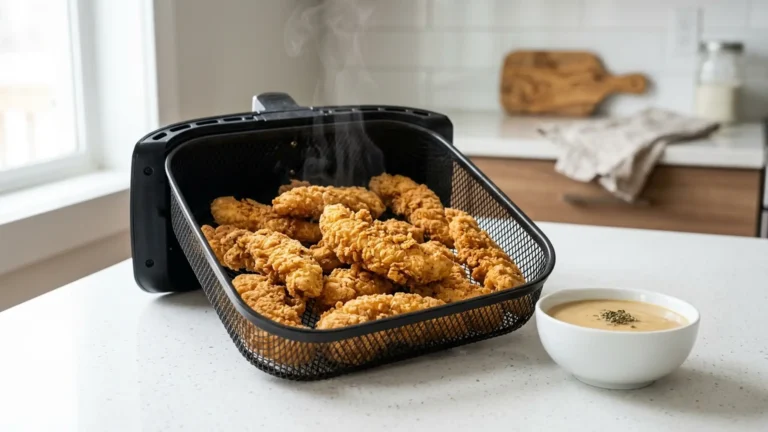
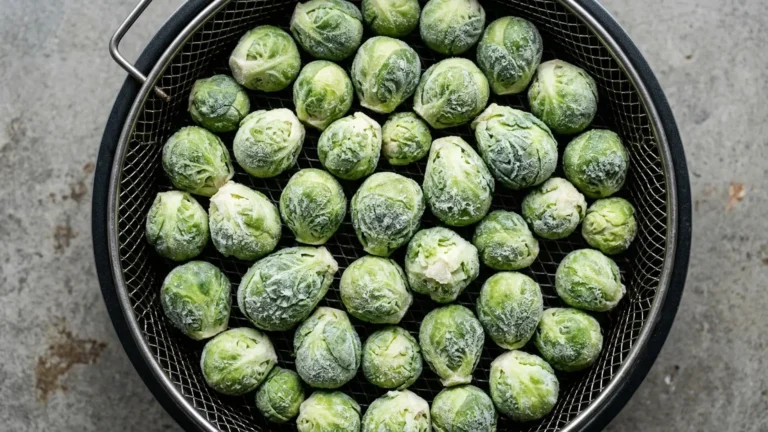
Frozen fries are the classic case where the air fryer simply wins on both speed and texture, and our breakdown of how to cook frozen fries in an air fryer gives times for every cut. Sausages and brats are another easy air-fryer job that the oven does more slowly and with less browning, as the times in our guide to cooking bratwurst in an air fryer show. On the other side, batch baking belongs in the oven, where a tray of cookies all comes out at once instead of three small rounds in a basket.
Texture and Even Cooking
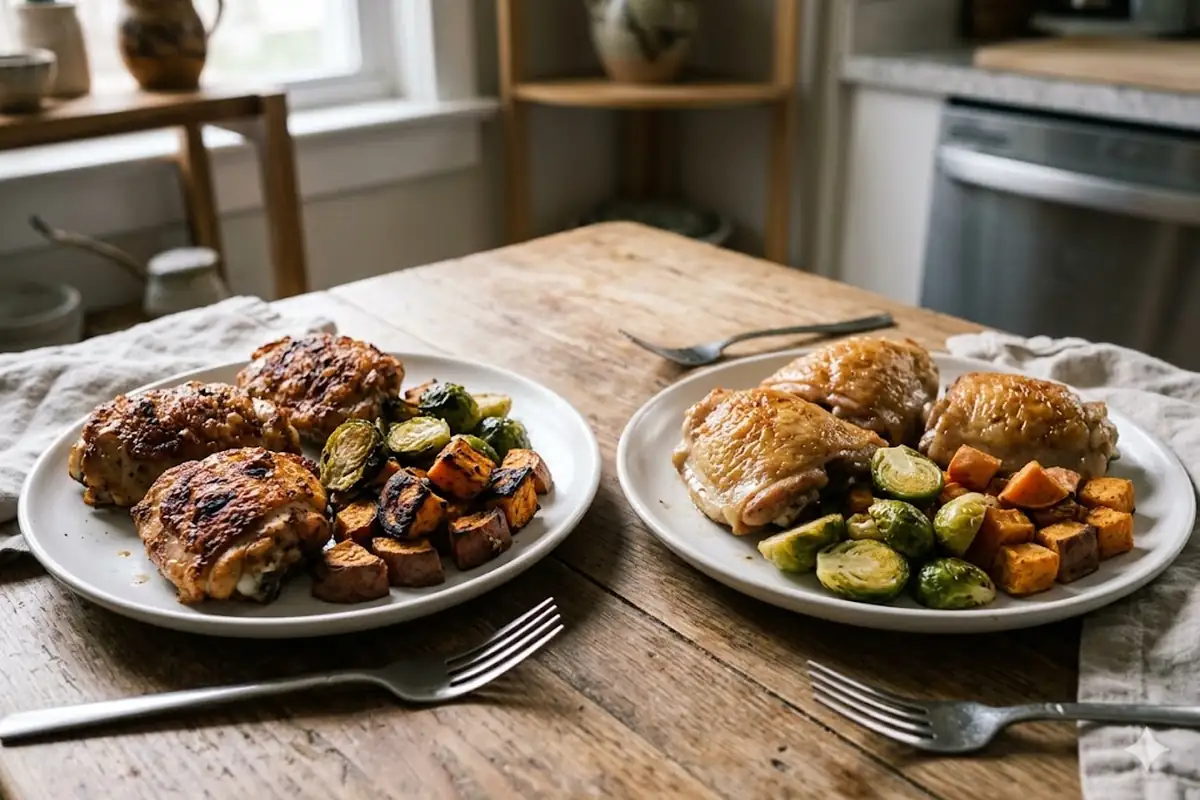
The air fryer’s strength is also its weakness. That aggressive fan gives unbeatable crisp on small batches, but it can dry out delicate items like cakes, custards, and lean fish if you are not careful, and it can physically blow light foods, parchment, and herbs around the basket. A conventional oven’s still, gentle heat is kinder to anything that needs to set slowly without forming a hard crust, which is why bakers prefer it for tender crumb and even rise.
Evenness also differs. In an air fryer, food touching the basket and food piled in the middle cook at different rates, so you must keep to a single layer and shake or flip partway through. A conventional oven’s larger cavity gives more room around each item, but its hot spots mean you rotate the pan instead. Both reward attention, just in different ways: shake the basket, or turn the tray.
There is also a moisture difference worth knowing. A conventional oven holds a larger pocket of air, so a roast or a loaf of bread sits in a more humid environment that helps the inside stay tender while the crust forms slowly. The air fryer’s constant high-speed airflow pulls moisture off the surface fast, which is perfect for crisping a coating but can leave lean cuts and plain chicken breast dry if you overcook them by even a couple of minutes. The fix in the air fryer is a light oil coating, a slightly lower temperature for thick cuts, and pulling food the moment a thermometer hits target. In the oven, the fix for dryness is usually the opposite problem, covering with foil early so the surface does not set before the center cooks. Knowing which way each appliance errs lets you steer around its weak point instead of fighting it.
Common Mistakes When Switching Between Them
The biggest mistake is overcrowding the air fryer. People used to filling an oven tray dump the same pile into a basket, the air cannot circulate, and the food steams instead of crisping. Cook in a single layer with space between pieces, and run a second batch if you must. The second mistake is using the same temperature you would in the oven, which scorches the surface; drop it 25 degrees. The third is forgetting to shake or flip, which leaves one side pale. And the fourth, going the other direction, is expecting oven food to be as crisp as air-fried food at the same effort, which it will not be unless the oven has its own convection or air fry mode.
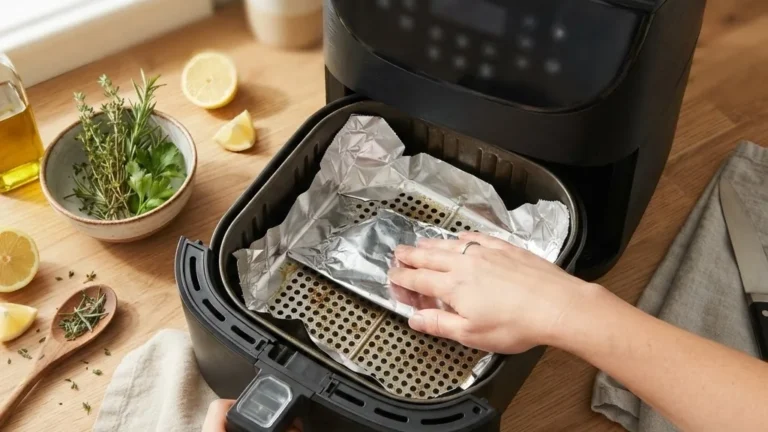
One more practical note about accessories. Things you toss into an oven without thinking, like a loose sheet of parchment or a strip of foil, behave differently in the high airflow of a basket, where a loose sheet can lift into the element. If you use liners, weigh them down with food and learn the rules first; our guides on parchment paper in an air fryer and foil in an air fryer cover the safe way to do it.
What About Ovens With an Air Fry Setting?
Many newer ranges and toaster ovens now include an air fry mode, which narrows the gap. That setting runs the oven’s convection fan at a higher speed, usually paired with a perforated tray, to mimic a basket air fryer. It works reasonably well and can spare someone from buying a second machine. The catch is that a full oven cavity is still large, so the airflow is less concentrated than a dedicated air fryer, crisping is usually a step behind on small batches, and the long preheat remains. For light or occasional crisping it is a fine all-in-one; for someone who air fries daily, a standalone unit is still faster and crisper. Independent testing outfits like America’s Test Kitchen have found the same pattern across many models.
Do You Need Both?
For most kitchens the two appliances complement each other rather than compete. Nearly every home already has an oven, so the real decision is usually whether to add an air fryer alongside it. If you cook small portions, crave crispy food, reheat a lot, or want to avoid heating the kitchen in summer, a countertop air fryer is a cheap, high-impact addition that handles the fast, crunchy jobs the oven does slowly. If you mostly cook large meals and bake in volume, the oven already covers you and an air fryer is a nice extra rather than a need. The only people who can comfortably skip the air fryer are those with a newer oven that has a strong air fry mode and who rarely cook for just one or two.
Frequently Asked Questions
Is an air fryer just a small convection oven?
Functionally close, yes. Both use a fan to circulate hot air, which is what browns and crisps food. An air fryer concentrates that airflow in a small cavity with a powerful fan, so it crisps harder and preheats in two to three minutes, while a conventional oven uses still radiant heat and a convection oven uses gentler airflow across a much larger space.
Does an air fryer cook faster than a conventional oven?
For small portions, clearly yes. It preheats in about 2 to 3 minutes versus 10 to 15 for a conventional oven, and its concentrated heat cooks a single layer of food roughly 20 percent faster. For large meals the oven can be quicker overall, because it cooks a full tray at once instead of several small batches.
How do I convert an oven recipe to an air fryer?
Lower the temperature by about 25 degrees Fahrenheit and cut the time by roughly 20 percent, then check early. For example, a recipe that calls for 425 degrees for 25 minutes in the oven becomes about 400 degrees for 18 to 20 minutes in the air fryer. Use a thermometer for any meat rather than trusting the clock.
Is an air fryer cheaper to run than an oven?
For small jobs, yes. An air fryer draws about 1,400 to 1,700 watts but heats a tiny cavity for a short time, while a full oven pulls more power and takes much longer to preheat and cook. For large batches the oven is more efficient per serving, since cooking one big tray beats running several small air-fryer rounds.
Can a conventional oven get food as crispy as an air fryer?
Not easily, because a conventional oven uses still air rather than a fan, so it browns more gently and slowly. You can improve crisp by preheating a sheet pan, using high heat near 450 degrees, and the broiler for the last few minutes, but the dedicated airflow of an air fryer still produces a crunchier result with less effort.
Should I buy an air fryer if I already have an oven?
If you cook small portions, love crispy food, or reheat often, an air fryer is a cheap, high-impact addition that does those jobs faster than the oven and without heating the kitchen. If you mostly cook large family meals and your oven already has a strong air fry mode, you may not need one.
Bottom Line
Air fryer vs conventional oven is really a question of scale and airflow, not of one machine being better than the other. The air fryer’s fan-forced heat wins on preheat speed, crispiness, energy use for small portions, and reheating leftovers, while the conventional oven wins on capacity, batch baking, and gentle, even cooking of large or delicate dishes. Convert recipes by dropping 25 degrees and cutting time by about a fifth, keep the basket to a single layer, and reach for the oven whenever you need volume. For most kitchens the happiest setup is both, letting each do the work it was built for, and you will rarely grab the wrong one twice.