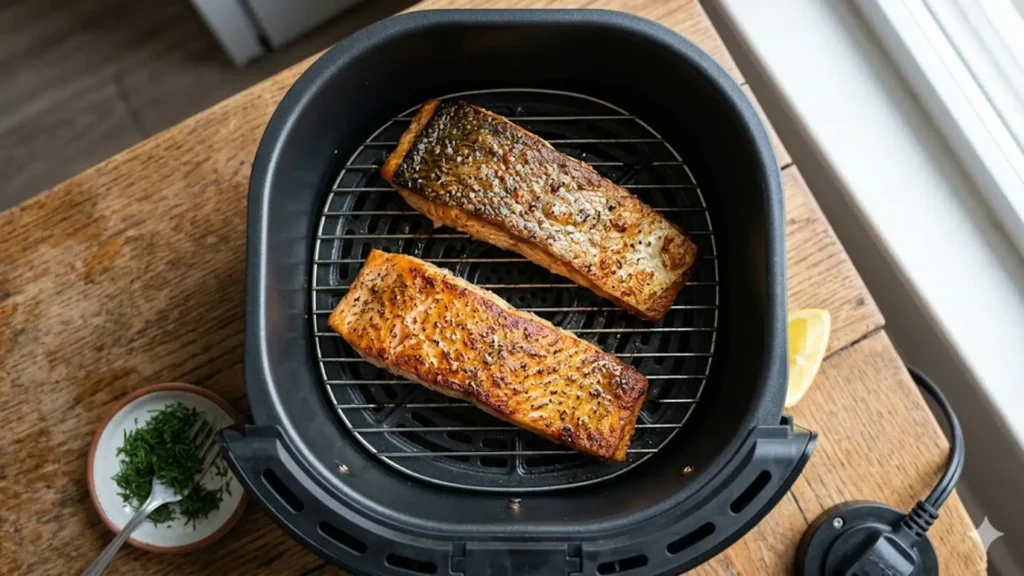
How long to cook salmon in air fryer comes down to one number you can memorize: 8 minutes at 400 degrees F for a standard 1-inch fillet. Thinner tail pieces finish in 6 minutes. Thick center-cut slabs near 1.5 inches need 10 to 11 minutes. Pull the fish when the thickest part hits 125 to 130 degrees F internal and let carryover heat carry it the rest of the way.
That is the short answer. The longer answer is what separates salmon that flakes into buttery sheets from salmon that turns into a dry pink eraser. I have cooked a lot of fish in these baskets, and the single biggest mistake people make is treating salmon like chicken. Chicken forgives. Salmon does not. A fillet goes from perfect to chalky in about 90 seconds, so timing matters more here than almost anything else you put in an air fryer.
The real answer depends on thickness, not weight
Recipes love to quote ounces. A 6-ounce fillet, they say. But ounces tell you nothing about how the heat travels. A wide thin 6-ounce piece and a narrow thick 6-ounce piece cook in completely different times. Thickness is the only measurement that matters, because heat moves from the outside in, and the center is always the last spot to reach temperature.
Grab a ruler or just eyeball the thickest point of the fillet. Then use this table. Every line assumes 400 degrees F, skin-on or skin-off, fillet sitting in a single layer with space around it.
| Fillet thickness | Time at 400 F | Pull temp (internal) |
|---|---|---|
| 0.5 inch (thin tail) | 6 minutes | 125 F |
| 0.75 inch | 7 minutes | 125 to 128 F |
| 1 inch (standard center) | 8 to 9 minutes | 128 to 130 F |
| 1.25 inch | 9 to 10 minutes | 130 F |
| 1.5 inch (thick slab) | 10 to 11 minutes | 130 F |
Notice the pull temps are all below the famous 145 degrees F that the USDA calls done. That is on purpose. Salmon keeps cooking after it leaves the basket. A 1-inch fillet pulled at 130 will coast up to roughly 140 to 145 over the next four minutes while it rests. If you wait until the thermometer reads 145 inside the air fryer, you have already overshot, and the result is the dry texture nobody wants.
Pick your doneness, then pick your pull temp
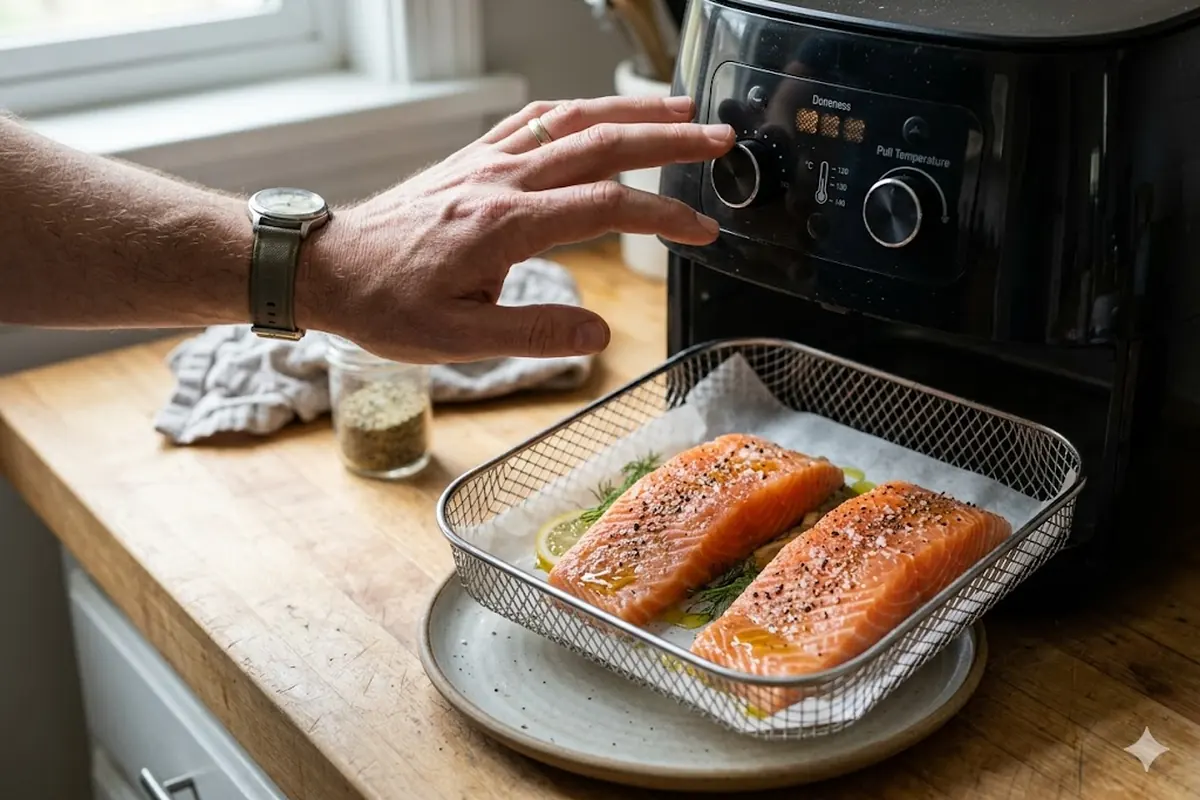
Salmon is one of the few proteins where you genuinely get to choose how done you want it, the same way you choose a steak. A buttery medium center tastes nothing like a firm well-done flake, and both are valid. The trick is knowing the target before the fish goes in, because once you overshoot there is no going back.
| Doneness | Pull temp | Final texture after rest |
|---|---|---|
| Medium rare | 120 F | Silky, almost translucent center |
| Medium | 125 to 128 F | Moist, just-flaking, buttery |
| Medium well | 130 to 133 F | Firm flake, fully opaque |
| Well done | 140 F | Dense, drier, fully set |
My own preference lands at medium, pulled around 127. The center still looks a shade darker than the edges, it gives under a fork without resistance, and the fat has rendered just enough to coat your tongue. Farmed Atlantic salmon, which is what most US grocery stores carry, has more fat than wild sockeye, so it stays forgiving even if you drift a degree or two. Wild king and sockeye run leaner, so I knock a minute off the time and pull them a touch earlier.
Carryover is the concept that ties this whole table together, and it is worth a sentence of explanation because it is the thing most home cooks ignore. When you pull the fillet, the outer layers are hotter than the center. That stored heat keeps flowing inward for several minutes, so the center temperature climbs even though the fish is sitting on a plate doing nothing. For a 1-inch fillet that climb is roughly 10 to 15 degrees F. That is why a fillet pulled at 128 lands at a perfect medium-well after resting, while a fillet pulled at 145 lands at well-past-done and dry. The number on your thermometer at pull time is not the number you eat. Plan for the climb and you will never overcook salmon again.
One more variable people forget is the starting temperature of the fish itself. A fillet straight from the back of a cold fridge can be 36 degrees F in the center, while one that rested on the counter for 15 minutes might be 50. That 14-degree head start shaves close to a full minute off the cook and, more importantly, helps the center catch up to the edges so the doneness is even. I now pull my salmon out of the fridge the moment I turn on the air fryer, and the few minutes of preheat double as a gentle warm-up for the fish.
Frozen salmon: the two-stage method that actually works
You do not have to thaw. This is the part most quick recipes skip or bury behind a link, and it is genuinely useful when dinner snuck up on you. The catch is that you cannot season a frozen brick because nothing sticks to ice. So you cook in two stages.
Stage one: set the air fryer to 360 degrees F and run the frozen fillet for 7 minutes. This thaws the surface and lets the exterior dry out. Stage two: pull it, brush on your oil, salt, and seasoning now that the surface will grip them, bump the temperature to 400 degrees F, and cook another 6 to 9 minutes depending on thickness. A standard 1-inch frozen fillet lands around 13 to 14 minutes total. Check the center with a thermometer the same way you would with fresh, aiming for that 128 to 130 pull.
One warning. Frozen fillets weep more liquid, so a thin layer of water can pool in the basket. That steam is the enemy of crisp skin. If crisp skin matters to you, pat the fillet hard with a paper towel between stage one and stage two, and the basket dries out by the time it finishes.
The night my salmon came out rubbery, and the fix
Here is a real one. Early on I kept getting salmon with a ring of pale, almost gray rubber around the edges while the center was fine. I blamed the air fryer. The air fryer was innocent. The problem was temperature shock: I was dropping cold-from-the-fridge fillets straight into a screaming hot basket, so the outer quarter inch blasted past done while the middle was still climbing.
The fix took two changes. First, I let the fillets sit on the counter for 15 minutes before cooking so they were not ice-cold in the center. Second, I stopped over-preheating. A 2 to 3 minute preheat is plenty; a 10-minute preheat just bakes the surface before the interior catches up. That gray-edge problem vanished overnight.
The other thing people panic about is the white stuff that oozes out, sometimes called albumin. It is just protein the heat squeezed out, totally harmless, but it looks like the fish is bleeding milk. You get more of it when the heat is too aggressive or the fish was not patted dry. A quick brine helps: dissolve a tablespoon of salt in two cups of water, soak the fillets for 10 minutes, pat dry, and the albumin drops way down.
How the air fryer cooks salmon differently from the oven
It helps to understand why the timing is so much shorter than a recipe card from your grandmother. An air fryer is a small convection oven with an aggressive fan, and that fan is the whole story. It strips away the thin layer of cooler air that normally insulates food in a still oven, so heat slams into the fillet from every direction at once. A salmon fillet that needs 18 to 20 minutes in a 400-degree conventional oven is done in 8 in the basket.
That speed is a gift and a trap. The gift is dinner in under ten minutes with almost no cleanup. The trap is that the same fan that cooks fast also dries fast, pulling moisture off the surface the entire time. That is why oil matters more here than in the oven. A light brush of avocado or olive oil is not just for flavor; it forms a barrier that slows moisture loss and helps the surface brown instead of dehydrate. The food scientists at America’s Test Kitchen have shown that a thin fat layer also helps seasoning adhere and conducts heat evenly across the surface, which is exactly what you want on a lean protein.
There is a practical takeaway buried in that physics. Because the fan is doing so much work, the position of the fillet matters. Center of the basket gets the most even airflow. Pushed against the wall, one side roasts harder than the other. If you are cooking a single fillet, put it dead center and you will not need to rotate it. The National Oceanic and Atmospheric Administration keeps a useful reference on choosing salmon if you want to match cooking time to the specific species you bought, since fat content shifts the math.
Skin-on, skin-off, and whether to flip
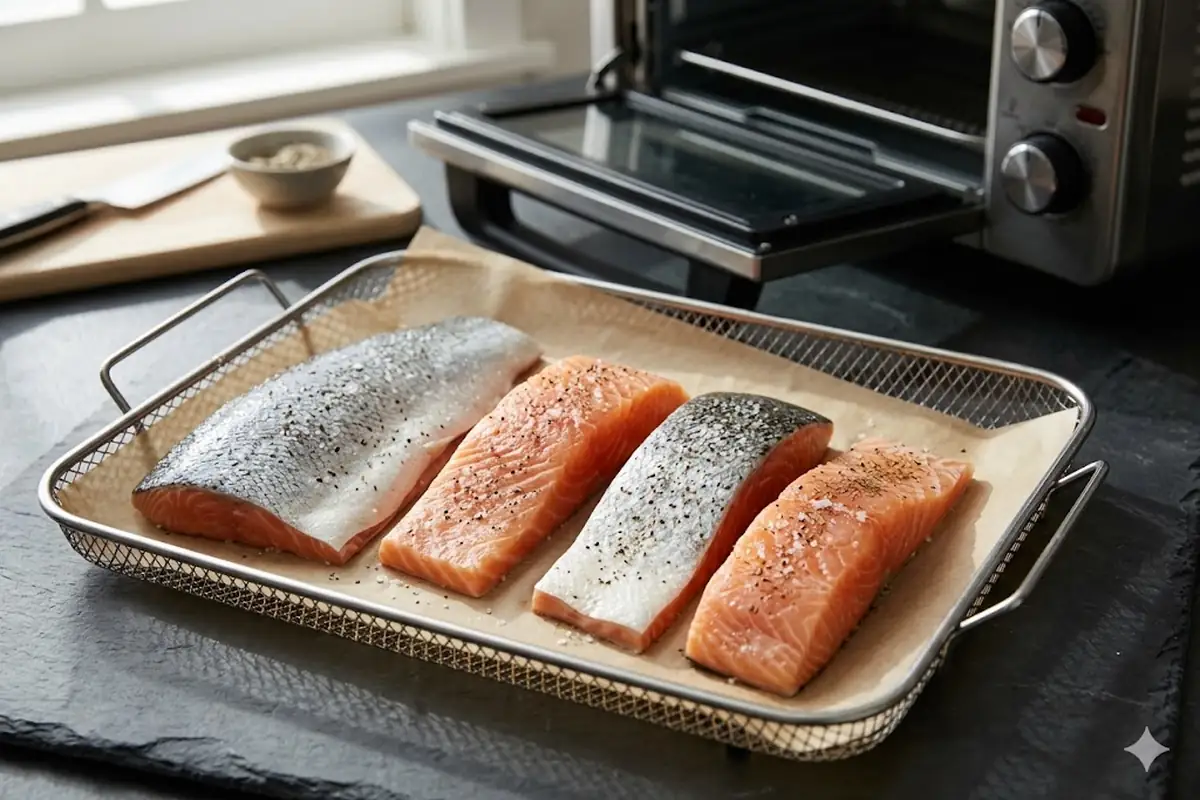
Cook skin-side down and do not flip. Salmon is delicate, and every flip is a chance to tear a fillet in half. The skin acts as a heat shield for the flesh and crisps into something genuinely good if you leave it undisturbed against the basket. If you bought skinless fillets, lay them on a small piece of parchment or a light coat of oil so they do not weld to the metal. Wondering what is safe to line the basket with? The team has a full rundown on using foil safely that covers when it helps and when it blocks airflow.
If you want to compare the hands-on technique side, the full step-by-step salmon walkthrough covers seasoning, oil choice, and plating in more depth than a timing guide needs to. This page is the one to bookmark for the clock; that one is for the how.
Common timing mistakes that ruin air fryer salmon
Crowding the basket is the quiet killer. Air fryers cook by moving hot air, and two fillets jammed against each other block that flow, so the touching edges steam instead of roast. Leave at least a half inch of gap. If you are cooking for four, do two batches rather than one crammed load. The first batch holds its heat fine on a plate under loose foil while the second cooks, and since each batch is under ten minutes you are not waiting long. A crammed basket that produces four mediocre fillets is worse than two batches of four great ones.
Guessing the thickness instead of looking is another quiet error. People assume every fillet from the same pack is identical, but the tail end of a side of salmon can be half the thickness of the shoulder end. If your pack has mixed pieces, sort them: cook the thin tails together and the thick centers together, or stagger when you pull each one. Trying to cook a thin tail and a thick center for the same eight minutes guarantees one of them comes out wrong.
Skipping the thermometer is the other one. I know, it feels fussy for a 9-minute cook. But salmon thickness varies so much that time alone is a guess, and an instant-read thermometer turns the guess into a fact for about twelve dollars. Stick it into the thickest part, not the thin edge, and read the lowest number you see.
Last, do not skip the rest. Three to four minutes on the plate lets the carryover finish the center and lets the juices settle back into the flesh instead of running out the moment you cut. Salmon pairs beautifully with a quick starch on the side; if you want a crisp partner, the reheating fries guide gets your second batch hot without sogginess while the fish rests. For a heartier spread, browse some chicken pasta ideas to round out the table.
Reheating leftover air fryer salmon without drying it out
Leftover salmon is famously easy to ruin in the microwave, where it turns rubbery and smells up the whole kitchen. The air fryer reheats it far better, but the timing flips: now your enemy is heat, not undercooking, because the fish is already cooked through. Set the basket to 300 degrees F, not 400, and warm the fillet for 3 to 4 minutes. Low and slow is the rule here. You are only trying to take the chill off and re-crisp the skin, not cook it a second time.
A trick that keeps reheated salmon moist is to brush the top with a few drops of water or oil before it goes back in, which gives the surface something to give up to the fan instead of pulling moisture from the flesh. Cold salmon also makes a great cold meal flaked over greens, so do not feel obligated to reheat at all. If you do, pull it the instant the center feels warm to a knife tip, around 110 to 120 degrees F, well short of cooking it further.
FAQ
What temperature should I set the air fryer for salmon?
Set it to 400 degrees F for fresh fillets. That gives you a roasted exterior in the same window the center reaches doneness. Drop to 360 degrees F only for the first stage of cooking salmon from frozen, then raise it back to 400 to finish.
How do I know when air fryer salmon is done without a thermometer?
Press the top of the thickest part with a fork and twist gently. Done salmon flakes apart along its natural lines with light pressure and looks opaque rather than glossy and raw. If it resists and still looks translucent in the center, give it another minute. A thermometer is more reliable, but the fork-flake test works in a pinch.
How long does frozen salmon take in the air fryer?
A standard 1-inch frozen fillet takes about 13 to 14 minutes total: 7 minutes at 360 degrees F to thaw the surface, then 6 to 9 minutes at 400 degrees F after you season it. Thinner pieces finish a couple minutes sooner. Always confirm the center with a thermometer at 128 to 130 degrees F.
Should I flip salmon in the air fryer?
No. Cook it skin-side down and leave it alone. Flipping delicate fillets risks tearing them, and the bottom crisps fine against the basket without help. The only time I flip is for very thick 1.5-inch slabs, and even then only once at the halfway mark.
Why is my air fryer salmon dry?
Almost always because it was pulled too late. Salmon keeps cooking off the heat, so if you wait for 145 degrees F inside the basket it overshoots during the rest. Pull at 125 to 130 instead and let carryover finish it. Cold-from-the-fridge fillets and over-preheating also dry the edges.
Do I need to preheat the air fryer for salmon?
A short 2 to 3 minute preheat helps the skin crisp, but a long preheat works against you by baking the surface before the inside catches up. If your model heats fast, you can skip the preheat entirely and just add a minute to the cook time.
Can I cook salmon and vegetables together in the air fryer?
Yes, if you pick vegetables that finish in roughly the same window, like asparagus or thin zucchini. Add denser vegetables such as potatoes earlier since they take longer than the fish. Keep everything in a single layer so the air can move, and the salmon still drives the timing.