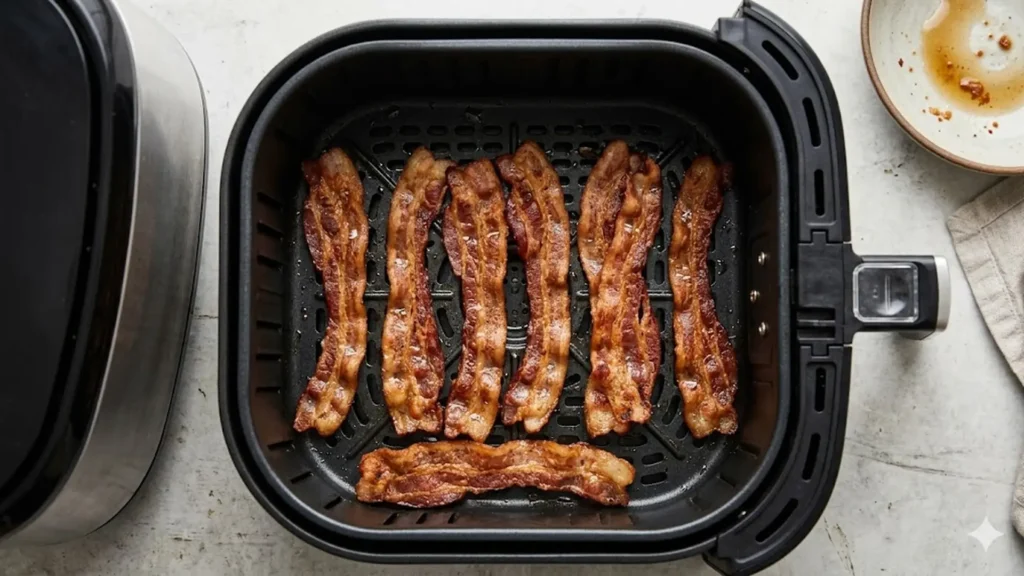
How to cook bacon in air fryer is simple once you know the one secret most recipes bury: cook it at 350 degrees F, not 400. Lay the strips in a single layer, run regular bacon 7 to 9 minutes and thick-cut 10 to 12, and you get crisp, flat bacon with no flipping and a fraction of the splatter. The lower temperature is not about gentleness. It is about keeping the rendered grease below its smoke point so your kitchen does not fill with haze.
That smoke-point detail is the whole reason air fryer bacon goes wrong for people. Bacon fat starts smoking around 400 degrees F, and plenty of guides tell you to crank the fryer to exactly that. Then they act surprised when the smoke alarm goes off. I learned this the loud way, standing on a chair waving a towel at the ceiling sensor while my bacon cooked perfectly below me. Drop to 350 and the problem mostly vanishes.
Why bacon belongs in the air fryer at all
I resisted air fryer bacon for a while. Skillet bacon felt sacred, and I figured the basket would just steam the strips. I was wrong. The thing the air fryer does that a skillet cannot is render the fat evenly while crisping every part of the strip at once, because the hot air wraps around all sides. In a skillet, the bacon sits in its own grease and you get crisp edges with chewy, fat-logged middles. In the basket, the grease drips away and the whole strip cooks to one even texture.
There is a hands-off bonus that matters more than I expected. Skillet bacon demands attention: flipping, adjusting heat, dodging splatter. Air fryer bacon you set and forget. I start a batch, walk away to scramble eggs or pour coffee, and come back to perfectly cooked strips with zero grease burns on my forearms. For a busy morning that alone justifies the method. The cleanup is gentler too, since the grease is contained in the drawer instead of speckled across the stovetop and backsplash.
The flavor holds up beautifully. Some people worry the air fryer will dry bacon out, but it does the opposite when you cook it right; the fat renders and bastes the meat as it goes. The result tastes like classic bacon, just cleaner and more even. Once you have made it this way a few times, the skillet starts to feel like the fussy option.
The temperature debate, settled
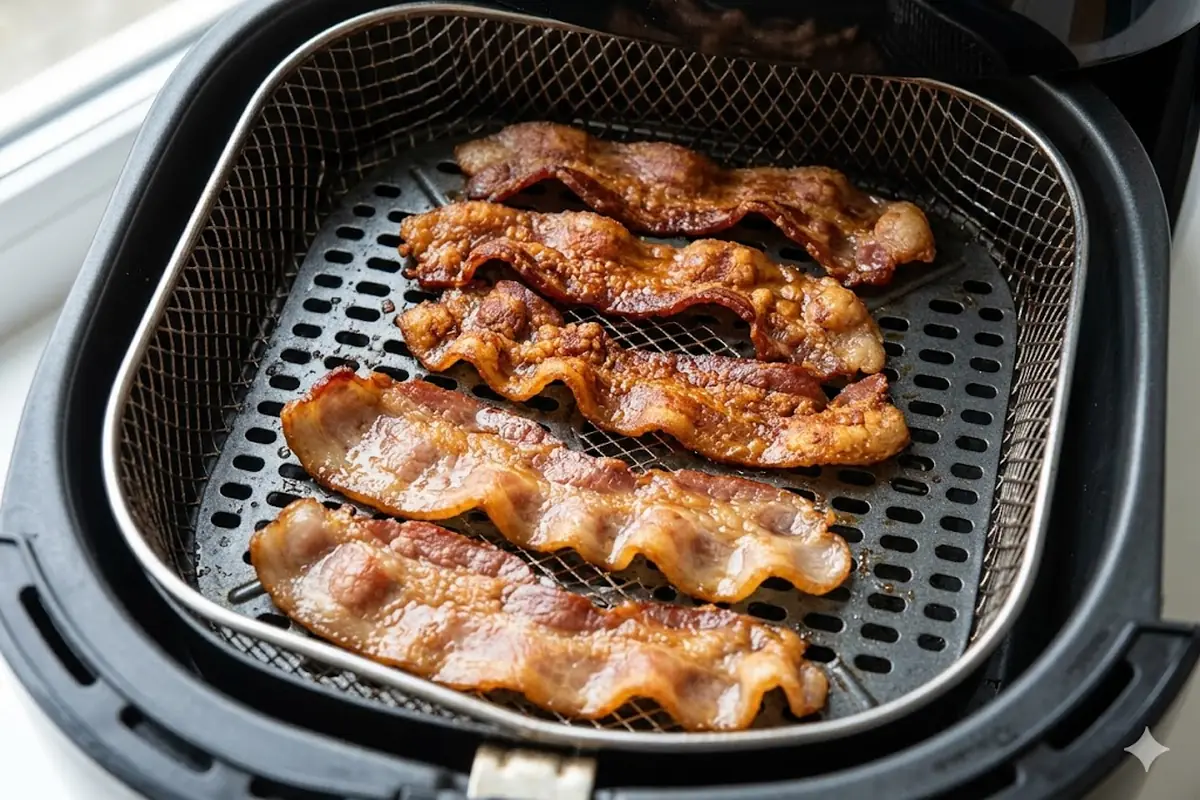
You will find two camps online. One says 400 degrees F for 8 to 10 minutes, the other says 350 degrees F for 7 to 9. Both produce crisp bacon, so why does it matter? Smoke. At 400, the grease that drips off and pools in the bottom of the basket hits its smoke point and you get that gray haze and a lingering smell. At 350, the bacon still crisps beautifully because the fat renders just fine at that temperature, but the pooled grease stays calm.
I cook at 350 every time now and have not set off the smoke alarm since. The only tradeoff is a minute or two of extra time, which is nothing. If you are in a genuine hurry and your air fryer vents well, 400 for 8 minutes works, but keep an eye on the drawer and pour off grease if it starts to pool. For most kitchens, 350 is the calmer, cleaner choice, and the bacon is just as good.
Crispiness on a dial: a time chart by texture
Bacon doneness is personal. Some people want it still a little chewy and bendable, others want it shatter-into-shards crisp. The beauty of the air fryer is that you control exactly where on that spectrum you land, just by adjusting minutes. Here is the chart I use for regular-cut bacon at 350 degrees F.
| Texture you want | Regular cut, 350 F | Thick cut, 350 F |
|---|---|---|
| Soft, still bendable | 6 to 7 min | 8 to 9 min |
| Classic, crisp but not brittle | 8 min | 10 to 11 min |
| Extra crispy, shatters | 9 to 10 min | 12 to 13 min |
Two things to remember reading this chart. Bacon firms up as it cools, so it always looks slightly less done in the basket than it will be on the plate. Pull it a hair before it looks perfect. And every air fryer runs a little different, so the first time you make bacon in yours, check at the early end of the range and learn your machine. After one batch you will know your numbers.
If you like your bacon truly shattering-crisp, there is a small extra step that helps: after pulling the strips, let them drain on a paper towel for two or three minutes. As the residual grease wicks away and the bacon cools, it tightens into that brittle snap. Trying to get there by simply cooking longer often just dries the meat out and pushes you toward burnt. Let cooling and draining do part of the work, and you reach extra-crispy without scorching the strip.
How to lay the strips so they cook flat and even
A single layer is non-negotiable. The strips can touch side to side, but they cannot overlap or stack, because anywhere two pieces cover each other stays soft and pale while the rest crisps. If your basket is small, cut the strips in half so they fit in one layer rather than draping them over the edge or piling them. Half-strips also fit a sandwich better anyway.
You do not need to flip air fryer bacon. The circulating hot air hits both sides, so it crisps top and bottom without intervention, which is half the appeal compared to babysitting a skillet. If you want maximally even results you can flip once at the halfway mark, but honestly I rarely bother. The one time flipping helps is with very thick artisan bacon, where a flip evens out the rendering.
Bacon also shrinks and curls as the fat renders. A little curl is normal and fine. If you want flatter strips for a sandwich, you can lay a second air fryer rack or a small trivet on top to weigh them down, but that is a refinement, not a requirement. America’s Test Kitchen has written about how rendering fat evenly is what gives bacon its crisp-tender contrast, and the air fryer does that rendering job well because the heat surrounds every strip.
The smoke alarm night, and the grease fix
Back to that night on the chair. The fix for a smoking air fryer is not a mystery once you understand it is the grease, not the bacon, making the smoke. Pooled fat in the bottom of the basket heats up, hits its smoke point, and vaporizes. So you manage the grease.
The simplest move is to pour a couple tablespoons of water into the bottom drawer beneath the basket before you start. The grease drips into the water instead of onto hot metal, and water cannot exceed 212 degrees F, so it never smokes. This trick alone solved my problem completely. The other classic fix is laying a slice of plain bread in the bottom drawer to soak up the drippings, which works too, though the water method is less wasteful. And between batches, always pour off or wipe out the accumulated grease, because that is what builds up and smokes on round two. If you are unsure what is safe to put in the drawer, the team’s guide on lining the basket covers the do’s and don’ts.
Thick-cut bacon needs a different mindset
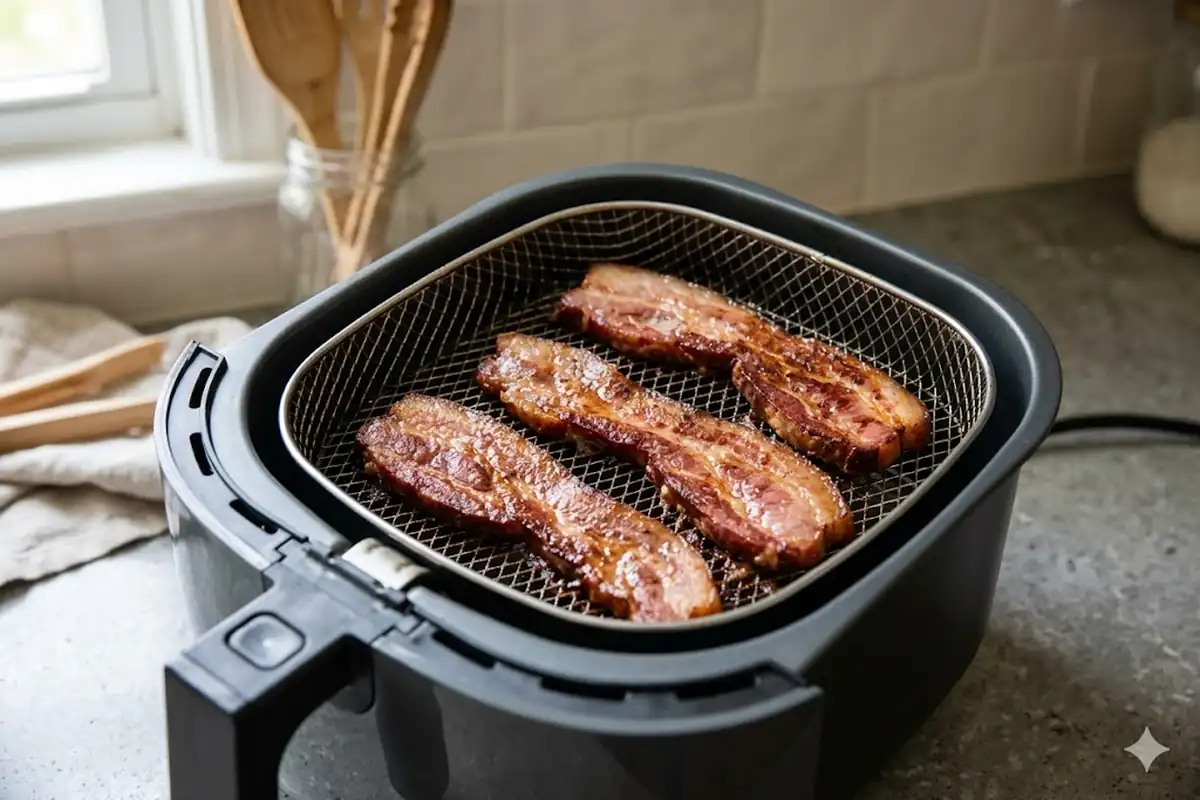
Thick-cut bacon is not just regular bacon that takes longer; it cooks on a different curve. The extra fat means more rendering, which means more time and more grease in the drawer. Where a regular strip is crisp at 8 minutes, a thick slab might still be flexible and needs 10 to 12 to firm up. Rushing thick-cut at a higher temperature to save time backfires, because the outside browns before the interior fat has rendered, leaving you with a strip that is scorched outside and fatty inside.
The patience pays off with a meatier, more satisfying bite that holds its shape on a sandwich or alongside eggs. Because thick-cut throws off more grease, the drawer fills faster, so check it midway and pour off the pooled fat if it is climbing toward the basket. This is exactly when the smoke risk spikes, so the water-in-the-drawer trick earns its keep with thick bacon more than any other cut. Give it the time it asks for and thick-cut bacon from the air fryer rivals anything from a diner griddle.
Turkey bacon and candied bacon
Turkey bacon behaves differently because it has far less fat to render. It will not crisp the same way pork bacon does, and it dries out if you push it too long. Cook turkey bacon at 350 degrees F for about 6 to 8 minutes, and give it a light spritz of oil first since it has almost no fat of its own to help it brown. Watch it closely near the end; the line between done and leathery is thin.
Candied or maple bacon is a treat the air fryer handles surprisingly well. Press brown sugar onto the strips before cooking, run them at 350 degrees F, and the sugar caramelizes into a glassy coating. The catch is that sugar burns, so check it a minute or two early and pull it the moment the coating turns deep amber. The drippings will be stickier, so the water-in-the-drawer trick matters even more here to keep things from scorching and smoking. A pinch of cracked black pepper or a dash of cayenne pressed in with the sugar turns plain candied bacon into a sweet-heat snack that disappears fast at a party. Let the strips cool fully before you move them, because the caramelized sugar is molten hot straight out of the basket and needs a minute to set into that glassy crunch.
Cleaning the basket without a fight
Bacon grease is the one downside, and a little technique keeps cleanup from being miserable. Let the basket cool until the grease firms up slightly but is still pourable, then tip it into a heatproof jar or an old can, never down the drain, where it solidifies and clogs pipes. Once the bulk of the grease is out, wipe the basket with a paper towel before it goes anywhere near the sink, so you are not pushing fat around with a sponge.
For the stuck-on bits, a soak in hot soapy water for ten minutes loosens everything, and most air fryer baskets are dishwasher safe if you would rather let the machine handle it. The water-in-the-drawer trick pays off here too, because a drawer half-full of grease-laden water pours out cleanly instead of leaving a baked-on layer. Doing this every batch, rather than letting grease accumulate over several uses, is the difference between a thirty-second wipe and a scrubbing chore.
One more habit worth keeping: do not let cooked grease sit in the drawer overnight. It congeals into a stubborn film and can pick up an off smell. Pour it out while it is still warm and the whole job stays easy. Treat the basket well and it pays you back with years of easy bacon mornings.
What to do with all that good bacon
Air fryer bacon is so easy that I make extra on purpose and keep cooked strips in the fridge for the week. Reheat them at 350 degrees F for 1 to 2 minutes and they crisp right back up, far better than the limp microwave version. Crumble cold bacon over salads, fold it into eggs, or layer it on a burger. The rendered grease is liquid gold too; strain it into a jar and use it to fry potatoes or eggs. A teaspoon of bacon fat in the basket before you cook hash browns or Brussels sprouts gives them a smoky depth nothing else matches, and it is free fat you already paid for. I keep a small jar in the fridge specifically for this, and it lasts weeks.
Bacon plays well with so many breakfast staples that it is worth pairing with whatever else your air fryer makes. Crisp hash browns are a natural match; the frozen hash browns guide gets them golden on the same single-layer principle. If you are building a bigger spread, a side of asian sauces can turn leftover bacon into a quick glazed bite. Cook once, eat well all week.
FAQ
What temperature should I cook bacon at in an air fryer?
Cook bacon at 350 degrees F. That is below the smoke point of bacon grease, which is around 400 degrees F, so the rendered fat does not fill your kitchen with smoke. The bacon still crisps perfectly at 350; you just trade a minute or two of time for a much cleaner cook.
How long does bacon take in the air fryer?
Regular-cut bacon takes 7 to 9 minutes at 350 degrees F, and thick-cut takes 10 to 12. For soft, bendable bacon aim for the low end, and for extra crispy that shatters, add a minute or two. Bacon firms up as it cools, so pull it just before it looks fully done.
Do I need to flip bacon in the air fryer?
No. The circulating hot air crisps both sides without flipping, which is one of the best parts of cooking bacon this way. You can flip once halfway for extra-even results, especially with very thick bacon, but for regular strips it is unnecessary.
How do I stop my air fryer from smoking when cooking bacon?
The smoke comes from grease, not the bacon. Pour a couple tablespoons of water into the bottom drawer so drippings fall into water instead of onto hot metal, or lay a slice of bread down to absorb the fat. Cooking at 350 instead of 400 also keeps the grease below its smoke point. Pour off accumulated grease between batches.
Can I cook turkey bacon in the air fryer?
Yes. Cook turkey bacon at 350 degrees F for about 6 to 8 minutes, and spritz it with a little oil first since it has very little fat of its own to render. Watch it closely near the end, because turkey bacon goes from done to dry and leathery quickly.
Should I preheat the air fryer for bacon?
Preheating is optional and makes little difference for bacon. If you preheat, the bacon may finish a minute sooner, but starting from cold is fine because the fat needs a little time to begin rendering anyway. Just check it at the early end of the time range either way.
How do I reheat air fryer bacon?
Reheat cooked bacon at 350 degrees F for 1 to 2 minutes. It crisps right back up and tastes far better than microwaved bacon, which goes limp. Make a big batch ahead, store it in the fridge, and reheat a few strips whenever you want them.