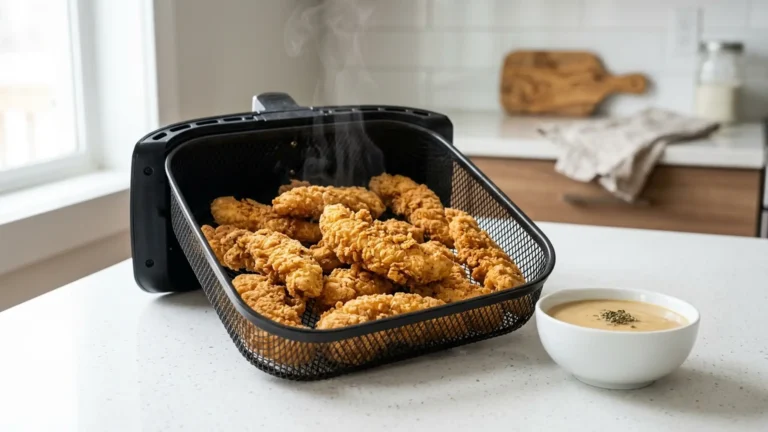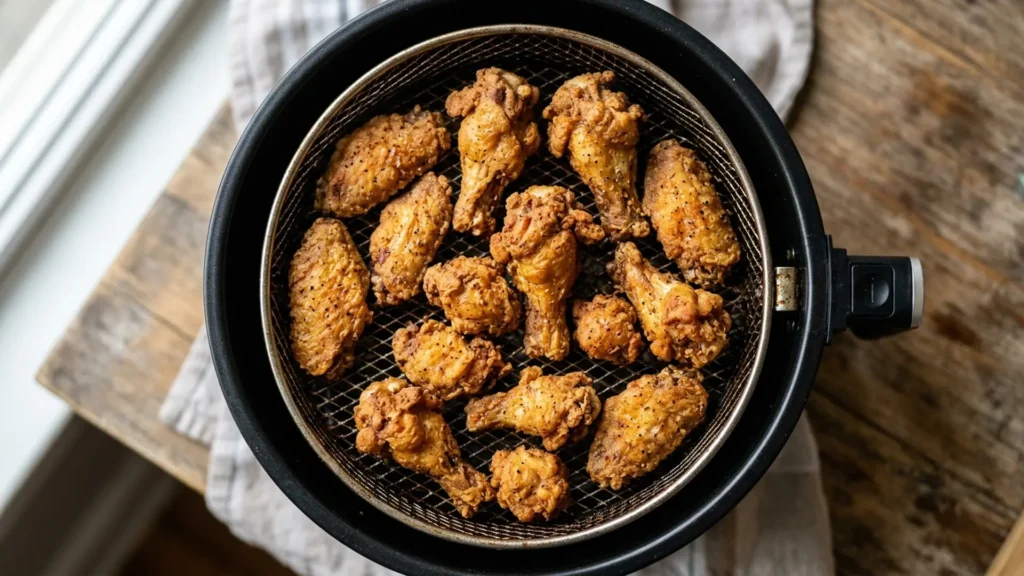
To reheat fried chicken in air fryer and keep it crispy, run it at 360 degrees F for 5 to 8 minutes, flipping once, until the center hits 165 degrees F. The lower temperature is the secret: it re-crisps the existing crust and warms the meat through without burning the breading you already cooked once. Let the chicken sit at room temperature for 15 minutes first, and you avoid the classic failure of a scorched crust wrapped around a cold center.
The air fryer is simply the best tool for this job, full stop. A microwave steams the crust into sad, soggy bread. An oven works but takes 20 minutes and heats up the kitchen. The air fryer surrounds the chicken in dry, moving heat that drives moisture out of the breading and crisps it back to almost-fresh, while the circulating air warms the meat evenly. Day-old fried chicken comes out of the basket tasting like you just made it, which is a small miracle for a leftover.
I went years reheating fried chicken in the microwave because it was fast, and I accepted soggy as just the price of leftovers. The first time I tried the air fryer instead, I genuinely could not believe the crust had come back. That is the experience most people have: the air fryer does not merely warm the chicken, it restores the texture that made it good in the first place. Once you have had crisp day-two fried chicken, going back to the microwave feels like throwing away the best part on purpose.
Why the air fryer beats every other method
Reheating fried chicken is really two problems at once: warm the meat without drying it, and re-crisp the crust without burning it. Most appliances solve one and fail the other. The microwave is fast and warms the meat, but it pumps moisture into the breading and you get a limp, greasy coating that slides off. There is no recovering microwaved fried chicken; the crust is gone.
The oven re-crisps decently because it uses dry heat, but it is slow, often 18 to 20 minutes, and it heats your whole kitchen to do it. For a couple of pieces that is a lot of energy and waiting. The air fryer splits the difference: it uses the same dry, crisping heat as an oven but concentrates it in a small chamber with a strong fan, so it crisps faster and more evenly. Two pieces are hot and crunchy in about 6 minutes.
The reason it crisps so well is the moving air. Fried chicken crust goes soggy in the fridge because it absorbs moisture from the meat and the air. Dry, circulating heat reverses that, wicking the moisture back out and re-hardening the breading. It is the same principle that makes the air fryer the best tool for bringing leftover fries back to life, and our guide to reheating fries in the air fryer leans on the exact same dry-heat logic.
There is also a texture nuance worth understanding. Fried chicken crust is held together by gelatinized starch and rendered fat. When that crust sits in the fridge, the starch reabsorbs moisture and goes pliable, which is the soft, slightly greasy texture you get from a cold leftover. Gentle dry heat does two things at once: it drives the absorbed water back out as steam, and it re-melts and re-renders the fat in the coating so it re-fries the crust a little from the inside. That is why a properly reheated piece does not just taste warm, it tastes freshly crisp. A microwave skips the second half of that entirely, which is the whole reason microwaved fried chicken can never get its crunch back no matter how long you run it.
The method, step by step
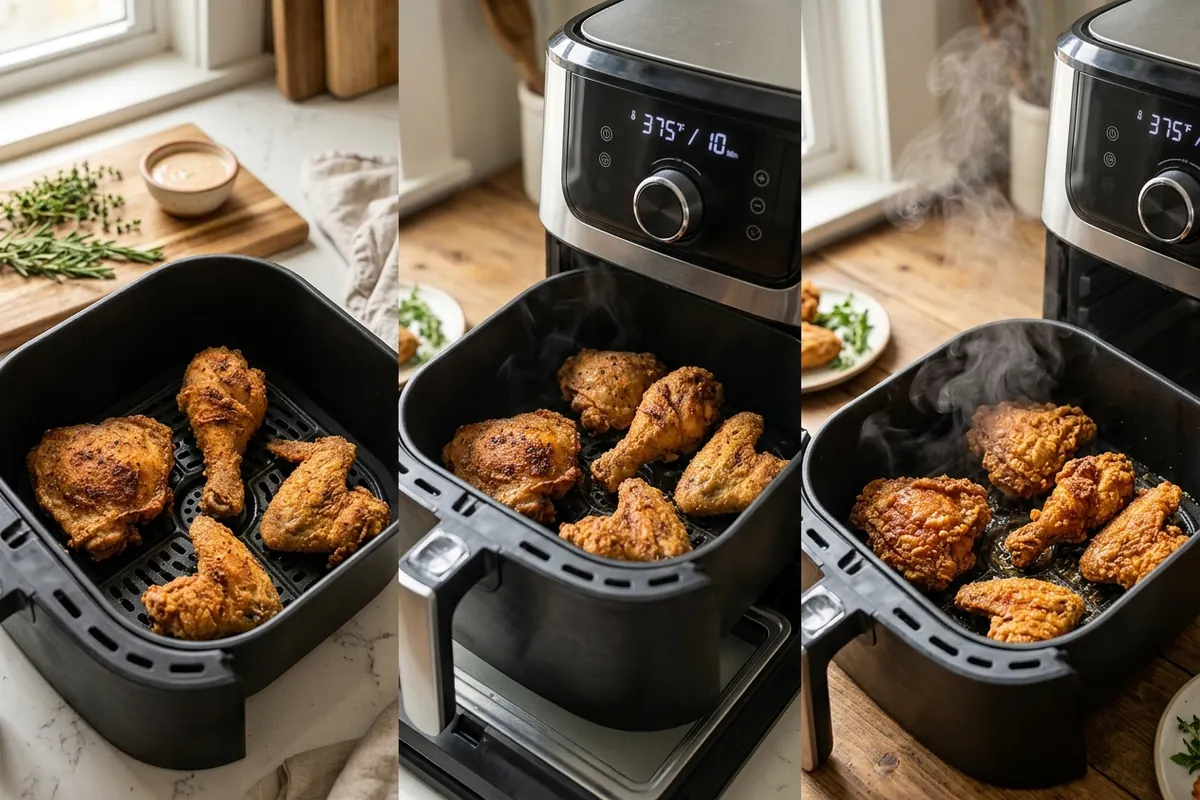
Here is the full sequence for reheating two to four pieces of fried chicken. The whole thing takes under 25 minutes including the room-temperature rest, and most of that is hands-off.
Start by pulling the chicken from the fridge and letting it sit on the counter for 15 to 20 minutes. This step is the one most people skip and the one that matters most. Cold chicken straight from the fridge has a fridge-cold center, so by the time the inside reaches a safe 165 degrees F, the crust has been in dry heat too long and scorches. Letting it warm up first means the inside and outside finish together.
While the chicken rests, you can preheat the air fryer to 360 degrees F for a few minutes, which helps the crust start crisping the moment the chicken goes in. Place the pieces in a single layer with space between them, skin or crust side up. Run 360 degrees F for 5 minutes, then flip each piece and run another 2 to 4 minutes. Check the internal temperature at the thickest part; you are done when it reads 165 degrees F. Larger pieces like thighs and drumsticks take the full time, while tenders and wings finish sooner.
Time by piece, the chart that matters
Fried chicken is not one thing. A thin tender and a thick bone-in thigh need very different times, and treating them the same is why people end up with one piece cold and another burnt. Cook similar pieces together and use this chart, all at 360 degrees F with a flip at the halfway mark.
| Piece | Total time at 360 F | Flip at |
|---|---|---|
| Chicken tenders or strips | 4 to 5 min | 2.5 min |
| Wings | 5 to 6 min | 3 min |
| Boneless breast piece | 5 to 7 min | 3 min |
| Bone-in thigh | 7 to 8 min | 4 min |
| Drumstick | 7 to 8 min | 4 min |
Two notes on reading this. First, these assume the chicken has had its room-temperature rest. Straight from the fridge, add 2 to 3 minutes to every line, and accept that the crust may darken more than you want. Second, bone-in pieces hold cold in the center longer because the bone is dense and slow to warm, so always check the meat right next to the bone with your thermometer, since that is the last spot to reach 165 degrees F.
If you are reheating breaded tenders specifically, the timing overlaps closely with cooking them from scratch, and our guide to air fryer chicken tenders gives the from-raw numbers if you ever start with uncooked strips instead of leftovers.
The 360 vs 375 vs 400 debate
You will see reheating temperatures ranging from 360 all the way to 400 degrees F, and the spread confuses people. Here is the reasoning. The chicken is already fully cooked, so your only jobs are warming it and re-crisping the crust, not cooking it through. That changes the math. At 400 degrees F the crust crisps fast but it can scorch and the breading can darken past the point of tasting good, especially since it was already browned once during frying.
At 360 degrees F you give the inside time to warm gently while the crust re-crisps at a pace that will not burn it. The result is a crust that tastes freshly fried rather than over-browned and bitter. If you are in a genuine hurry and reheating thin pieces like tenders, 375 degrees F shaves a minute, but for anything bone-in, 360 is the safer, better choice. The crust was cooked once already; you are reviving it, not re-frying it, and lower heat respects that.
Whatever temperature you pick, the finish line is the same: 165 degrees F internal. That is the USDA-recommended safe minimum for cooked chicken, and reheated leftovers should hit it just like fresh. The USDA food safety guidance is clear that previously cooked poultry should be reheated to 165 degrees F, so a thermometer is not optional here, it is how you know the chicken is both safe and properly hot in the middle.
Keeping the crust crisp and the meat juicy
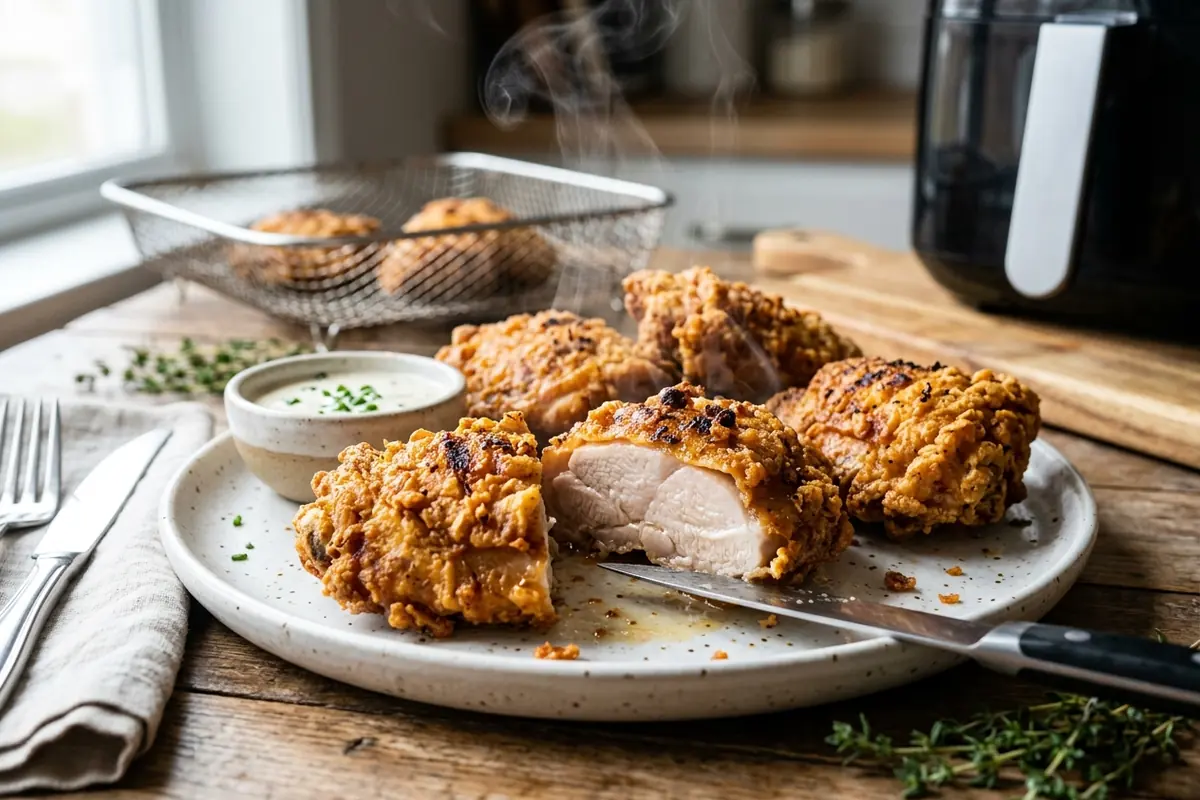
The crisp-versus-juicy tension is the whole game with reheated fried chicken. A few small habits tip both in your favor. First, never stack or overlap pieces. Anywhere two pieces touch stays soft and steams instead of crisps, and the contact points trap moisture. A single layer with air gaps lets every surface crisp evenly. If you have a lot of chicken, run it in batches rather than piling it in.
Second, do not add oil or cover the chicken. The crust already has rendered fat in it from frying, and the dry air is what re-crisps it. Adding oil or a foil tent traps moisture and softens the breading, which is exactly what you are trying to avoid. The basket should be open and the air should move freely around every piece.
Third, resist the urge to overcook in pursuit of extra crunch. Once the center hits 165 degrees F, the chicken is done, and leaving it longer just dries the meat. If your crust is not as crisp as you want at 165, give it one extra minute at 380 degrees F rather than a long stretch at 360, a short hot burst at the end crisps the exterior without overcooking the interior. America’s Test Kitchen has noted that dry heat re-crisps fried coatings better than any moist method, which is precisely why the open, fan-driven air fryer works so well here.
Storing fried chicken so it reheats well
How you store the chicken determines how well it reheats, and a few storage habits make a real difference. Cool the chicken to room temperature before refrigerating, but do not leave it out longer than 2 hours total, since cooked poultry left at room temperature past that window enters the unsafe zone for bacteria. Once cooled, store it in an airtight container.
Here is a small trick: line the container with a paper towel and store the chicken in a single layer if you can, crust side up. The paper towel absorbs excess moisture, and keeping pieces from stacking prevents the crust from getting soggy where pieces press together. Properly stored, fried chicken keeps in the fridge for 3 to 4 days, after which the texture and safety both decline. The single-layer storage habit pays off twice: it keeps the crust from going soft against neighboring pieces, and it lets the chicken come back to room temperature faster and more evenly before you reheat, which feeds straight into a better result in the basket.
| Storage question | Answer |
|---|---|
| How long in the fridge? | 3 to 4 days in an airtight container |
| Can I freeze it? | Yes, up to 4 months; thaw in fridge before reheating |
| Room temp before reheating? | 15 to 20 min, but never more than 2 hours total out |
| Best storage position? | Single layer, crust up, on a paper towel |
If you froze the chicken, thaw it in the fridge overnight before reheating, and then follow the same 360-degree method, adding a couple of minutes since frozen-then-thawed chicken starts colder and slightly wetter. Never reheat fried chicken more than once; each reheat dries it further and reheating leftovers repeatedly raises food-safety risk.
Reheating takeout vs homemade fried chicken
Not all fried chicken reheats the same, and where it came from matters. Homemade fried chicken usually has a thinner, lighter crust that re-crisps fast, so it often hits the early end of the time ranges. Restaurant and fast-food chicken, the kind with a thick, craggy, double-dredged crust, holds more moisture in that heavy coating and benefits from a slightly longer reheat and sometimes a final 1-minute burst at 380 degrees F to drive the dampness back out of the breading. The thicker the crust, the more it wants that hot finishing minute.
Bone-in takeout pieces also tend to arrive larger than what most people fry at home, so lean toward the longer end of the chart for those, and always confirm with a thermometer next to the bone. One more takeout-specific tip: if the chicken came in a closed container or bag and sat steaming on the drive home, the crust is already softened from trapped moisture, so it especially needs the dry air fryer to revive it. Pull it out of any wrapping, let it sit at room temperature, and the open-basket reheat will undo most of that steam damage and bring the crunch back. Treat the crust thickness, not the brand, as your guide to how long it needs.
FAQ
What temperature should I reheat fried chicken in the air fryer?
360 degrees F is ideal. The chicken is already cooked, so your only jobs are warming the meat and re-crisping the crust without burning it. Higher temperatures like 400 degrees F can scorch the already-browned breading, so the lower 360 gives a fresher-tasting crust.
How long does it take to reheat fried chicken in the air fryer?
Most pieces take 5 to 8 minutes at 360 degrees F with a flip at the halfway mark. Thin tenders finish in 4 to 5 minutes, while bone-in thighs and drumsticks need the full 7 to 8 minutes. Always confirm the center reaches 165 degrees F.
Do I need to let fried chicken come to room temperature first?
Yes, it helps a lot. Resting the chicken on the counter for 15 to 20 minutes lets the inside and outside finish heating together, so the crust does not scorch while the center is still cold. Do not leave it out longer than 2 hours total for safety.
Why does my reheated fried chicken get soggy?
Sogginess usually comes from stacking pieces, covering them, or adding oil, all of which trap moisture in the crust. Reheat in a single layer with space between pieces, leave the basket open, and let the dry circulating air wick moisture out and re-crisp the breading.
What internal temperature should reheated fried chicken reach?
165 degrees F at the thickest part, measured with an instant-read thermometer. For bone-in pieces, check the meat right next to the bone, since that is the slowest spot to heat. This is the USDA-recommended safe minimum for reheated poultry.
Can I reheat frozen fried chicken in the air fryer?
Thaw it in the fridge overnight first for the best texture, then reheat at 360 degrees F, adding a couple of minutes since it starts colder. You can reheat from frozen in a pinch at a lower 330 degrees F for longer, but thawing first gives a crisper result.
Bottom line
Reheating fried chicken in the air fryer turns a soggy leftover back into something close to fresh, and the formula is simple: rest the chicken at room temperature, run 360 degrees F for 5 to 8 minutes with a flip, and pull it when the center hits 165 degrees F. Keep pieces in a single layer, skip the oil and the foil, and let the dry, moving air re-crisp the crust. Match the time to the piece using the chart, check bone-in pieces next to the bone, and you will get crunchy, juicy fried chicken from the fridge in under ten minutes of cook time. It beats the microwave and the oven on every front that matters.