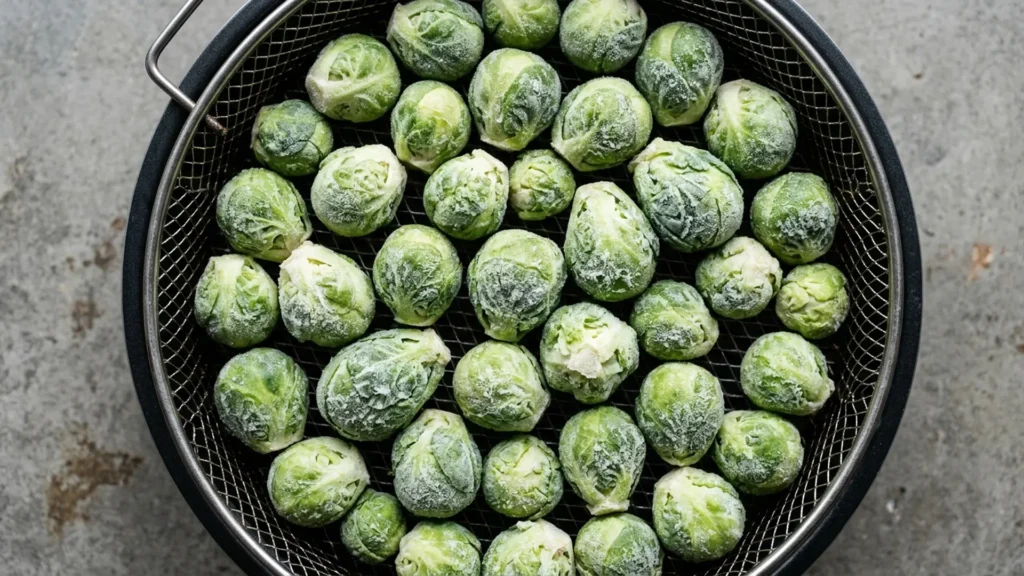
Frozen brussel sprouts air fryer cooking is the fastest way I know to turn a bag of icy green orbs into crispy, caramelized sprouts with blistered edges and tender centers. Run them at 390 degrees F for about 16 to 18 minutes total, shaking the basket halfway, and do not thaw them first. Cooking straight from frozen is the whole trick: thawed sprouts release water and steam into mush, while frozen sprouts hit the hot dry air and crisp.
The other detail that changes everything is when you add the oil and seasoning. You cannot toss rock-hard frozen sprouts in oil and expect it to stick; it slides off the ice. So you cook them dry for the first stretch until they loosen and the surface ice cooks off, then toss them in oil and seasoning, then finish them hot to crisp. That two-stage approach is why some people get caramelized, restaurant-quality sprouts while others get pale, soggy ones from the exact same bag.
Brussels sprouts have a reputation as the vegetable kids push to the edge of the plate, and almost always that reputation comes from sprouts that were boiled or steamed into bitter, sulfurous mush. The air fryer flips that completely. High, dry heat caramelizes the natural sugars in the sprout and crisps the outer leaves, turning the same vegetable sweet, nutty, and almost snackable. People who are certain they hate Brussels sprouts routinely change their minds after eating them blistered out of an air fryer. So if frozen sprouts have always disappointed you, the method below is likely the missing piece, not the vegetable itself.
Why you should not thaw frozen sprouts
Every instinct says to thaw frozen vegetables before cooking, and for frozen Brussels sprouts that instinct is wrong. Thawing a frozen sprout releases the water that the freezing process locked into its cells. That water has to go somewhere, and in the closed environment of an air fryer basket it turns to steam. Steam is the enemy of crisp; it softens the outer leaves and leaves you with gray, mushy sprouts instead of caramelized ones.
Cooking from frozen avoids this. The frozen surface hits the hot, dry, moving air and the moisture flashes off the outside fast, before it can pool and steam. The result is a sprout that browns and blisters on the outside while the inside steams gently in its own contained moisture, going fork-tender. You get the contrast that makes a good Brussels sprout: crisp, almost-charred leaves around a soft, sweet center.
This is the same reason most frozen vegetables and frozen foods do better straight from the freezer in an air fryer than thawed. The dry circulating heat is built to handle surface moisture, and it does it best when the food goes in frozen. If you have ever pulled off crispy results with other frozen items, the principle carries straight over, and our broader guide to cooking in an air fryer explains why that dry-heat-from-frozen approach works across the board.
It helps to picture what is happening to a single sprout in the basket. Frozen Brussels sprouts are blanched before freezing, which means they are already partially cooked and just need to be heated through and browned, not cooked from raw. That blanching is good news: it means the centers soften reliably in the time it takes the edges to caramelize, so you rarely get the raw, bitter middle that fresh sprouts can have if undercooked. The thawing problem is purely about surface water. Keep that surface dry by going straight from frozen, and the blanched interior does the rest, turning sweet and tender while the outer leaves blister. Understanding that the sprout is half-cooked already is what makes the timing forgiving and the results consistent.
The two-stage method, step by step
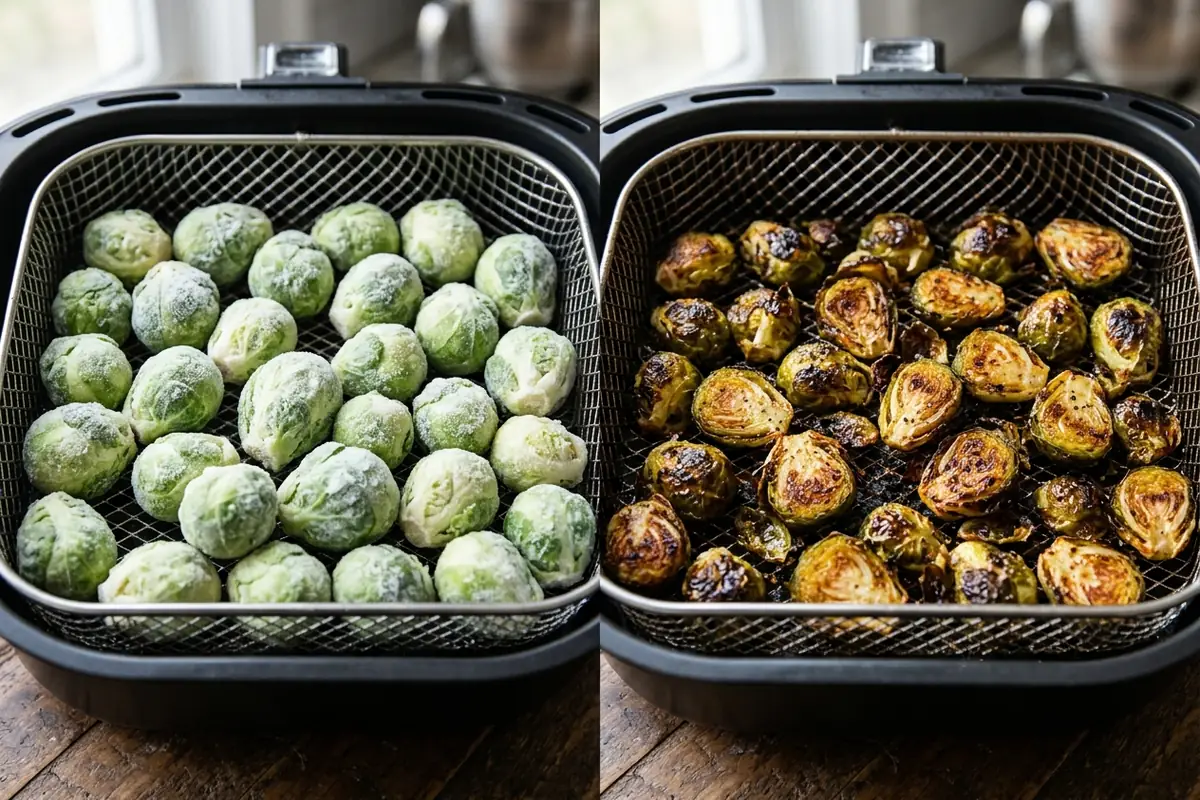
Here is the exact sequence I use for a standard 12 to 16 ounce bag of frozen Brussels sprouts. Stage one cooks off the surface ice and loosens the sprouts. Stage two crisps them with oil and seasoning. The whole thing runs about 16 to 18 minutes.
Pour the frozen sprouts straight from the bag into the basket. Do not add oil yet and do not season. Run the air fryer at 390 degrees F for 8 minutes. During this stage the surface ice cooks off and the sprouts soften enough to handle. When the timer goes off, pull the basket and dump the sprouts into a bowl. Now toss them with a tablespoon or two of oil, salt, pepper, and whatever else you like. If any sprouts are large, halve them now; the cut faces will caramelize beautifully in the next stage.
Return the oiled, seasoned sprouts to the basket in a single layer and run another 8 to 10 minutes at 390 degrees F, shaking the basket once at the halfway point so they brown evenly. They are done when the edges are deeply browned and blistered and a fork slides easily into the center. If you want them crispier, give them 2 more minutes and watch closely, because they go from caramelized to burnt quickly at the end.
Time and temperature by size and batch
Brussels sprouts vary a lot in size, from marble-small to golf-ball-large, and size drives how long they need. Big sprouts need more time and benefit from halving; small ones crisp fast. Here is my chart, all at 390 degrees F with the two-stage method and a shake at the halfway point of stage two.
| Sprout size and batch | Stage 1 (dry) | Stage 2 (oiled) | Total time |
|---|---|---|---|
| Small sprouts, single layer | 7 min | 7 to 8 min | 14 to 15 min |
| Standard sprouts, single layer | 8 min | 8 to 10 min | 16 to 18 min |
| Large sprouts, halved | 8 min | 10 to 12 min | 18 to 20 min |
| Double batch, crowded | 9 min | 12 to 14 min | 21 to 23 min |
Two things to note. First, a crowded basket cooks slower and crisps worse, because the sprouts shield each other from the air and trap moisture between them. If you are cooking a double batch, expect longer times and more frequent shaking, or better yet, run two single-layer batches for the crispest result. Second, every air fryer runs differently, so check at the early end of stage two the first time and learn your machine’s pace.
For comparison, fresh Brussels sprouts run faster because they have no ice to cook off, usually 12 to 15 minutes total at 375 degrees F in one stage. So if a recipe calls for fresh and you only have frozen, add roughly 4 to 6 minutes and use the two-stage dry-then-oiled approach instead of tossing everything in oil at the start.
The 375 vs 390 vs 400 question
Recipes for frozen Brussels sprouts call for anywhere from 375 to 400 degrees F, and the spread has a logic worth understanding. At 375 degrees F you get gentle, even cooking and the centers turn tender, but the edges may not blister as hard, so you trade some crispness for forgiveness. At 400 degrees F the edges char fast and deep, but a crowded or large sprout can burn on the outside before the center softens.
390 degrees F is the sweet spot for frozen sprouts because it is hot enough to caramelize and blister the edges, but not so hot that the outside scorches before the inside cooks through. It also pairs well with the two-stage method: stage one cooks off the ice at a temperature that will not burn the still-wet surface, and stage two crisps the now-oiled, drier sprout at the same heat. If your air fryer runs hot, treat 390 as 400 and check early; if it runs cool, you can push the final 2 minutes to 400 for extra char.
The number on the dial matters less than the doneness cues at the end. The cooking science writers at Serious Eats have long made the case that high, dry heat is what coaxes deep caramelization out of cruciferous vegetables, and the air fryer delivers exactly that kind of heat. You want two things: edges that are deeply browned and blistered, and centers that a fork pierces with no resistance. If the edges are browning before the centers soften, drop the temperature 10 degrees and add time. If the centers are soft but the edges are pale, push the heat up for a final crisping burst.
Seasoning and flavor combinations
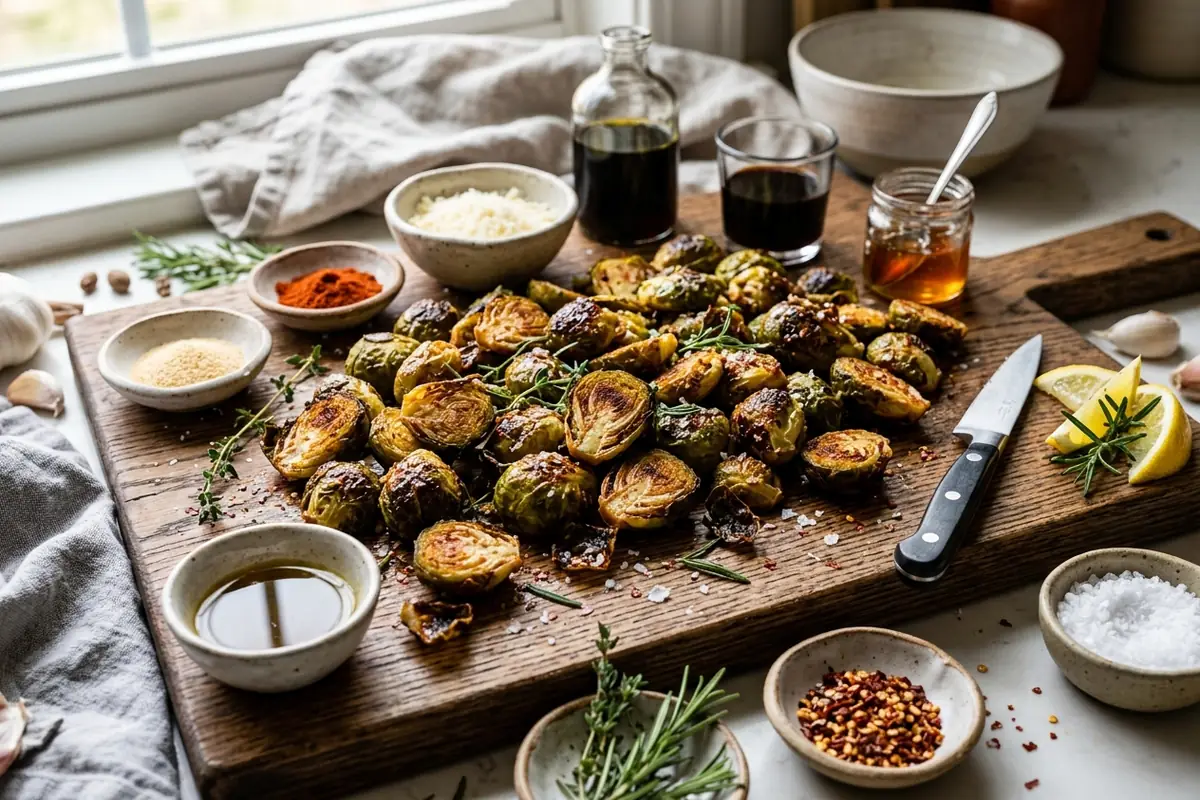
Because you season in stage two, after the sprouts have loosened and dried, the oil and spices actually cling to every surface instead of sliding off the ice. That clean, slightly dry surface takes flavor beautifully, which is why air fryer Brussels sprouts can be so much more interesting than steamed ones.
The simplest plan is olive oil, salt, and black pepper, and it is genuinely all you need. From there, a few combinations earn their keep. Balsamic vinegar tossed on in the last 2 minutes caramelizes into a sweet-tangy glaze. Grated Parmesan added at the very end melts and crisps into a savory crust. A drizzle of honey plus a pinch of red pepper flakes gives you a sweet-heat finish that disappears fast at the table. Garlic powder and smoked paprika build a smoky, savory bark without any fresh garlic burning.
Add anything sugary, like honey or balsamic, only in the final 2 minutes, because sugar burns in the air fryer’s high heat. Toss the sprouts in plain oil and salt for the main crisp, then add the sweet element at the end for a glaze rather than a scorch. Sturdy dry spices like paprika, garlic powder, and pepper can go on at the start of stage two and ride the whole way through.
What to serve them with and storing leftovers
Crispy frozen Brussels sprouts are a fast, hands-off side that pairs with almost any protein from the same machine. Run a protein first, hold it warm, then cook the sprouts, or stagger them so both finish together. They sit naturally next to other air fryer vegetables, and our method for crisping zucchini uses the same single-layer, shake-the-basket discipline if you want to build a two-vegetable plate. For a cozy full meal, a warm bowl from the soup network at Simmerstead rounds things out while the sprouts crisp.
Leftover cooked sprouts keep in an airtight container in the fridge for 3 to 4 days. They lose some crispness in storage, since the trapped steam softens them, but the air fryer revives them: 350 degrees F for 3 to 4 minutes re-crisps the edges without overcooking. Do not microwave leftover sprouts if you care about texture, because the microwave steams them right back to mush, undoing all the crisping work.
You can also meal-prep them, cooking a big batch and reheating portions through the week. Just slightly undercook the first round if you know you will reheat, since the reheat adds a few more minutes of browning. Cooked sprouts do not freeze well after air frying, so cook only what you will eat within a few days and pull fresh frozen sprouts from the bag for the next batch. Because the raw frozen sprouts keep for months in the freezer, you always have a fast, healthy side on hand, which is the real convenience here: no shopping, no chopping, and dinner-ready vegetables in under 20 minutes whenever you want them.
Troubleshooting and getting maximum char
If your sprouts keep coming out pale instead of caramelized, the usual culprit is a crowded basket. Caramelization needs each sprout to have direct contact with the moving air, and when they are piled two or three deep, the ones underneath just steam in the trapped moisture of the ones on top. Spread them to a single layer, even if it means a second batch, and you will see the difference immediately: blistered, browned edges instead of a uniform dull green. The shake at the halfway mark matters for the same reason, rotating which surfaces face the heat so the browning is even rather than one-sided.
If the edges char but the centers stay hard, your sprouts are likely on the large side and need either halving or a lower-and-longer approach: drop to 375 degrees F and add 3 to 4 minutes so the heat has time to reach the middle before the outside burns. If the opposite happens and the centers go soft while the edges stay pale, push the final 2 minutes up to 400 degrees F for a hot blistering finish. The goal is always the same two cues working together: deeply browned, almost-charred outer leaves and a center that a fork slides into without resistance. Once you can read those two signals, you can hit the result you want regardless of how your particular bag of sprouts is sized, and the whole thing becomes a reliable weeknight habit rather than a guess.
FAQ
Do I need to thaw frozen Brussels sprouts before air frying?
No, and you should not. Thawing releases water that turns to steam in the basket and makes the sprouts soggy. Cook them straight from frozen so the surface ice flashes off in the dry heat and the edges can caramelize and crisp while the centers steam tender.
What temperature and time for frozen Brussels sprouts in the air fryer?
390 degrees F for 16 to 18 minutes total is the sweet spot, using a two-stage method: about 8 minutes dry to cook off the ice, then 8 to 10 minutes after tossing in oil and seasoning, shaking once at the halfway mark.
Why are my air fryer Brussels sprouts soggy?
Sogginess usually comes from thawing them first, crowding the basket, or oiling them while still iced so they steam. Cook from frozen, keep them in a single layer, and add oil only after stage one when the surface has dried, then finish hot to crisp the edges.
Should I cut frozen Brussels sprouts in half?
Halve only the large ones, and do it after stage one when they have softened enough to cut safely. The cut faces caramelize beautifully and large sprouts crisp more evenly halved. Small and standard sprouts can stay whole.
When do I add oil and seasoning to frozen sprouts?
After the first dry stage, not before. Frozen sprouts have an ice glaze that oil and spices slide right off. Cook them dry for about 8 minutes first, then toss the loosened, drier sprouts in oil and seasoning so it actually clings, and finish cooking.
Can I cook a double batch of frozen sprouts at once?
You can, but a crowded basket cooks slower and crisps worse because the sprouts shield each other from the air. Expect 21 to 23 minutes and shake more often, or run two single-layer batches for the crispest result.
Bottom line
Frozen Brussels sprouts in the air fryer go from icy to caramelized in under 20 minutes when you follow two rules: never thaw them, and oil them only after the first dry stage. Run 390 degrees F in two stages, shake the basket, and finish until the edges blister and a fork slides into the center. Season after they loosen so the flavor clings, add anything sugary only at the end, and keep the basket to a single layer for the crispest result. Learn how your machine runs, and a plain bag of frozen sprouts becomes one of the easiest, most crowd-pleasing sides you can make.