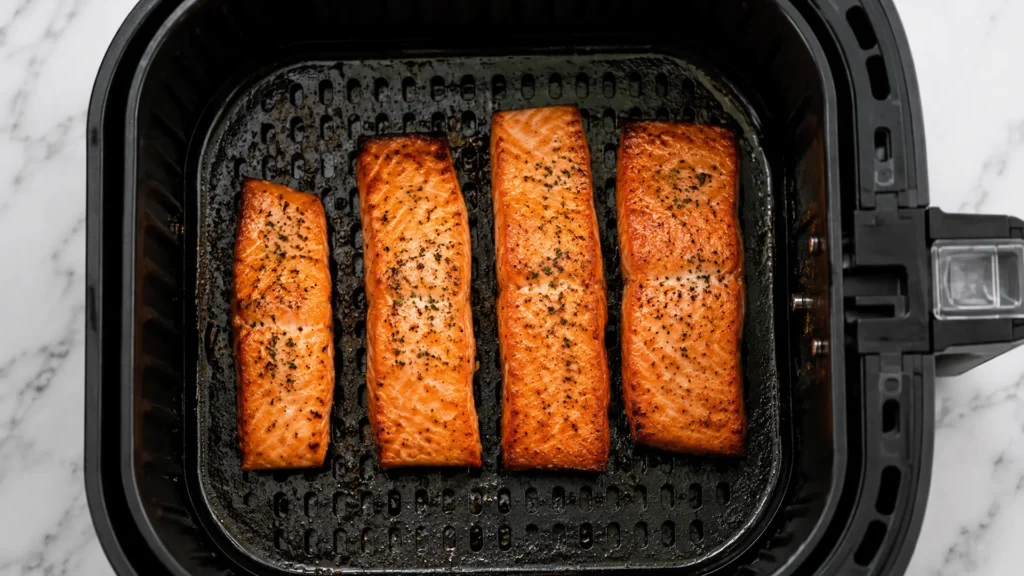
Can you cook salmon in an air fryer? Yes, and it is one of the best things the appliance does. A salmon fillet cooks in 7 to 9 minutes at 400 degrees Fahrenheit, coming out flaky and moist inside with lightly browned edges, and you can go straight from fresh or frozen with no skillet, no splatter, and no flipping. The circulating hot air cooks salmon evenly and fast, which is exactly what this delicate fish needs, because the number one thing that ruins salmon is overcooking it. The air fryer gets you in and out before that happens.
Below is the exact time and temperature for every thickness, the internal temperature to cook to, how to get crispy skin or skip the skin entirely, how to handle frozen fillets without thawing, and the fixes for dry or undercooked fish. Salmon is one of the few proteins that turns out better in the air fryer than on the stove for most home cooks, because the gentle even heat is far more forgiving than a screaming-hot pan.
The Exact Time and Temperature for Salmon
Cook salmon at 400 degrees Fahrenheit for 7 to 9 minutes for a standard 1-inch-thick fillet. Thinner tail pieces need less, thick center-cut fillets need a touch more, and frozen fillets need several extra minutes. The single most reliable way to nail it is to cook to internal temperature rather than the clock, since fillet thickness varies so much.
| Salmon type | Temperature | Time |
|---|---|---|
| Thin fillet (under 1 inch) | 400 F | 6-7 min |
| Standard fillet (1 inch) | 400 F | 7-9 min |
| Thick center cut (1.5 inch) | 400 F | 9-11 min |
| Frozen fillet | 390 F | 12-15 min |
| Salmon for well-done | 400 F | 10-12 min |
The rule of thumb that never fails: pull the salmon at an internal temperature of 125 to 130 degrees for a moist, just-cooked center, or 145 degrees if you want it fully firm, which is the USDA safe-for-everyone number. Salmon keeps cooking after you pull it, so removing it a few degrees early and letting it rest 3 minutes lets carryover heat finish the job without drying it out.
Why the Air Fryer Works So Well for Salmon
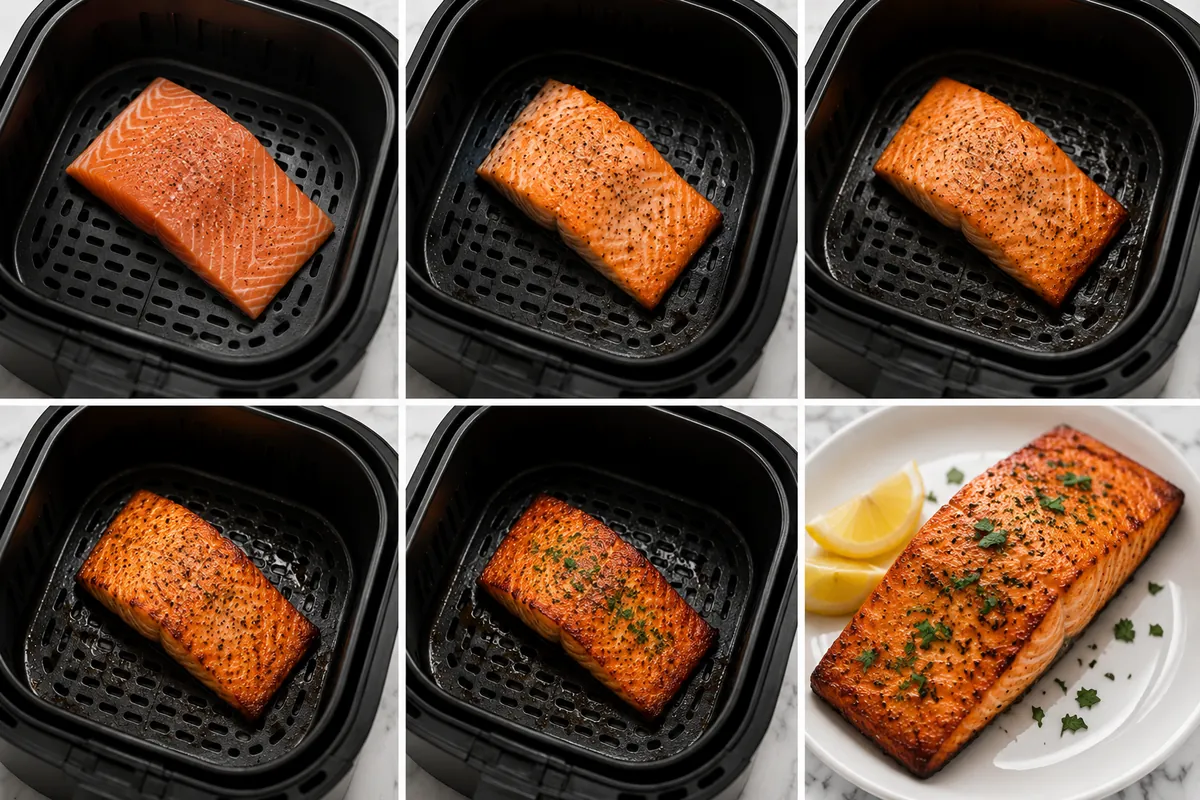
Salmon is delicate and has a narrow window between underdone and dried out, which is what makes it intimidating on the stove. A pan gives you blasting heat on one face and forces you to flip a fragile fillet that wants to break apart. The air fryer surrounds the fish with even, moving heat at a moderate temperature, so it cooks through gently from all sides at once and you never have to flip it. That even, hands-off heat is the entire reason air fryer salmon comes out reliably moist where pan salmon so often turns out dry on the outside and raw in the middle.
The speed helps too. Because the fillet is done in under 10 minutes, the proteins do not have time to seize up and squeeze out moisture the way they do during a long bake. If you are still getting comfortable with your machine and how its heat behaves with proteins, our guide to how to use an air fryer covers preheating, basket spacing, and temperature behavior, all of which apply directly to cooking fish.
Step by Step
- Pat the salmon completely dry with paper towels. A dry surface browns and, if you keep the skin, crisps; a wet surface steams. This step matters more than any other.
- Rub each fillet with a thin coat of olive or avocado oil and season with salt, pepper, garlic powder, and paprika, or whatever blend you like.
- Preheat the air fryer to 400 degrees for 3 minutes. A hot start sears the surface and keeps the inside juicy.
- Place the fillets in the basket in a single layer, not touching, skin-side down for moist flesh and easy serving. Do not flip during cooking.
- Cook 7 to 9 minutes for a 1-inch fillet. Start checking at 6 minutes with an instant-read thermometer in the thickest part. Pull at 125 to 130 degrees for moist, or 145 for fully firm.
- Let it rest 3 minutes off the heat. Carryover cooking finishes it gently and the rest keeps the juices in. Then serve.
No liner is required, and going liner-free gives the best browning, but a small piece of parchment makes cleanup easier and keeps skinless fillets from sticking. If you use parchment, weigh it down with the fish so the fan cannot blow it into the heating element.
Skin On or Skin Off, and Which Way Up
You can cook salmon either way, and the choice changes how you place it. If you want to eat the skin and have it turn crisp, cook the fillet skin-side up so the moving air hits the skin directly and crisps it. If you do not care about the skin and want the moistest, most evenly cooked flesh, cook skin-side down, which protects the bottom of the fillet from the basket and makes the cooked fish easy to lift off the skin with a spatula. Both are valid; the trade-off is crispy skin versus the most tender flesh.
If you bought skinless fillets, place them on a light coat of oil or a piece of parchment so they do not stick, and treat them exactly like skin-down fillets. Skin, when you keep it, also acts as insulation that helps prevent the bottom from overcooking, which is a quiet bonus even if you plan to peel it off and not eat it. Leave the skin on during cooking for that protection, then remove it after if you prefer.
Cooking Salmon From Frozen
One of the best features of the air fryer is that you can cook salmon straight from frozen without thawing, which is a lifesaver on a night you forgot to defrost. Frozen fillets need a two-stage approach: cook at 390 degrees for about 5 minutes first to thaw the surface, then pull it out, pat off any released moisture, brush with oil and season (seasoning will not stick to a frozen fillet), and return it for another 7 to 10 minutes until it hits temperature. Total time runs 12 to 15 minutes depending on thickness.
The slightly lower temperature of 390 degrees keeps the outside from overcooking while the center catches up from frozen. Always finish to internal temperature rather than the clock here, because a frozen fillet’s thickness and how solidly frozen it is both affect timing. Frozen salmon cooked this way comes out nearly as good as fresh, and it makes salmon a genuine weeknight option even when you did not plan ahead.
Glazes, Marinades, and Seasoning
Salmon takes flavor beautifully, and the air fryer’s dry heat caramelizes sweet glazes into a sticky finish. The catch with sugary glazes is that they can burn before the fish is done, so brush them on partway through rather than at the start. Apply the glaze in the last 3 to 4 minutes of cooking and watch the edges.
A few reliable directions: a honey-garlic glaze of honey, minced garlic, soy sauce, and a splash of lemon; a teriyaki or brown-sugar-and-Dijon glaze for a sweet-savory crust; or a simple Cajun or lemon-pepper dry rub if you want crispness over stickiness. For dry rubs, season before cooking since they will not burn. For wet marinades, do not marinate longer than 30 minutes, because the acid in citrus or vinegar starts to break down the fish and turn the surface mushy. A pat-dry after marinating helps the fillet brown instead of steam.
One more glaze tip worth knowing: a thin layer browns and caramelizes, a thick layer just slides off and pools in the basket where it burns and smokes. Brush a light coat, let it set for a minute under the heat, then add a second light coat if you want a heavier finish. A maple-soy or miso-honey glaze applied this way builds a lacquered, restaurant-style crust that you cannot get from dumping sauce on at the start. If smoke is a concern with sugary glazes, slide a small piece of foil or parchment under the fillet to catch the drips, and the air fryer stays clean.
Troubleshooting Dry or Undercooked Salmon
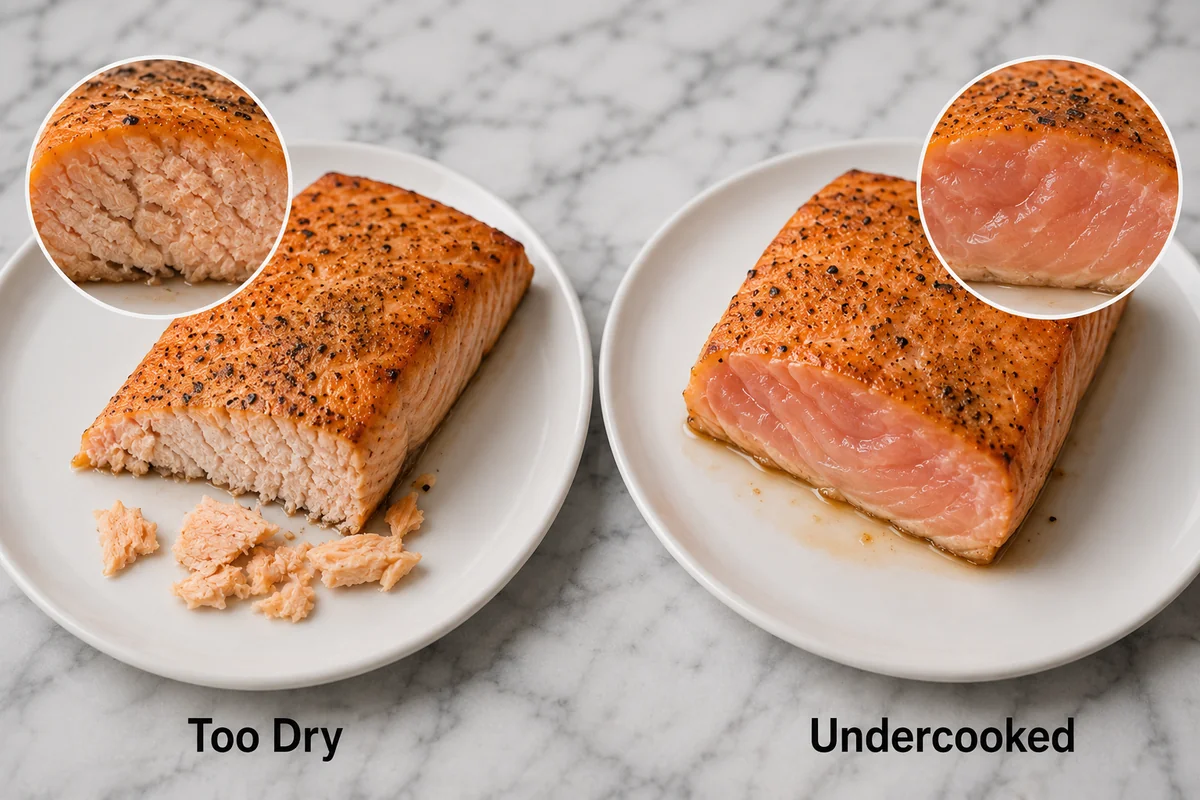
Salmon problems are almost always a timing or temperature issue, and they are easy to fix once you know the cause. This is the part most recipes leave out, and it is what separates good salmon from great.
| Problem | Cause | Fix |
|---|---|---|
| Dry, chalky flesh | Overcooked past 145 F | Pull at 125-130 F, rest 3 min |
| Raw, cold center | Thick fillet, too little time | Add 2-3 min, check temp |
| Skin soggy, not crisp | Skin down or fillet wet | Skin up, pat fully dry first |
| White stuff oozing out | Cooked too hot, too fast | Normal but reduce heat slightly |
| Stuck to basket | No oil or liner on skinless | Oil the basket or use parchment |
That white substance that sometimes seeps out is albumin, a harmless protein that the fish pushes out when cooked too quickly or too hot. It is safe to eat but a sign you can dial the heat back a little. The biggest fix on this list is simply buying a cheap instant-read thermometer; the difference between perfect salmon and dry salmon is often 15 seconds, and a thermometer takes all the guesswork out.
Cuts and Portions: Fillets, Steaks, and Whole Sides
The cut you buy changes the cooking slightly. Individual fillets are the easiest and what these times are built around, cooking evenly because they are a consistent thickness. Salmon steaks, which are cross-sections cut through the bone, are thicker and rounder, so add a minute or two and check the temperature near the bone, where heat reaches last. A whole side of salmon is too long for most baskets and cooks unevenly because the thin tail finishes long before the thick shoulder, so cut a side into similar-sized portions before cooking rather than fighting one big piece.
Portion size matters for spacing, too. The fillets should sit in a single layer with air space between them; crammed together, they steam each other and the edges that touch never brown. If you are cooking for a family, work in batches and hold the first batch warm in a low oven, or step up to a larger basket. Two to three fillets is the comfortable maximum for most standard baskets, and crowding past that costs you the even browning that makes air fryer salmon worth doing in the first place. A quick note on portion thickness: if your fillets vary a lot, arrange the thickest pieces toward the center of the basket where airflow is strongest, and the thinner tail pieces toward the edges, so everything finishes closer to the same time.
What to Serve With Air Fryer Salmon
Salmon cooks so fast that the smart move is to use the air fryer for a side too, or to lean on quick stovetop accompaniments. Roasted asparagus, broccoli, or green beans can go in the basket for a few minutes after the salmon rests, and a batch of air fryer hard boiled eggs made earlier in the day rounds out a salmon-and-grain bowl with extra protein. Rice, quinoa, or a simple salad finish the plate without much effort.
If you are deciding whether your countertop convection oven could handle salmon as well as a basket air fryer, the airflow design changes how evenly fish cooks, and we lay out the differences in our comparison of the convection oven versus air fryer. For a single fillet or two, the concentrated heat of a basket model usually cooks salmon faster and more evenly than a large convection cavity.
Buying and Storing Salmon for the Air Fryer
The quality of the fillet matters as much as the cooking. Look for fillets that are uniform in thickness so they cook evenly; if you buy a long side of salmon, cut it into pieces of similar thickness rather than cooking thin tail and thick center together. Both wild and farmed salmon air fry well, though farmed tends to be fattier and more forgiving of slight overcooking, while leaner wild salmon needs to be watched a little more closely.
Store fresh salmon in the coldest part of the fridge and cook it within two days, or freeze it for up to three months. Cooked salmon keeps in an airtight container for three to four days and reheats gently at 350 degrees for 3 to 4 minutes, though it is best to slightly undercook salmon you plan to reheat so it does not dry out the second time. For testing-backed technique on cooking fish, America’s Test Kitchen is a reliable reference, and the FDA publishes the safe internal temperature guidance for seafood.
Frequently Asked Questions
How long does salmon take in an air fryer?
A standard 1-inch fillet takes 7 to 9 minutes at 400 degrees Fahrenheit. Thin tail pieces need 6 to 7 minutes, thick center cuts need 9 to 11, and frozen fillets need 12 to 15 minutes at 390 degrees. Cook to an internal temperature of 125 to 130 degrees for moist or 145 for fully firm.
What temperature do you cook salmon in an air fryer?
Use 400 degrees Fahrenheit for fresh fillets and 390 degrees for frozen, which keeps the outside from overcooking while the center catches up. The temperature stays the same across thicknesses; you adjust the time, not the heat, and finish to internal temperature for the most reliable result.
Do you cook salmon skin up or down in the air fryer?
Cook it skin-side up if you want crispy skin, since the moving air crisps the skin directly. Cook it skin-side down for the moistest, most evenly cooked flesh and easy lifting off the skin after. Either way works; the choice is crispy skin versus the most tender fish.
Can you cook frozen salmon in an air fryer?
Yes, with no thawing. Cook at 390 degrees for about 5 minutes to thaw the surface, then pat it dry, brush with oil, season, and cook another 7 to 10 minutes until it reaches temperature. Total time runs 12 to 15 minutes depending on thickness. Always finish to internal temperature.
How do you know when air fryer salmon is done?
The most reliable test is an instant-read thermometer reading 125 to 130 degrees for a moist center or 145 degrees for fully firm. Visually, cooked salmon turns opaque and flakes easily with a fork. Because salmon carries over after cooking, pull it a few degrees early and let it rest 3 minutes.
Why is my air fryer salmon dry?
Dry salmon is overcooked salmon, full stop. The fish goes from moist to chalky in under a minute, so the fix is to pull it at 125 to 130 degrees internal and let carryover heat finish it during a 3-minute rest. A cheap instant-read thermometer is the single best tool for never overcooking salmon again.
Bottom Line
Salmon in the air fryer is fast, forgiving, and consistently better than what most home cooks get from a pan. Set it to 400 degrees, give a 1-inch fillet 7 to 9 minutes, and cook to an internal temperature of 125 to 130 for moist or 145 for firm, resting it 3 minutes before serving. Pat it dry for browning, choose skin-up for crisp skin or skin-down for tender flesh, and go straight from frozen at 390 when you forget to thaw. Once you cook salmon this way, the splattering stovetop version stops being worth the cleanup.