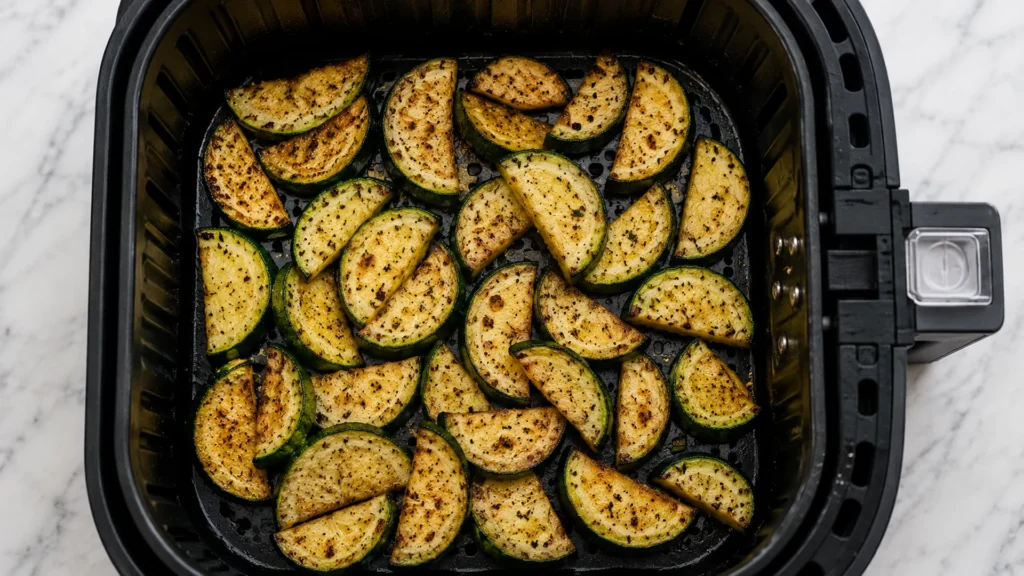
How to cook zucchini in air fryer comes down to two things most people get wrong: cutting it the right size and giving it room to breathe. Cook zucchini at 400 degrees Fahrenheit for 8 to 12 minutes depending on how you cut it, in a single layer with space between the pieces, and it comes out browned at the edges and tender inside instead of the gray, watery mush that turns people off this vegetable. Zucchini is about 95 percent water, so the whole game is driving that moisture off fast with hot circulating air before the pieces collapse. The air fryer does that better than any oven.
Below you will find the exact time and temperature for every cut, from quick rounds to breaded fries to zucchini chips, the trick to keeping it from going soggy, the seasoning that actually sticks, and the fixes for the two problems everyone hits. Done right, air fryer zucchini is fast enough for a weeknight side and good enough that people who say they hate zucchini go back for seconds.
The Exact Time and Temperature for Zucchini
Set the air fryer to 400 degrees Fahrenheit. Cook time depends entirely on the cut: small bite-sized pieces finish fastest, spears take a bit longer, and breaded fries need a little more. Shake or flip at the halfway point so every side browns. These are the numbers to work from.
| Cut | Temperature | Time |
|---|---|---|
| Half-moons or rounds (3/4 inch) | 400 F | 8-10 min |
| Bite-sized chunks | 400 F | 7-9 min |
| Spears | 400 F | 10-12 min |
| Breaded zucchini fries | 400 F | 10-13 min |
| Thin chips (1/4 inch) | 375 F | 12-15 min |
Pull zucchini when it is browned at the edges and tender but still has a little structure. The trap people fall into is cooking it until it is completely soft, which is exactly when it turns soggy, because the cell walls break down and release all that stored water. Al dente with browned edges is the target, not mush.
Why Zucchini Goes Soggy, and How the Air Fryer Fixes It
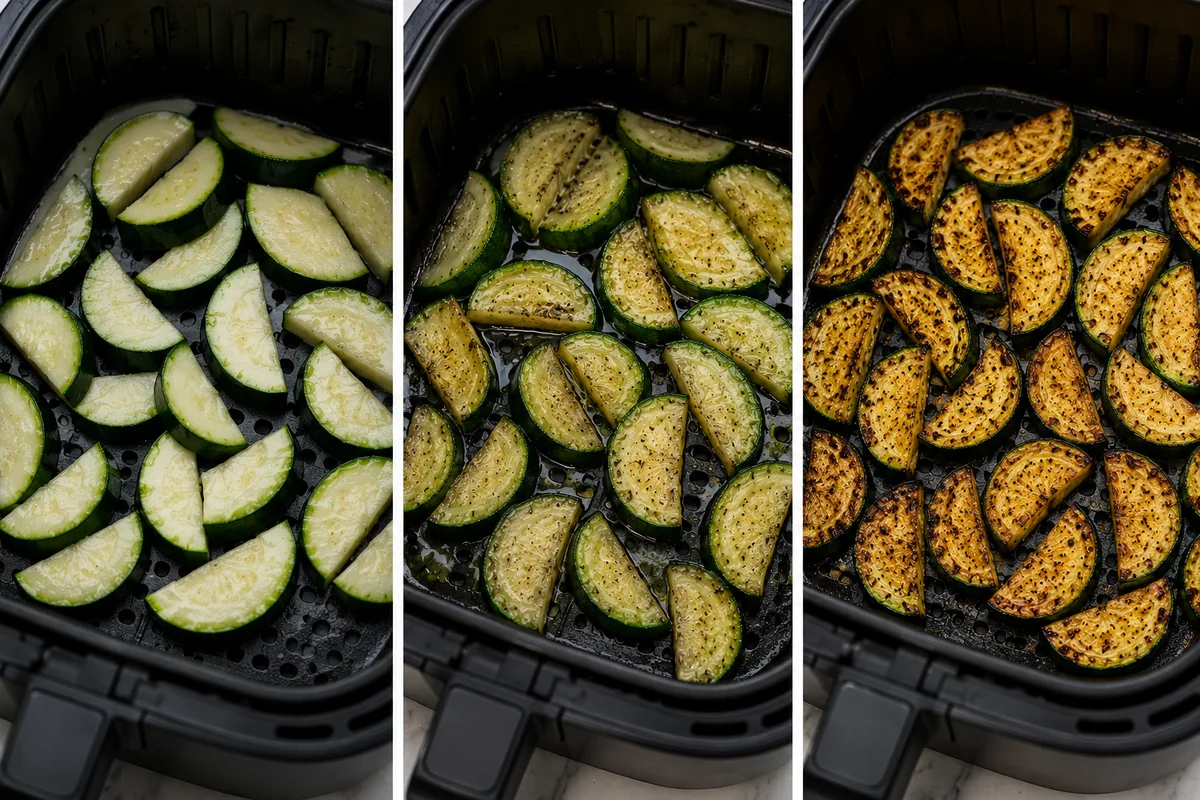
Zucchini is mostly water, and water is the enemy of browning. When you cook it slowly or crowd it, the moisture it releases turns to steam that has nowhere to go, so the pieces simmer in their own liquid and come out limp and gray. The air fryer beats this by surrounding the zucchini with fast-moving 400-degree air that evaporates surface moisture as quickly as it appears, so the pieces brown instead of steam. The faster the water leaves, the crisper the result.
That is why the two non-negotiable rules are a single layer and patting the zucchini dry before cooking. If the pieces overlap, the ones underneath steam; if the surface is wet going in, the first few minutes are wasted boiling off that water instead of browning. Get both right and the air fryer does the rest. If you are still learning how your machine moves air and holds temperature, our guide to how to use an air fryer covers the basket-spacing and preheat habits that make every vegetable come out better.
Step by Step
- Wash and trim the zucchini, then cut it to your chosen shape. For an everyday side, quarter it lengthwise and cut crosswise into 3/4-inch half-moons so the pieces are uniform.
- Pat the cut zucchini dry with paper towels. This is the most skipped and most important step. Dry zucchini browns; wet zucchini steams.
- Toss with a thin coat of olive oil and your seasoning. Use just enough oil to make the spices stick, about a teaspoon per medium zucchini. Too much oil makes it greasy and soggy.
- Preheat the air fryer to 400 degrees for 3 minutes, then spread the zucchini in a single layer with space between pieces. Work in batches if it does not fit.
- Cook 8 to 10 minutes for half-moons, shaking the basket at the 5-minute mark. The pieces should be browned at the edges and fork-tender.
- Tip them onto a plate and finish with grated parmesan, a squeeze of lemon, or fresh herbs while they are hot. Serve right away, since zucchini softens as it sits.
Do not salt the zucchini long before cooking. Salt pulls water out, and if you salt it 20 minutes ahead it sits in a puddle and steams. Salt it as you toss it with oil right before it goes in, or season after cooking.
Cutting Zucchini: Rounds, Spears, Fries, and Chips
Half-moons and rounds
The everyday cut. Quarter the zucchini lengthwise then slice into 3/4-inch half-moons, or slice a whole zucchini into thick rounds. Uniform thickness is what matters so everything cooks at the same rate. These are the most forgiving cut and the best place to start.
Spears
Cut the zucchini into eighths lengthwise to make long spears, good for dipping and for serving alongside a protein. Spears hold their shape well and look tidy on a plate, but they cook a little longer because they are thicker, so give them 10 to 12 minutes and flip once.
Breaded zucchini fries
For crispy fries, cut into spears or sticks, dredge in flour, dip in beaten egg, then coat in a mix of panko, parmesan, and seasoning. The breading is what crisps, so press it on well. A light spray of oil over the coated fries helps them turn golden. Cook at 400 for 10 to 13 minutes, flipping halfway, until the crust is deep golden and crunchy.
Thin chips
For zucchini chips, slice into thin 1/4-inch rounds, pat very dry, and cook at a lower 375 degrees for 12 to 15 minutes so they dry out and crisp without burning. Watch them closely toward the end, since thin chips go from crisp to scorched fast. They will not be potato-chip crunchy unless dehydrated longer, but they make a great low-carb snack.
Seasoning That Actually Sticks
The secret to seasoning sticking to zucchini is a thin coat of oil that the spices cling to, applied before cooking. Toss the pieces in a bowl with oil first, then add the dry seasoning and toss again so it coats evenly rather than clumping. A few reliable blends: Italian seasoning, garlic powder, salt, and pepper for a classic roasted side; chili powder and cumin for a Tex-Mex slant; or smoked paprika and onion powder for depth.
Parmesan is the standout finisher. Grated parmesan added in the last 2 minutes of cooking melts into a savory crust, or tossed on the moment the zucchini comes out it clings to the hot surface. For breaded versions, mixing parmesan into the panko gives both crunch and flavor. A squeeze of fresh lemon at the end brightens everything and cuts the richness, and fresh herbs like basil or dill add a garden note that pairs naturally with summer zucchini.
Troubleshooting: Soggy, Burnt, or Bland Zucchini
Nearly every zucchini problem traces to moisture, crowding, or timing. Here are the fixes for the issues people actually hit, which is the part most recipes skip entirely.
| Problem | Cause | Fix |
|---|---|---|
| Soggy, watery zucchini | Crowded or not dried | Single layer, pat dry first |
| Mushy, no structure | Overcooked past tender | Pull at al dente, check early |
| Greasy | Too much oil | Use about 1 tsp per zucchini |
| Breading falls off | Skipped flour or egg step | Flour, egg, then panko in order |
| Bland | Seasoned too little or too late | Salt with oil, finish with lemon |
Soggy is the headline complaint, and it is always one of two things: the basket was crowded so the zucchini steamed, or the pieces were not dried before cooking. Fix both and the problem disappears. The second most common issue is mushy zucchini, which means it cooked too long; zucchini softens fast at the end, so check it a minute or two before you think it is done and pull it while it still has a bite.
Cooking Zucchini and Yellow Squash Together
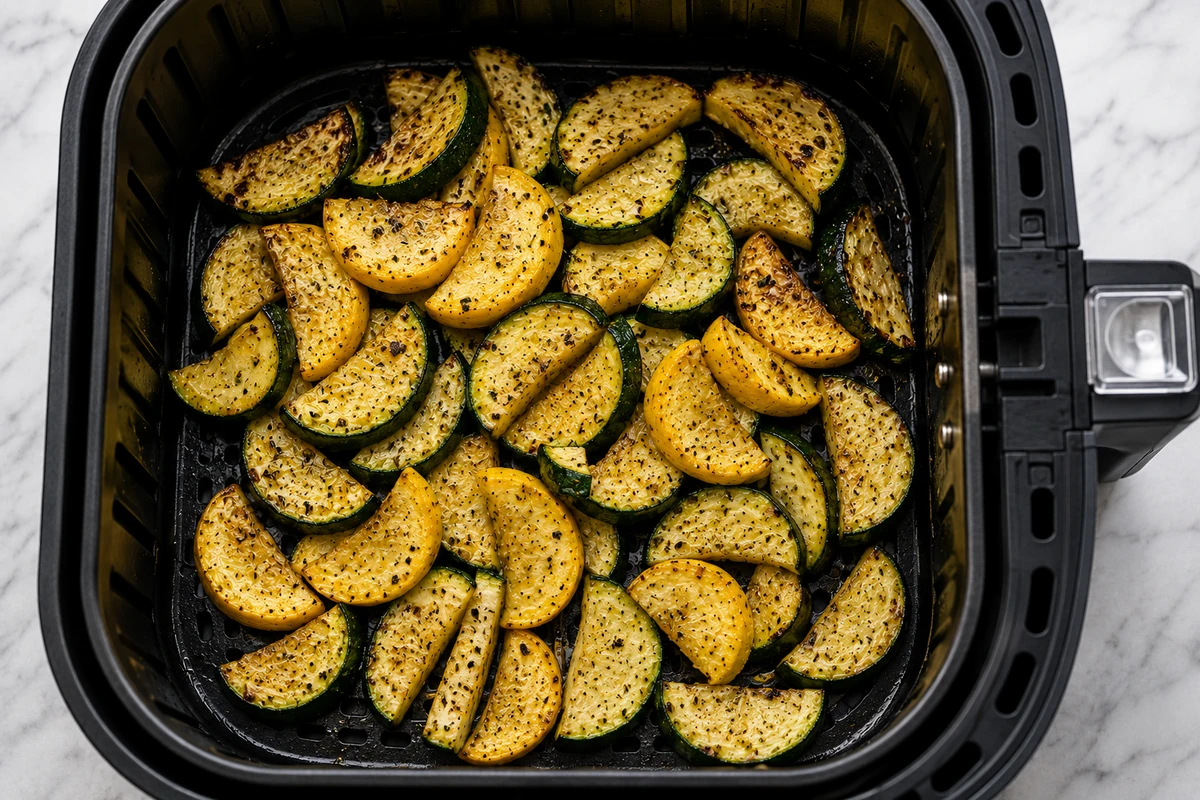
Zucchini and yellow summer squash are nearly identical in texture and water content, so they cook together perfectly and make a colorful side. Cut both into matching 3/4-inch half-moons so they finish at the same time, toss them with the same oil and seasoning, and cook at 400 degrees for 8 to 10 minutes with a shake at the halfway point. The yellow squash browns a shade faster because it tends to be slightly softer, so if anything pull the squash a minute before the zucchini if you are being precise, though in practice cooking them together works fine.
The same single-layer and pat-dry rules apply, only more so, because you now have twice the vegetable releasing twice the moisture. If a single layer of both will not fit, cook in two batches rather than crowding, since a crowded basket of squash steams into mush even faster than zucchini alone. A mix of the two with a finish of parmesan and fresh herbs is one of the best fast vegetable sides the air fryer makes, and it uses up the summer glut when both are in season at once.
Making Crispy Zucchini Fries Worth the Effort
Breaded zucchini fries are the dish that converts zucchini skeptics, and the air fryer makes them without the deep-fry mess. The key is a proper three-step breading: flour first so the egg has something to grip, beaten egg second to glue the coating, and a panko-parmesan mix last for crunch. Skip any step and the breading slides off in the basket. Press the panko on firmly, then let the breaded fries sit for 5 minutes before cooking so the coating sets, which helps it stay put.
A light, even spray of oil over the breaded fries is what turns the panko from pale and dusty to deep golden and crunchy, so do not skip it, but keep it light. Cook at 400 degrees for 10 to 13 minutes, flipping halfway, and resist crowding even more than usual, because fries that touch trade crunch for sog where they meet. Serve them right away with marinara or ranch for dipping. These hold up far better than oven zucchini fries and rival the deep-fried version with a fraction of the oil, which is the whole appeal of doing them in the air fryer.
Air Fryer Settings and Model Differences
Air fryers vary in power, and zucchini is sensitive to it because of its high water content. A high-wattage basket evaporates surface moisture quickly and browns zucchini in the times above; a lower-wattage budget unit moves air more gently, so the zucchini may need a couple of extra minutes and benefits even more from being dried thoroughly and spread out. If your machine runs hot, start checking at the early end of each time range.
Larger oven-style air fryers with racks cook zucchini well but heat less evenly than a small basket, so rotate the tray at the halfway mark. The shake step is more important on lower-power machines, where the pieces need help moving around to brown on all sides. The first time you make zucchini, note when it hits your ideal texture, and after one batch you will know your machine’s number. For a side that browns like this, a concentrated basket airflow tends to beat a big convection cavity, and we lay out the difference in our comparison of the convection oven versus air fryer.
Serving, Storing, and Reheating
Air fryer zucchini works as a side for almost anything: grilled chicken, fish, steak, or a grain bowl. It folds into frittatas and quiches, tops a flatbread, or rounds out a vegetable plate. Because it shares the basket so easily, you can cook it alongside other quick air fryer foods, and it pairs well on a brunch plate with air fryer hard boiled eggs for a fast, light meal.
Zucchini is best fresh, since it softens as it cools, but leftovers keep in an airtight container in the fridge for three days. Reheat in the air fryer at 375 degrees for 3 to 4 minutes rather than the microwave, which turns it limp. It will not be quite as crisp as fresh, but the air fryer revives it far better than any other method. For testing-backed technique on roasting vegetables, America’s Test Kitchen is a reliable reference, and the Healthline nutrition database has details if you are tracking the calories and nutrients in zucchini.
One thing not to do is freeze cooked air fryer zucchini. Because it is mostly water, freezing forms ice crystals that rupture the cell walls, and what thaws out is watery and limp with none of the texture you worked to build. If you want to preserve a summer glut, freeze raw shredded zucchini for baking instead, or slice and freeze it for soups and stews where texture does not matter. For the crisp-edged air fryer version, cook it fresh in small batches as you need it, which only takes about ten minutes anyway. That speed is the real argument for the air fryer over the oven for this vegetable: a single tray of zucchini that would tie up the oven for half an hour is done in a third of the time, with better browning and no preheating a large cavity for one side dish.
Frequently Asked Questions
How long do you cook zucchini in an air fryer?
Cook zucchini half-moons at 400 degrees Fahrenheit for 8 to 10 minutes, shaking once at the halfway mark. Bite-sized chunks take 7 to 9 minutes, spears 10 to 12, breaded fries 10 to 13, and thin chips 12 to 15 minutes at 375 degrees. Pull it when it is browned at the edges and tender but not mushy.
What temperature should you cook zucchini in an air fryer?
Use 400 degrees Fahrenheit for most cuts, which evaporates the zucchini’s moisture fast enough to brown rather than steam. Drop to 375 degrees only for thin chips, which need a lower temperature to dry out and crisp without scorching before they cook through.
How do you keep air fryer zucchini from getting soggy?
Pat the cut zucchini completely dry before cooking, use only a thin coat of oil, and spread the pieces in a single layer with space between them. Crowding and wet surfaces are the two causes of soggy zucchini, since both trap the steam the vegetable releases. Also pull it at al dente, not fully soft.
Do you need to peel zucchini before air frying?
No. The skin is thin, tender, and full of nutrients, and it helps the pieces hold their shape during cooking. Just wash the zucchini, trim the ends, and cut it. Peeling removes structure and makes the pieces more likely to go mushy.
Should you salt zucchini before air frying?
Salt it as you toss it with oil right before cooking, not 20 minutes ahead. Salting early pulls water out of the zucchini, leaving it sitting in a puddle that steams rather than browns. A light salt with the oil, or seasoning after cooking, gives flavor without the moisture problem.
Can you put breaded zucchini in an air fryer?
Yes, and it makes excellent fries. Dredge zucchini sticks in flour, dip in beaten egg, then coat in panko mixed with parmesan, pressing the breading on well. A light oil spray helps it brown. Cook at 400 degrees for 10 to 13 minutes, flipping once, until the crust is deep golden and crunchy.
Bottom Line
Air fryer zucchini is quick, healthy, and far better than its soggy reputation once you follow the two rules: dry the pieces before cooking and give them a single layer with room to breathe. Set it to 400 degrees, give half-moons 8 to 10 minutes with a shake at the halfway point, and pull it while it still has a bite. Season with oil so the spices stick, finish with parmesan or lemon, and reheat leftovers in the air fryer to bring back the crisp. Cut it right and give it space, and even the zucchini skeptics at your table will come around.